
Technology
Niall O’Connor Cohere Health Bio: From Precision Oncology to Healthcare AI and Predictive Biology

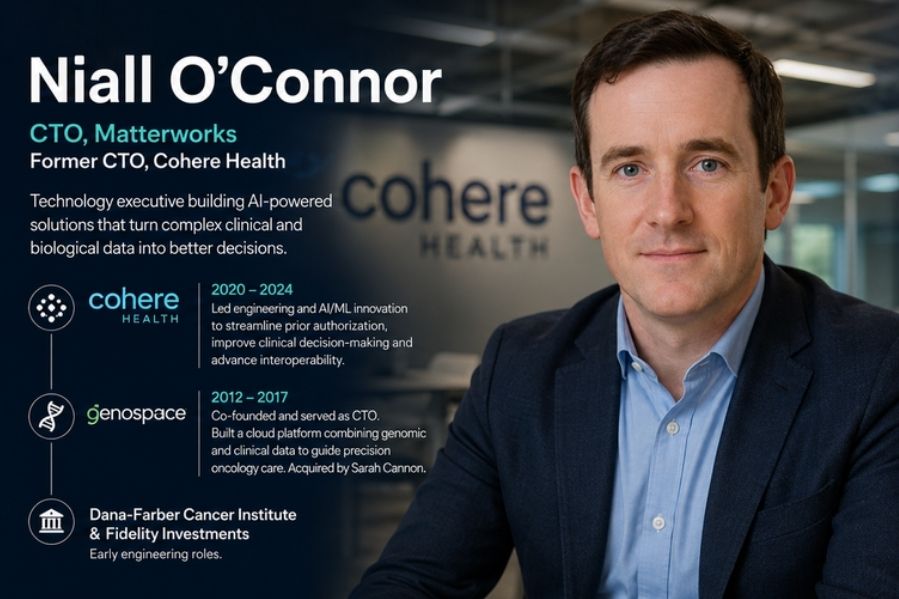
Niall O’Connor is a healthcare and life-sciences technology executive best known for his tenure as Chief Technology Officer at Cohere Health, where he helped build AI and machine-learning systems to make clinical decision-making and prior authorization less burdensome. His career, however, began well before Cohere: he co-founded precision-medicine software company Genospace and worked in engineering at Dana-Farber Cancer Institute and Fidelity Investments. In May 2024, Matterworks appointed him CTO, refocusing him more directly on biological data and life-sciences discovery. Unlike a conventional public personality, O’Connor maintains a predominantly professional profile; reliable information about his age, family, wealth, and private life is limited.
What makes O’Connor’s career significant is the continuity between apparently different problems. At Genospace, the challenge was extracting useful clinical meaning from genomic data. At Cohere Health, the work focused on extracting useful signals from fragmented healthcare records and administrative processes. At Matterworks, the problem has shifted toward interpreting complex molecular measurements with artificial intelligence.
The underlying theme has barely changed: turning difficult biological or clinical data into information that supports decision-making.
The Cohere Health Years
O’Connor became one of the senior technical figures associated with Cohere Health during the company’s early growth.
Contemporary records already identified him as Cohere’s CTO in 2020, while Cohere’s own publications consistently described him in that role from at least 2021 onward. Matterworks subsequently identified Cohere Health as his previous company when announcing his appointment in May 2024. The exact beginning and end months of his Cohere tenure are less well documented in the primary sources reviewed, so claims that give an exact March 2020-to-early-2024 employment period should be treated with caution rather than repeated as settled fact.
His technical mandate was substantial. Matterworks described O’Connor as having led the development of Cohere’s AI and machine-learning products for automating high-quality clinical decision-making.
That description matters because Cohere was tackling one of American healthcare’s most stubborn administrative problems: utilization management and prior authorization.
Prior authorization traditionally requires providers to demonstrate to an insurer that the proposed care meets coverage and medical-necessity criteria. The process can involve clinical documentation, manual reviews, multiple software systems and, notoriously, faxed records.
O’Connor’s work sat at the intersection of those processes and machine intelligence.
His View of Healthcare AI Was More Practical Than Promotional
One of the clearest explanations of O’Connor’s technical philosophy came in a 2021 interview with Healthcare IT News.
He argued that established clinical guidelines should remain the foundation of decision-support models rather than being discarded for algorithms. In his description, machine learning is especially useful when real patients do not fit neatly into generalized guidelines—for example, when multiple comorbidities complicate a case.
His description of the fundamental problem was concise:
“Clinical data analysis isn’t a big data problem; it’s a messy data problem.”
That distinction helps explain much of his work at Cohere.
Healthcare systems already possess enormous quantities of information. The difficulty is that clinically relevant facts may be distributed across structured fields, physician notes, claims, scanned records, and other formats. O’Connor discussed using natural language processing to identify information hidden within narrative clinical notes, including references to lifestyle effects or to a patient’s ability to return to work after surgery. He also discussed supplementing models with information on social determinants of health.
This was not AI being positioned as a substitute for medicine. It was AI being used as an interpretation and workflow layer around information that healthcare organizations already generate.
Prior Authorization and the Goal of Automation
By 2023, O’Connor was speaking publicly about using machine learning to accelerate prior-authorization decisions.
In a HIMSS TV interview, he discussed automation strategies to prevent administrative processes from overwhelming payers and providers. Independent coverage from Healthcare IT News similarly reported Cohere’s use of machine learning to evaluate patient and provider information beyond an isolated authorization transaction.
Cohere also framed interoperability as essential to a future in which appropriate authorizations could become effectively “touchless”—meaning less manual intervention for both providers and health plans. Its December 2023 interoperability guide featured O’Connor alongside engineering operations manager Jason Amaral and emphasized that merely creating technical connections between organizations was insufficient; the systems also needed usable clinical information to support decision-making.
That position reveals an important aspect of O’Connor’s work: automation depends on infrastructure.
An algorithm cannot meaningfully accelerate clinical administration if the underlying information remains trapped in incompatible systems or arrives as documents that software cannot reliably interpret.
Security Was Part of the Engineering Problem
Healthcare AI also requires something less glamorous than sophisticated models: rigorous information security.
In August 2022, Cohere announced that its utilization-management platform had achieved HITRUST r2 certification. O’Connor said the company had built its technology stack around stringent security and privacy standards designed to protect client data.
The certification does not, by itself, establish the clinical effectiveness of an AI system, but it illustrates the operating environment in which O’Connor built software.
Healthcare technology must satisfy demands that consumer software often does not face to the same degree: sensitive medical information, regulated data flows, auditability, health plan requirements, and clinical consequences.
Engineering leadership in that environment involves far more than model performance.
Cohere’s Current “Agentic AI” Should Not All Be Retroactively Attributed to O’Connor
There is an important timeline distinction.
Cohere Health now describes its broader platform as agentic AI and connected clinical intelligence. In June 2026, more than two years after Matterworks announced O’Connor as its CTO, Cohere publicized an expansion of Cohere Unify across areas including appeals, care management, claims operations, and quality.
It would therefore be misleading to imply that every product Cohere markets today was built personally under O’Connor.
The defensible conclusion is narrower: he led major AI and machine-learning development during Cohere’s formative period in intelligent utilization management and prior-authorization automation. The company’s later agentic AI products represent an evolution of the organization following his departure.
Before Cohere: Building Genospace
O’Connor’s healthcare-data background predates Cohere by years.
Matterworks states that he co-founded Genospace in 2012, building a cloud software business that combined molecular genomic data with clinical information for personalized oncology.
The objective was technically demanding but straightforward in principle: cancer treatment was becoming increasingly informed by molecular characteristics, yet generating genomic data was only one part of the problem. Physicians and researchers also needed software that could organize, interpret, and apply that information.
O’Connor served in senior engineering leadership and ultimately as CTO.
A 2016 Boston Globe profile described him as Genospace’s chief technology officer. It characterized the company’s platform as software for making genomic and biomedical information useful to healthcare users, including physicians and patients.
In 2017, Genospace merged with Sarah Cannon, HCA Healthcare’s cancer institute. Industry reporting at the time said the transaction was intended to strengthen the use of molecular profiling for personalized cancer care and clinical-trial matching.
The financial terms were not publicly disclosed.
Dana-Farber, Fidelity and the Foundations of His Career
Before Genospace, O’Connor held software-engineering positions at Dana-Farber Cancer Institute and Fidelity Investments, according to Cohere Health’s published biography.
Those two environments appear unrelated at first glance—one centered on cancer research, the other financial services—but they help explain the mix of disciplines visible later in his career.
His published work has included machine-learning applications in both finance and bioinformatics, while his later leadership positions demanded experience with large datasets, security, analytical systems, and regulated environments.
That combination ultimately became highly transferable to precision medicine.
Education
O’Connor earned a Bachelor of Engineering in Electronics and Computers from the National University of Ireland, Galway, now known as the University of Galway.
He later attended an Executive Education Program at the Wharton School of the University of Pennsylvania. Cohere Health and professional biographies consistently identify both credentials.
The distinction is important: available sources describe Wharton executive education, not a Wharton MBA or another degree. Claims that upgrading that training into a graduate degree would be inaccurate.
Moving to Matterworks
On May 2, 2024, Matterworks publicly announced O’Connor’s appointment as Chief Technology Officer alongside Jennifer M. Campbell’s appointment as Chief Scientific Officer.
Matterworks operates further upstream in the life sciences process than Cohere does. The company is developing AI systems for interpreting complex biological measurements, including what it calls Large Spectral Models, designed to make mass spectrometry and biochemical omics data more directly interpretable by machine learning systems.
Recent Matterworks material continues to link O’Connor to the company, including scientific work on biochemical analysis of AI-designed incretin receptor agonists.
The move therefore looks less like a departure from his previous career than a return to one of its earliest themes.
Genospace attempted to make molecular and clinical data usable for precision oncology. Cohere applied machine intelligence to clinical and administrative healthcare data. Matterworks is attempting to extract predictive biological information from complex molecular measurements.
Different markets, similar engineering question: how can software convert difficult scientific data into decisions people can actually use?
Personal Life, Age and Net Worth
O’Connor has maintained a comparatively low-profile public presence outside his professional work.
Authoritative sources reviewed for this profile do not reliably establish his date of birth or exact age, and there is insufficient high-quality public documentation to responsibly publish claims about a spouse, children, or other family relationships.
Treat those details as private unless O’Connor chooses to disclose them publicly through a reliable source.
The same standard applies to money. Verified financial data concerning Niall O’Connor’s personal net worth, salary, equity holdings, or compensation has not been publicly disclosed. Estimates published by unsourced biography or wealth websites should not be presented as fact.
Why Niall O’Connor’s Career Matters
O’Connor’s professional history provides a useful case study in how healthcare AI developed before the current explosion of generative and agentic systems.
His work moved through three stages of the same broader problem: genomic interpretation at Genospace, clinical and administrative intelligence at Cohere Health, and predictive biological modeling at Matterworks.
What distinguishes the record is not a single headline technology. It is the repeated focus on the less-visible infrastructure around intelligent systems—data quality, interoperability, security, clinical guidelines, and translating machine output into usable decisions.
That is also why describing O’Connor simply as “the former CTO of Cohere Health” understates his background.
Cohere may be the company through which many healthcare professionals encountered his ideas about AI and prior authorization. Still, his career spans a longer continuum: from engineering and bioinformatics to precision oncology, healthcare automation, and now AI-driven predictive biology.

Pasonet Explained: Why This Digital Name Is More Complicated Than It First Appears

1upHealth Revenue Cycle Automation Partnerships: What’s Real, What’s Emerging, and Why 2027 Changes the Stakes

Kögel Trailer GmbH Manufacturing or Wholesale? The Business Model Behind the German Trailer Company

Paul Smalley Studied at University: The Education Behind His Global Football Career

Fawn Radmanich Marketing Strategy Experience: Why Her 25-Year A/E/C Career Centers on Winning Complex Work

Emily Seitz Pawlak at TriHealth: The Revenue Cycle Executive Who Pushed Automation Beyond Billing

Jadene Elden, AI Automation and RCM at Southcoast Health: What the Public Record Actually Shows

Tina Esposito Advocate Health Bio: The Data Executive Shaping Analytics, AI and Patient Care

Michael Roe Operating Partner NexPhase: The Verified Record Behind the Name — and the michaelroe.net Question

Briana Biagi Banner Health Fallon NV Staff Directory: What Current Records Actually Show

Astrid Hannah: The Inspiring Story of John Hannah’s Daughter and Her Life Beyond Competitive Swimming

Best Pasticho Venezuelan Lasagna Near Me: A Complete Guide to Finding This Rich Latin Comfort Food
Natasha Podstepny LinkedIn Performant Healthcare Nashville: Inside Her Professional Journey

John Minoli: The Private Life and Career of Sheena Easton’s Fourth Husband

Jeroen Dik: How He Built a Powerful Legacy in Performance Tuning and Motorsport

Lihnk Explained: The Mysterious Search Term, Possible Meanings, and What Users Should Know

Colitre Explained: The Powerful Story Behind a Rare Name and Its Modern Identity

Nigora Whitehorn: The Inspiring Life, Marriage, and Story Behind Duncan Bannatyne’s Wife

Kemberly Blackledge LinkedIn Nashville General Hospital Chief Revenue Officer: How She Built a Powerful Healthcare Finance Career

Elegant Florals Emily Davis Business Description: A Refined Look at Floral Art, Event Design, and Botanical Creativity
Pasonet Explained: Why This Digital Name Is More Complicated Than It First Appears
1upHealth Revenue Cycle Automation Partnerships: What’s Real, What’s Emerging, and Why 2027 Changes the Stakes
Kögel Trailer GmbH Manufacturing or Wholesale? The Business Model Behind the German Trailer Company
Paul Smalley Studied at University: The Education Behind His Global Football Career
Fawn Radmanich Marketing Strategy Experience: Why Her 25-Year A/E/C Career Centers on Winning Complex Work
Emily Seitz Pawlak at TriHealth: The Revenue Cycle Executive Who Pushed Automation Beyond Billing
Jadene Elden, AI Automation and RCM at Southcoast Health: What the Public Record Actually Shows
Tina Esposito Advocate Health Bio: The Data Executive Shaping Analytics, AI and Patient Care
Michael Roe Operating Partner NexPhase: The Verified Record Behind the Name — and the michaelroe.net Question
Briana Biagi Banner Health Fallon NV Staff Directory: What Current Records Actually Show
-
 Celebrity4 months ago
Michael Scott Ryan: The Private Writer Known for His Connection to Jennifer Ehle
-
 Celebrity4 months ago
Daniel Guerard, The Private French Salon Owner Behind Lorraine Bracco’s Early Life Story
-
 Celebrity5 months ago
Caroline Hickman: The Private Life and Public Attention Around Steve Coogan’s Former Wife
-
 Celebrity3 months ago
Benn George, The Private British Businessman Behind a Powerful Chapter in Tiffany Darwish’s Life