
Lifestyle
Kornwurm: The Tiny Grain Pest That Can Hollow Out Food From the Inside

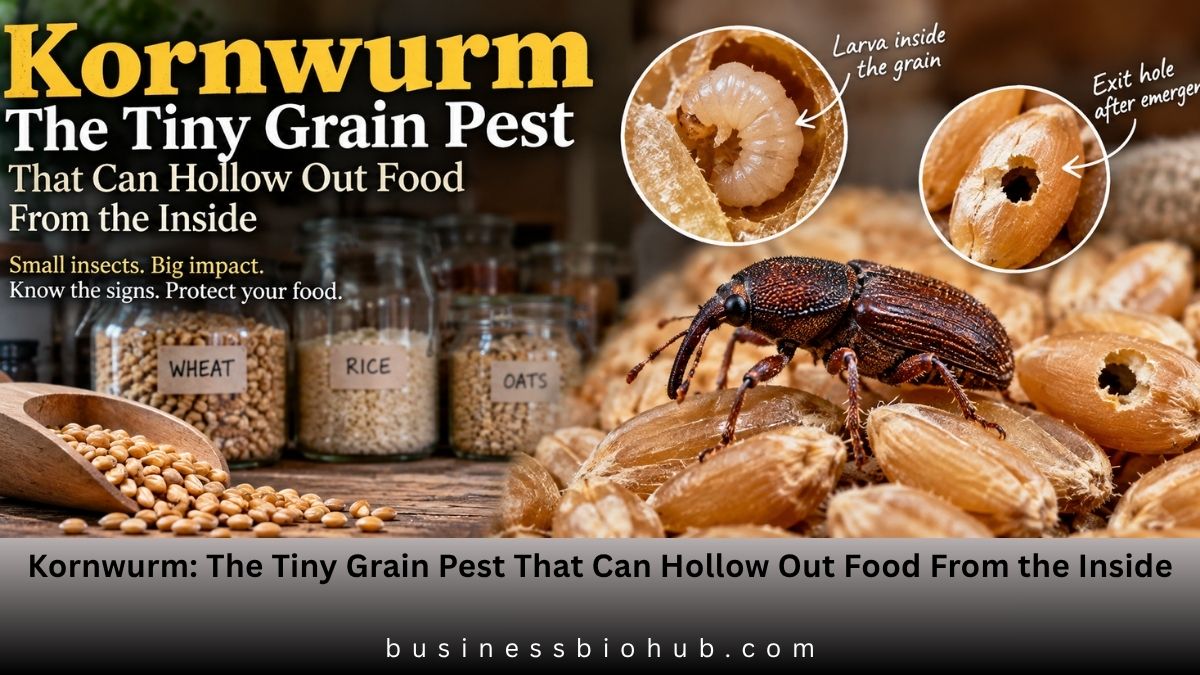
A Kornwurm can remain almost invisible while damaging grain from the inside. A bag of wheat, rice, barley, oats, or another dry food may look normal at first, even though an insect is developing inside individual kernels. By the time small beetles or exit holes appear, the infestation may already have progressed well beyond what can be seen on the surface.
That makes the term especially relevant wherever grain is stored: kitchens, pantries, farms, silos, mills, bakeries, warehouses, and food-processing facilities. Germany’s Umweltbundesamt classifies grain weevils as important stored-product pests and advises that infested food or animal feed should no longer be consumed.
There is also an important naming problem. Kornwurm does not always describe one exact species. German dictionaries historically use the term for the larva of the grain weevil and, in another sense, for the caterpillar of the grain moth. Understanding that distinction is the first step toward identifying what is actually attacking stored food.
BLUF: Kornwurm is a German term most commonly associated with grain-damaging insects, particularly the larval stage of the common grain weevil, Sitophilus granarius. The larva develops inside a kernel, consumes its contents, pupates there, and eventually emerges as a small brown weevil. The term can also describe the grain-moth caterpillar.
One Word, Two Different Grain Pests
The biggest mistake when researching Kornwurm is assuming that the word identifies a single biological species.
Duden gives two meanings. The first is the larva of the Kornkäfer, or grain weevil, which eats a grain kernel from within. This has historically been called the schwarzer Kornwurm, or black Kornwurm. The second meaning refers to the caterpillar of the Kornmotte, traditionally called the weißer Kornwurm, or white Kornwurm.
That distinction matters because the insects belong to completely different groups.
| Term | Biological identity | Scientific name | Main identifying feature |
|---|---|---|---|
| Schwarzer Kornwurm | Grain-weevil larva/adult grain weevil | Sitophilus granarius | Larva develops inside an individual grain |
| Kornkäfer | Adult grain weevil | Sitophilus granarius | Small brown weevil with an elongated snout |
| Weißer Kornwurm | Grain-moth caterpillar | Tinea granella | Moth larva associated with stored plant products |
| Kornmotte | Adult grain moth | Tinea granella | Small moth whose caterpillar damages stored grain |
The European and Mediterranean Plant Protection Organization recognizes Sitophilus granarius as the grain weevil or granary weevil, while German common names include Gemeiner Kornkäfer. Taxonomically, it is an insect in the order Coleoptera and genus Sitophilus.
What a Kornwurm Does Inside a Grain Kernel
The most striking part of a grain-weevil infestation happens where people cannot easily see it.
A female Sitophilus granarius makes an opening in a kernel using her elongated snout and deposits an egg. According to an official German information sheet, a female can lay up to around 200 eggs, with eggs placed individually into grain kernels. The resulting larva is pale, legless and curved.
Instead of crawling openly through a cupboard, the developing larva remains inside its food source. It consumes much of the grain’s interior, develops further and eventually pupates within the kernel. The young adult then emerges, leaving behind a visibly damaged or hollowed grain.
This hidden development explains why a newly purchased package can appear clean while containing affected kernels.
Germany’s Umweltbundesamt notes that the development of grain-weevil larvae takes place inside grain and therefore may not initially be visible externally. One later warning sign is the appearance of exit holes where adults have emerged.
The Foods Most Likely to Reveal an Infestation
A Kornwurm problem is principally a stored-food problem, not a parasite of humans.
The common grain weevil and related Sitophilus species are particularly associated with cereal products. The Umweltbundesamt lists rye, wheat, barley, oats, buckwheat, maize, millet and rice among vulnerable foods. Other dry products—including pasta, nuts, dried fruit, dried vegetables and pulses—can also be associated with grain-weevil infestations.
That means detection should not stop after one contaminated packet has been found.
Nearby dry foods should be inspected because pests can spread through a storage area, especially when packages are open, damaged or insufficiently sealed.
Signs worth checking immediately
Look for:
- Small brown beetles walking in or around stored foods
- Hollow or unusually lightweight grain kernels
- Small emergence holes in individual grains
- Powdery material accumulating around damaged products
- Contamination or visible insect remains
- Unexplained insect activity inside pantry cupboards
An isolated beetle does not automatically prove that every food package nearby is infested, but it is enough to justify a careful inspection of the storage area.
Why Kornwurm Damage Is More Than an Appearance Problem
The obvious loss is the grain itself. A larva can consume much of a kernel’s usable interior, reducing the quality and value of the stored product.
A larger infestation creates additional problems.
The Umweltbundesamt reports that heavily infested stored products may develop higher temperature and humidity, creating conditions that can encourage secondary contamination involving microorganisms, mites and mould. For that reason, the agency recommends disposing of affected food and feed rather than consuming it.
This is an important distinction for household advice. The practical concern is not simply whether accidentally seeing one insect is unpleasant. An established infestation means the stored product has been biologically damaged and potentially contaminated.
Editorial stance: Treat visible grain pests as evidence of a storage problem rather than merely removing the insects you can see. The hidden life stage inside individual kernels is precisely what makes grain-weevil infestations easy to underestimate.
The Most Effective Household Response Starts Without Insecticide
Finding Kornwurm-related insects does not automatically mean a kitchen needs aggressive chemical treatment.
The first response is source control.
Identify affected packages, separate them from unaffected food and examine nearby cereals, rice, flour products, pasta, pulses, nuts and other dry foods. Infested products should be discarded in accordance with local waste practices.
Then clean the storage space thoroughly. Pay particular attention to shelf corners, cracks, package debris and spilled grain. Newly purchased foods should ideally be kept in airtight containers, while storage areas should remain cool and clean.
The German Environment Agency specifically recommends regular inspection, cool storage and tightly closed containers. It also states that freezing susceptible material at −18°C for at least three days kills grain-weevil larvae and adults.
The agency advises against routine insecticide use for grain weevils in private homes and recommends professional pest-control assistance when an infestation cannot be brought under control through household measures.
A practical control sequence
- Locate the source by checking all vulnerable stored foods.
- Discard confirmed infested food rather than attempting to eat around damaged grains.
- Vacuum and clean cupboards, especially cracks and shelf joints.
- Inspect unopened packages for damage or insects.
- Move clean foods into sealed containers.
- Use appropriate freezing where suitable for products you are treating preventively.
- Recheck the pantry regularly for newly emerging adults.
- Call a qualified pest professional if the infestation continues.
Grain Weevil, Rice Weevil or Maize Weevil?
Identification becomes slightly more difficult because Sitophilus granarius is not the only Sitophilus species associated with stored food.
The Umweltbundesamt also identifies the rice weevil (Sitophilus oryzae) and maize weevil (Sitophilus zeamais) as pests capable of entering households through infested products.
The common grain weevil is brownish and does not fly. Rice and maize weevils are visually similar but can show four poorly defined reddish patches on their wing covers.
| Feature | Common grain weevil | Rice/maize weevils |
|---|---|---|
| Genus | Sitophilus | Sitophilus |
| Typical body form | Small weevil with long snout | Very similar |
| Wing-cover markings | Generally without four reddish patches | Often four reddish patches |
| Flight ability | Flightless | Species differ from S. granarius |
| Stored-food importance | High | High |
Exact species identification may require specialist examination because these insects are only a few millimetres long.
The Small Hole in a Grain Is the Clue That Matters
Kornwurm is an old name, but the storage problem behind it remains highly relevant. The most important fact is that the familiar “worm” may actually represent a hidden stage in the life cycle of a grain weevil, particularly Sitophilus granarius.
Because development occurs inside individual kernels, prevention depends less on chasing visible insects and more on inspection, sealed storage, cleanliness and rapid removal of infested food.
And when identifying the term itself, precision matters: Kornwurm can refer to more than one grain pest. Recognizing that linguistic distinction prevents a simple word from producing the wrong biological diagnosis.
FAQs
What exactly is a Kornwurm?
A Kornwurm is a traditional German name for a grain-damaging insect stage. Most commonly it refers to the larva associated with the common grain weevil, Sitophilus granarius. Duden also records Kornwurm as a name for the caterpillar of the grain moth, so the word should not automatically be treated as a single scientific species.
Is Kornwurm the same as Kornkäfer?
Kornwurm and Kornkäfer are closely connected but are not strictly identical terms. In its grain-weevil meaning, Kornwurm traditionally refers to the larval form, while Kornkäfer refers to the adult beetle Sitophilus granarius. The adult is a small brown weevil identifiable by its elongated snout.
Can Kornwurm infest rice?
Yes, grain-associated weevils can infest rice. The Umweltbundesamt lists rice among foods vulnerable to Sitophilus species and also recognizes Sitophilus oryzae, the rice weevil, as another important household stored-product pest. Wheat, rye, barley, oats, maize and millet can also be affected.
Should food containing Kornwurm be eaten?
Infested food should not be consumed. Germany’s Umweltbundesamt recommends disposing of food and feed affected by grain weevils because infestation damages and contaminates the product and can create conditions favourable to secondary problems such as mites, bacteria or mould.
How can Kornwurm be prevented?
Kornwurm prevention is primarily good food-storage hygiene. Regularly inspect dry foods, keep storage spaces clean, prevent grain or flour from accumulating in cupboard cracks, and store vulnerable products cool and in airtight containers. These measures reduce both unnoticed introduction and the ability of an infestation to spread.
Does freezing kill grain weevils?
Freezing can kill common grain-weevil life stages when applied correctly. The German Environment Agency recommends −18°C for at least three days as a method capable of killing larvae and adult grain weevils. Suitability still depends on whether the particular food can safely be frozen without unacceptable quality damage.
Editorial Disclaimer
This article distinguishes between historical/common German terminology and modern scientific identification. Kornwurm is not an unambiguous scientific species name. Pest appearance can vary, and closely related stored-product insects may be difficult to identify without specialist examination. Food-safety and pest-control decisions should follow current local authority guidance.

Pasonet Explained: Why This Digital Name Is More Complicated Than It First Appears

1upHealth Revenue Cycle Automation Partnerships: What’s Real, What’s Emerging, and Why 2027 Changes the Stakes

Kögel Trailer GmbH Manufacturing or Wholesale? The Business Model Behind the German Trailer Company

Paul Smalley Studied at University: The Education Behind His Global Football Career

Fawn Radmanich Marketing Strategy Experience: Why Her 25-Year A/E/C Career Centers on Winning Complex Work

Emily Seitz Pawlak at TriHealth: The Revenue Cycle Executive Who Pushed Automation Beyond Billing

Jadene Elden, AI Automation and RCM at Southcoast Health: What the Public Record Actually Shows

Tina Esposito Advocate Health Bio: The Data Executive Shaping Analytics, AI and Patient Care

Michael Roe Operating Partner NexPhase: The Verified Record Behind the Name — and the michaelroe.net Question

Briana Biagi Banner Health Fallon NV Staff Directory: What Current Records Actually Show

Astrid Hannah: The Inspiring Story of John Hannah’s Daughter and Her Life Beyond Competitive Swimming

Best Pasticho Venezuelan Lasagna Near Me: A Complete Guide to Finding This Rich Latin Comfort Food

Natasha Podstepny LinkedIn Performant Healthcare Nashville: Inside Her Professional Journey

John Minoli: The Private Life and Career of Sheena Easton’s Fourth Husband

Jeroen Dik: How He Built a Powerful Legacy in Performance Tuning and Motorsport

Lihnk Explained: The Mysterious Search Term, Possible Meanings, and What Users Should Know

Colitre Explained: The Powerful Story Behind a Rare Name and Its Modern Identity

Nigora Whitehorn: The Inspiring Life, Marriage, and Story Behind Duncan Bannatyne’s Wife

Kemberly Blackledge LinkedIn Nashville General Hospital Chief Revenue Officer: How She Built a Powerful Healthcare Finance Career

Elegant Florals Emily Davis Business Description: A Refined Look at Floral Art, Event Design, and Botanical Creativity
Pasonet Explained: Why This Digital Name Is More Complicated Than It First Appears
1upHealth Revenue Cycle Automation Partnerships: What’s Real, What’s Emerging, and Why 2027 Changes the Stakes
Kögel Trailer GmbH Manufacturing or Wholesale? The Business Model Behind the German Trailer Company
Paul Smalley Studied at University: The Education Behind His Global Football Career
Fawn Radmanich Marketing Strategy Experience: Why Her 25-Year A/E/C Career Centers on Winning Complex Work
Emily Seitz Pawlak at TriHealth: The Revenue Cycle Executive Who Pushed Automation Beyond Billing
Jadene Elden, AI Automation and RCM at Southcoast Health: What the Public Record Actually Shows
Tina Esposito Advocate Health Bio: The Data Executive Shaping Analytics, AI and Patient Care
Michael Roe Operating Partner NexPhase: The Verified Record Behind the Name — and the michaelroe.net Question
Briana Biagi Banner Health Fallon NV Staff Directory: What Current Records Actually Show
-
 Celebrity4 months ago
Michael Scott Ryan: The Private Writer Known for His Connection to Jennifer Ehle
-
 Celebrity4 months ago
Daniel Guerard, The Private French Salon Owner Behind Lorraine Bracco’s Early Life Story
-
 Celebrity5 months ago
Caroline Hickman: The Private Life and Public Attention Around Steve Coogan’s Former Wife
-
 Celebrity3 months ago
Benn George, The Private British Businessman Behind a Powerful Chapter in Tiffany Darwish’s Life