
Technology
BrandRank.ai Normalization Transformation Rules: What Is Verified, What Is Inferred, and How the Data Logic Really Works

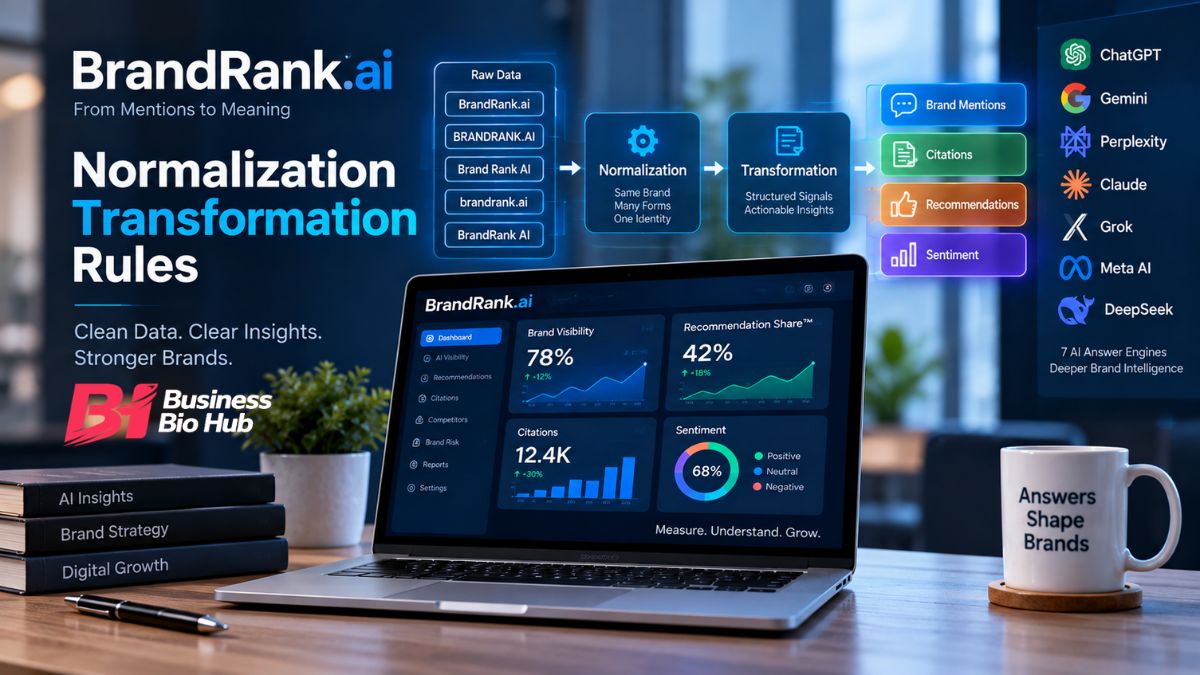
AI answer engines have created a measurement problem that conventional rank tracking was never designed to solve. A brand can appear as a company name, shortened alias, product line, regional subsidiary, domain, citation, recommendation, or passing mention—and those signals do not necessarily mean the same thing.
That distinction matters because BrandRank.AI now measures how brands appear across major AI answer engines and emphasizes Recommendation Share™, visibility, vulnerability, citations, content readiness, and brand-risk intelligence. Its current public materials say it tracks priority questions daily across seven AI answer engines, including ChatGPT, Gemini, Perplexity, Grok, Claude, Meta AI, and DeepSeek.
Yet searches for brandrank.ai normalization transformation rules can create the impression that BrandRank.AI has released a public technical rulebook for canonicalization, deduplication, field transformation, or scoring.
That is where precision becomes essential.
BLUF: BrandRank.ai normalization transformation rules are not currently documented by BrandRank.AI as a named public technical specification. The phrase is better understood as shorthand for normalization and transformation practices that could make brand names, URLs, citations, prompts, AI responses, products, markets, and recommendation signals consistent enough for reliable analysis.
The First Rule Is Separating BrandRank.AI’s Published System From an Unpublished Rulebook
A review of BrandRank.AI’s current public website, FAQ, platform descriptions, and company materials does not reveal a technical specification formally titled “Normalization Transformation Rules.”
What BrandRank.AI does publicly document is considerably clearer.
Its FAQ says the platform runs daily tests on prioritized queries across AI engines, captures generated responses, identifies cited sources, extracts key claims, and evaluates signals to identify risks and opportunities. It also describes a Brand Health and Trust framework built around Visibility, Vulnerability, and Content Readiness.
The company’s homepage places additional emphasis on Recommendation Share™, which measures whether a brand is actually recommended in important buying questions rather than merely appearing somewhere inside an answer. BrandRank says the platform repeatedly measures strategically important questions, strengthens evidence, addresses content gaps, builds third-party authority, publishes changes, and measures again.
BrandRank.AI’s July 2026 announcement about its acquisition of Averi.AI technology likewise describes a workflow covering AI Search Visibility, Content Readiness, Brand Vulnerability, Recommendation Share™, content creation, publishing, and subsequent measurement. It does not disclose a normalization grammar, transformation syntax, entity-resolution threshold, or proprietary mapping table.
That distinction protects readers from converting plausible data-engineering practices into invented product documentation.
“Agents will act on the answer, not the page.” — BrandRank.AI
What Normalization and Transformation Actually Mean in an AI Brand Dataset
Normalization and transformation solve related but different problems.
Normalization creates consistency. It determines when multiple representations should be treated as equivalent for analytical purposes.
Transformation creates structured meaning. It converts raw observations into fields, categories, indicators, or metrics that downstream systems can query and compare.
Consider these strings:
BrandRank.AIBRANDRANK.AIBrandRank AIBrand Rank AIbrandrank.ai
A human reader can usually infer that they refer to the same organization. A literal string-matching system may not.
A normalization layer could create a canonical entity:
canonical_brand = BrandRank.AI
while retaining each observed variant.
Transformation comes next. Suppose an AI answer says that BrandRank.AI is recommended for monitoring AI visibility and includes a citation to its official domain.
A transformation pipeline might create analytical values such as:
brand_mentioned = truerecommendation_detected = truesource_domain = brandrank.aicitation_type = first_partyanswer_engine = ChatGPTmarket = USprompt_type = category_comparisonresponse_timestamp = recorded_time
Those examples explain the engineering concept. They should not be represented as BrandRank.AI’s disclosed internal database fields.
A Practical Rule Stack for Normalizing Brand and AI-Answer Data
The safest framework preserves the raw evidence first and standardizes only what can be standardized without losing business meaning.
| Data layer | Practical normalization rule | Transformation output | Main risk |
|---|---|---|---|
| Brand name | Map verified aliases to one canonical entity | Entity ID, canonical name | Merging unrelated brands |
| URL | Remove irrelevant tracking variations where appropriate | Canonical source/page | Combining materially different pages |
| Product | Resolve spelling and naming variants | Product/entity relationship | Mixing product with parent company |
| Geography | Standardize country/market labels | Locale or market field | Hiding regional differences |
| Citation | Resolve duplicate references to the same source | Citation count/source class | Inflated citation totals |
| AI response | Preserve original answer before classification | Mention, claim, sentiment, recommendation | Destroying context |
| Prompt | Group truly equivalent questions | Intent/topic category | Treating different intents as identical |
| Time | Store consistent timestamps | Trend period | Comparing observations from different periods |
Canonical identity should come before scoring
A measurement system should know what entity it is measuring before calculating visibility or recommendation metrics.
That means creating a stable canonical record containing information such as:
- official entity name;
- primary website;
- legitimate aliases;
- product relationships;
- parent or subsidiary relationships;
- relevant countries or markets;
- historical names where necessary;
- an internal stable identifier.
Google’s Organization structured-data guidance follows a similar identity principle at the web-publishing level. Google recommends properties such as name, alternateName, url, and sameAs, and says organization markup can help it understand administrative details and disambiguate an organization.
Schema.org defines sameAs as a URL that unambiguously identifies the same entity.
That does not mean BrandRank.AI uses Google’s schema model internally. It demonstrates why canonical identity is a fundamental entity-resolution problem across machine-readable systems.
Mention, citation, and recommendation are not synonyms
This is one of the most consequential transformation rules an analyst can apply.
A brand may be:
- absent;
- mentioned neutrally;
- cited as a source;
- discussed as an option;
- compared with competitors;
- recommended;
- recommended with caveats;
- negatively characterized.
Collapsing those states into brand_present = true destroys information.
BrandRank.AI’s public product language supports this broader distinction. Its FAQ describes analysis of complete responses, cited sources, claims, competitor benchmarking, visibility, vulnerability, and content readiness rather than relying on a single raw mention count.
The Biggest Failure Mode Is Over-Normalization
Messy data creates noise.
Over-cleaned data creates false confidence.
Suppose an organization owns several brands. Automatically merging every product and subsidiary into the parent company might make a dashboard look cleaner while making recommendation data less accurate.
The same warning applies to international operations.
example.com
example.co.uk
and
example.de
might belong to one corporate group, but the pages can contain different products, regulations, prices, languages, offers, and claims.
BrandRank.AI explicitly says its platform supports multi-brand and multi-market environments while preserving local priorities, country-specific answer engines, language differences, and local sources of authority. That makes market-level distinctions analytically important rather than something to erase during cleanup.
Differences worth preserving
Do not automatically collapse:
- parent company and consumer brand;
- brand and individual product;
- current and discontinued products;
- global and country-specific websites;
- two pages with materially different content;
- historical and current company identities;
- brand mention and brand recommendation;
- factual citation and editorial opinion;
- first-party and independent sources;
- answers captured from different models or dates.
The objective is comparability without artificial uniformity.
A Reliable Transformation Pipeline Needs Provenance, Confidence, and Versioning
Normalization should not operate as an invisible cleanup script.
Every transformed observation should ideally remain traceable to evidence.
A strong governance model can preserve:
raw observation → normalized value → canonical entity → analytical classification → metric
Alongside that chain, retain:
- AI engine;
- model or product where available;
- prompt;
- full original answer;
- capture date and time;
- country and language;
- cited URL;
- canonical URL;
- classification confidence;
- manual-review status;
- transformation-rule version.
Why version the rules?
Because normalization logic changes.
An alias judged equivalent in September may later become a separate product. A redirected domain might change ownership. A regional site may split from the global company. A new model can format citations differently.
If historical records are silently reprocessed with new rules, trend lines can move even when the underlying AI behavior did not.
Versioning prevents a data-cleaning update from masquerading as a real-world change in brand performance.
Entity Consistency Helps Machines, but It Is Not an AI-Ranking Shortcut
Brands can reduce ambiguity before third-party monitoring tools ever process their information.
Google recommends Organization structured data and says relevant properties can help it understand and disambiguate an organization. Its documentation includes fields such as name, alternateName, url, contact details, and sameAs.
That supports several sensible publishing practices:
- use a consistent official brand name;
- clearly identify products and their parent organization;
- maintain accurate About and contact information;
- keep structured data synchronized with visible content;
- use canonical URLs correctly;
- identify legitimate external profiles;
- correct obsolete company or product information;
- maintain clear evidence for important factual claims.
But normalization should not be marketed as a secret switch that guarantees citations in AI answers.
BrandRank.AI’s own FAQ says AI visibility is influenced by authority, structure, corroboration, citation presence, and trust signals. Its product workflow also emphasizes strengthening proof, closing content gaps, building third-party authority, publishing changes, and measuring the results again.
Clean identity is infrastructure.
It is not a substitute for credible evidence.
The Useful Truth Is More Valuable Than a Fictional Technical Specification
The search phrase brandrank.ai normalization transformation rules points toward a legitimate technical challenge, but accuracy requires resisting the temptation to turn plausible engineering practices into undocumented BrandRank.AI features.
What is verified is substantial enough.
BrandRank.AI monitors strategically important AI prompts, analyzes generated answers and cited sources, evaluates brand visibility and vulnerability, measures content readiness, benchmarks competitors, traces problematic source material, and increasingly centers Recommendation Share™ as a commercial measure of whether a brand is actually chosen by AI answer engines.
Normalization and transformation are logical requirements for making complex brand datasets comparable. Canonical identities, URL handling, source deduplication, entity relationships, provenance, confidence scoring, market separation, and rule versioning are practical ways to build that consistency.
They should simply be labeled correctly: a defensible data-processing framework, not a disclosed BrandRank.AI proprietary rule set unless BrandRank.AI publishes one.
FAQs
What are BrandRank.ai normalization transformation rules?
BrandRank.ai normalization transformation rules are best understood as a general data-governance concept, not a publicly documented BrandRank.AI specification. Normalization makes equivalent brand names, URLs, products, citations, and other observations comparable. Transformation converts those cleaned observations into structured signals such as mentions, recommendations, sources, claims, markets, or competitive measurements.
Has BrandRank.AI officially published normalization transformation rules?
No public BrandRank.AI material reviewed for this article identifies a product specification under that exact name. BrandRank.AI publicly documents Recommendation Share™, Visibility, Vulnerability, Content Readiness, prompt testing, citation analysis, claim extraction, competitor benchmarking, and risk monitoring, but it does not publicly disclose a proprietary normalization rulebook.
What is the difference between normalization and transformation?
Normalization is the process of making equivalent representations consistent enough to compare, while transformation converts raw information into another usable structure or analytical field. For example, several spellings of a company name can normalize to one entity, while an AI response can transform into separate fields for recommendation status, citation source, market, topic, and timestamp.
Why would normalization matter for AI visibility measurement?
Normalization matters because AI answers generate heterogeneous data across prompts, models, sources, languages, products, and dates. Without entity resolution and deduplication, one company can be counted as several entities or one citation as several sources. Excessive normalization creates the opposite problem by merging distinctions that affect the real meaning of the answer.
Should every brand alias be merged into one canonical name?
No. A brand alias should be merged only when sufficient context establishes that both records represent the same analytical entity. Similar spelling alone is not enough. Parent companies, subsidiaries, products, regional operations, franchises, and historical entities may need separate canonical records even when they share names, domains, or ownership relationships.
Can better structured data increase BrandRank.AI performance?
Structured data can reduce entity ambiguity and help search systems understand an organization, but no verified public evidence establishes a direct formula connecting a particular schema property to a specific BrandRank.AI score. Google says Organization markup can help disambiguate organizations, while BrandRank.AI emphasizes broader factors including evidence, authority, citations, content structure, accuracy, and corroboration.
Editorial Disclaimer
This article distinguishes publicly documented BrandRank.AI capabilities from general normalization and data-transformation practices. Examples of canonical fields, transformation pipelines, confidence values, entity-resolution logic, URL processing, and rule versioning are explanatory models, not representations of BrandRank.AI’s proprietary software architecture. Product capabilities and terminology may change as BrandRank.AI updates its platform.

Telehealth Psychiatric & Mental Health Care: Accessible Support for a Healthier Mind

West Palm Beach Detox: A Safe and Supportive Start to Lasting Recovery

Drug & Alcohol Rehab in West Palm Beach, FL: Start Your Journey to a Healthier Life

Drug & Alcohol Detox in South Carolina: A Complete Guide to Safe Recovery

Drug and Alcohol Detox Kentucky: Your Guide to Safe Recovery at Paducah Detox Center

Addiction Treatment in Plymouth: Understanding Addiction & Mental Health Treatment

Ohio Center for Adolescent Wellness: Your Guide to Teen Mental Health Services in Ohio

Massachusetts Center for Adolescent Wellness: Your Guide to Teen Mental Health & Addiction Treatment in MA

Foundation Diploma Singapore: A Practical Route Towards Higher Education

How to Stay Safe and Private While Using Public Wi-Fi

Paul Smalley Studied at University: The Education Behind His Global Football Career

Diamo Jewels Under the Lens: What Buyers Should Know Before Ordering in 2026

Billie Henry: Inside the Private Life Dawn French Fought to Keep Out of the Spotlight

Tina Esposito Advocate Health Bio: The Data Executive Shaping Analytics, AI and Patient Care

Kögel Trailer GmbH Manufacturing or Wholesale? The Business Model Behind the German Trailer Company

iPhone 17 Pro Max Phone Case: Best Protection Choices That Actually Matter in 2026

Pasonet Explained: Why This Digital Name Is More Complicated Than It First Appears

1upHealth Revenue Cycle Automation Partnerships: What’s Real, What’s Emerging, and Why 2027 Changes the Stakes

Industrial Entrepreneurs Memorandum: The 2026 IEM Rules Every Large Manufacturer Should Understand

EliseAI Head of Partnerships 2024–2026: The Leadership Shift Behind Its Expanding AI Partner Network
Telehealth Psychiatric & Mental Health Care: Accessible Support for a Healthier Mind
West Palm Beach Detox: A Safe and Supportive Start to Lasting Recovery
Drug & Alcohol Rehab in West Palm Beach, FL: Start Your Journey to a Healthier Life
Drug & Alcohol Detox in South Carolina: A Complete Guide to Safe Recovery
Drug and Alcohol Detox Kentucky: Your Guide to Safe Recovery at Paducah Detox Center
Addiction Treatment in Plymouth: Understanding Addiction & Mental Health Treatment
Ohio Center for Adolescent Wellness: Your Guide to Teen Mental Health Services in Ohio
Massachusetts Center for Adolescent Wellness: Your Guide to Teen Mental Health & Addiction Treatment in MA
Foundation Diploma Singapore: A Practical Route Towards Higher Education
How to Stay Safe and Private While Using Public Wi-Fi
-
 Celebrity4 months ago
Michael Scott Ryan: The Private Writer Known for His Connection to Jennifer Ehle
-
 Celebrity4 months ago
Benn George, The Private British Businessman Behind a Powerful Chapter in Tiffany Darwish’s Life
-
 Celebrity5 months ago
Daniel Guerard, The Private French Salon Owner Behind Lorraine Bracco’s Early Life Story
-
 Celebrity6 months ago
Caroline Hickman: The Private Life and Public Attention Around Steve Coogan’s Former Wife