
Business
What Is Hard Water? Understanding Water Hardness in the UAE and GCC

Introduction
If you have ever noticed white crusty marks around your taps, cloudy spots on glassware or a kettle that seems to fill with chalky flakes, you have already met hard water. It is one of the most common water quality issues in the world, and in the UAE and wider Gulf region, it affects homes, hotels, offices and factories alike.
Hard water is not usually a health risk. In fact, the minerals it carries are naturally present in many foods. But for plumbing, appliances and industrial equipment, it can be a costly and persistent problem.
We explain what hard water is, how hardness is measured, why it is common in the GCC, the damage it can cause, and the most effective ways to treat it.
What Is Hard Water?
Hard water is water that contains high levels of dissolved minerals, mainly calcium and magnesium. These minerals enter water as it passes through rock and soil, especially limestone, chalk and gypsum. The more of these minerals the water carries, the “harder” it is.
There are two main types of hardness:
- Temporary hardness is caused by calcium and magnesium bicarbonates. It can be reduced by boiling, which is why kettles collect scale.
- Permanent hardness is caused by sulphates and chlorides of calcium and magnesium. Boiling does not remove it, so it needs proper treatment.
How Is Water Hardness Measured?
Hardness is usually expressed as milligrams per litre (mg/L) or parts per million (ppm) of calcium carbonate. A widely used scale is:
| Classification | Hardness (mg/L as CaCO₃) |
| Soft | 0 to 60 |
| Moderately hard | 61 to 120 |
| Hard | 121 to 180 |
| Very hard | Above 180 |
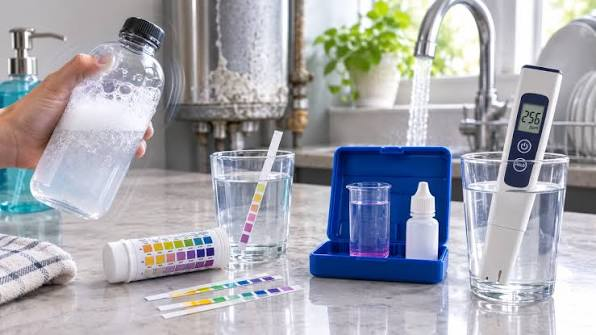
Some industries also use grains per gallon (gpg) or German degrees (°dH). Simple test strips can give a quick reading, while laboratory analysis or digital meters provide more accurate results.
Water Hardness in the UAE and GCC
Water hardness in the Gulf depends heavily on where the water comes from.
Desalinated water. Most municipal supply in the UAE and GCC comes from desalination plants. Freshly desalinated water is actually very soft, so utilities add minerals back (a process called remineralisation) to make it stable, protect pipelines and improve taste. The resulting tap water is usually in the soft to moderately hard range, though it can vary by area and supply network.
Groundwater. Wells and boreholes, still used for farms, villas, labour camps and some industrial sites, often draw water that is very hard and high in dissolved salts. Limestone and gypsum formations across the Arabian Peninsula load groundwater with calcium, magnesium and sulphates.
Storage and distribution. Rooftop tanks, long pipe runs and high temperatures can all affect water quality before it reaches the tap. Heat in particular speeds up scale formation, so even moderately hard water can cause problems in Gulf conditions.
Industrial concentration. In cooling towers and boilers, water evaporates and leaves minerals behind. Even soft feed water can become very hard inside these systems over time.
The result is that hardness is a real concern for many properties and almost every industrial facility in the region.
How Hard Water Affects Homes, Buildings and Industry
In Homes and Buildings
- Scale on fixtures. White deposits build up on taps, showerheads and tiles, making cleaning a constant chore.
- Shorter appliance life. Water heaters, washing machines, dishwashers and coffee machines lose efficiency and break down sooner.
- Higher energy bills. Scale inside water heaters acts as insulation, so more energy is needed to heat water.
- Dry skin and dull hair. Hard water reacts with soap, leaving residue that many people find irritating.
- More soap and detergent. Hard water reduces lather, so households and hotels use more cleaning products.
In Industry
For industrial users, the impact is far more serious and expensive.
- Boiler scale reduces heat transfer, increases fuel use and can cause tubes to overheat and fail.
- Cooling tower and heat exchanger fouling lowers cooling efficiency and leads to frequent cleaning shutdowns.
- RO membrane scaling forces higher operating pressure, more chemical cleaning and earlier membrane replacement.
- Product quality issues in food, beverage, textile and pharmaceutical production, where water is an ingredient or process input.
- Blocked pipes and valves that restrict flow and increase maintenance costs.
How to Treat Hard Water
The right solution depends on how hard the water is, how much you use and what you need it for.
Water Softeners
Water softeners are the most common solution for hardness. They use ion exchange resin to swap calcium and magnesium for sodium (or potassium). When the resin is full, it is regenerated with salt brine and used again. Softeners are widely used in villas, hotels, laundries, boiler feed and cooling tower make-up.
The control valve is the brain of a softener system. It manages service, backwash, brining and rinse cycles automatically. Reliable valves such as Clack Softener Valves help systems regenerate efficiently, saving salt and water while delivering consistent soft water.
Reverse Osmosis
Reverse osmosis removes hardness along with most other dissolved salts, making it ideal where very pure water is needed, such as drinking water, food and beverage production, pharmaceuticals and boiler feed. To prevent scaling on the membranes themselves, RO systems are usually paired with softening or antiscalant dosing. Working with established RO Membrane Suppliers in UAE ensures you get membranes suited to your feed water and quick replacements when needed.
Antiscalant and Chemical Treatment
In cooling towers, boilers and RO systems, antiscalants keep minerals in solution so they do not form scale. This does not remove hardness, but it controls its effects and is often used alongside softening.
Choosing the Right Solution
Start with a proper water test, then match the treatment to your needs. A villa may only need a compact softener, while a factory may need softening, RO and chemical dosing working together. An experienced Water Treatment Equipment Supplier can help you size the system correctly and supply quality components with local support.
Conclusion
Hard water may look harmless, but its effects add up quickly. In homes, it means scale, damaged appliances and higher energy bills. In industry, it means fouled boilers, scaled membranes, frequent shutdowns and rising maintenance costs.
In the UAE and GCC, where groundwater is often very hard and high temperatures speed up scaling, understanding water hardness is the first step to protecting your property or plant. With a simple water test and the right combination of softening, reverse osmosis and chemical control, hard water can be managed effectively and affordably for years to come.
Frequently Asked Questions (FAQs)
1. Is hard water safe to drink?
Generally, yes. The calcium and magnesium in hard water are not considered harmful to health at normal levels. The main problems are scale, reduced soap performance and damage to appliances and equipment.
2. Is tap water in the UAE hard?
Municipal tap water in the UAE comes mostly from desalination and is remineralised, so it is usually soft to moderately hard. However, groundwater from wells is often very hard, and storage conditions can affect quality.
3. How can I tell if I have hard water?
Common signs include white scale on taps and showers, spots on glassware, poor soap lather and scale inside kettles. A test strip or laboratory analysis will confirm the exact hardness level.
4. What is the difference between a water softener and an RO system?
A softener removes hardness minerals by ion exchange but leaves other dissolved salts. RO removes hardness and most other dissolved salts, producing much purer water.
5. How often does a water softener need regeneration?
It depends on water hardness, resin capacity and daily water use. Modern metered control valves regenerate only when needed, which saves salt and water.
6. Why is hard water a bigger problem in industry?
Industrial systems heat and concentrate water, which makes minerals drop out as scale much faster. This reduces efficiency, increases energy use and can damage expensive equipment such as boilers and RO membranes.

How portable chargers Are Redefining Personal Energy Management in a Connected World in 2026

What Is Hard Water? Understanding Water Hardness in the UAE and GCC

Improve PC Maintenance with Cleaning, Uninstalling, and Stress Testing

Telehealth Psychiatric & Mental Health Care: Accessible Support for a Healthier Mind

West Palm Beach Detox: A Safe and Supportive Start to Lasting Recovery

Drug & Alcohol Rehab in West Palm Beach, FL: Start Your Journey to a Healthier Life

Drug & Alcohol Detox in South Carolina: A Complete Guide to Safe Recovery

Drug and Alcohol Detox Kentucky: Your Guide to Safe Recovery at Paducah Detox Center

Addiction Treatment in Plymouth: Understanding Addiction & Mental Health Treatment

Ohio Center for Adolescent Wellness: Your Guide to Teen Mental Health Services in Ohio

Massachusetts Center for Adolescent Wellness: Your Guide to Teen Mental Health & Addiction Treatment in MA
Ohio Center for Adolescent Wellness: Your Guide to Teen Mental Health Services in Ohio
Drug and Alcohol Detox Kentucky: Your Guide to Safe Recovery at Paducah Detox Center
Addiction Treatment in Plymouth: Understanding Addiction & Mental Health Treatment
Drug & Alcohol Rehab in West Palm Beach, FL: Start Your Journey to a Healthier Life
Telehealth Psychiatric & Mental Health Care: Accessible Support for a Healthier Mind
West Palm Beach Detox: A Safe and Supportive Start to Lasting Recovery
Drug & Alcohol Detox in South Carolina: A Complete Guide to Safe Recovery
Improve PC Maintenance with Cleaning, Uninstalling, and Stress Testing
What Is Hard Water? Understanding Water Hardness in the UAE and GCC
How portable chargers Are Redefining Personal Energy Management in a Connected World in 2026
What Is Hard Water? Understanding Water Hardness in the UAE and GCC
Improve PC Maintenance with Cleaning, Uninstalling, and Stress Testing
Telehealth Psychiatric & Mental Health Care: Accessible Support for a Healthier Mind
West Palm Beach Detox: A Safe and Supportive Start to Lasting Recovery
Drug & Alcohol Rehab in West Palm Beach, FL: Start Your Journey to a Healthier Life
Drug & Alcohol Detox in South Carolina: A Complete Guide to Safe Recovery
Drug and Alcohol Detox Kentucky: Your Guide to Safe Recovery at Paducah Detox Center
Addiction Treatment in Plymouth: Understanding Addiction & Mental Health Treatment
Ohio Center for Adolescent Wellness: Your Guide to Teen Mental Health Services in Ohio
-
 Celebrity5 months ago
Michael Scott Ryan: The Private Writer Known for His Connection to Jennifer Ehle
-
 Celebrity5 months ago
Benn George, The Private British Businessman Behind a Powerful Chapter in Tiffany Darwish’s Life
-
 Celebrity6 months ago
Daniel Guerard, The Private French Salon Owner Behind Lorraine Bracco’s Early Life Story
-
 Celebrity7 months ago
Caroline Hickman: The Private Life and Public Attention Around Steve Coogan’s Former Wife