
Business & Leadership
CHST Certification: Smart Guide to Requirements, Exam, and Career Value

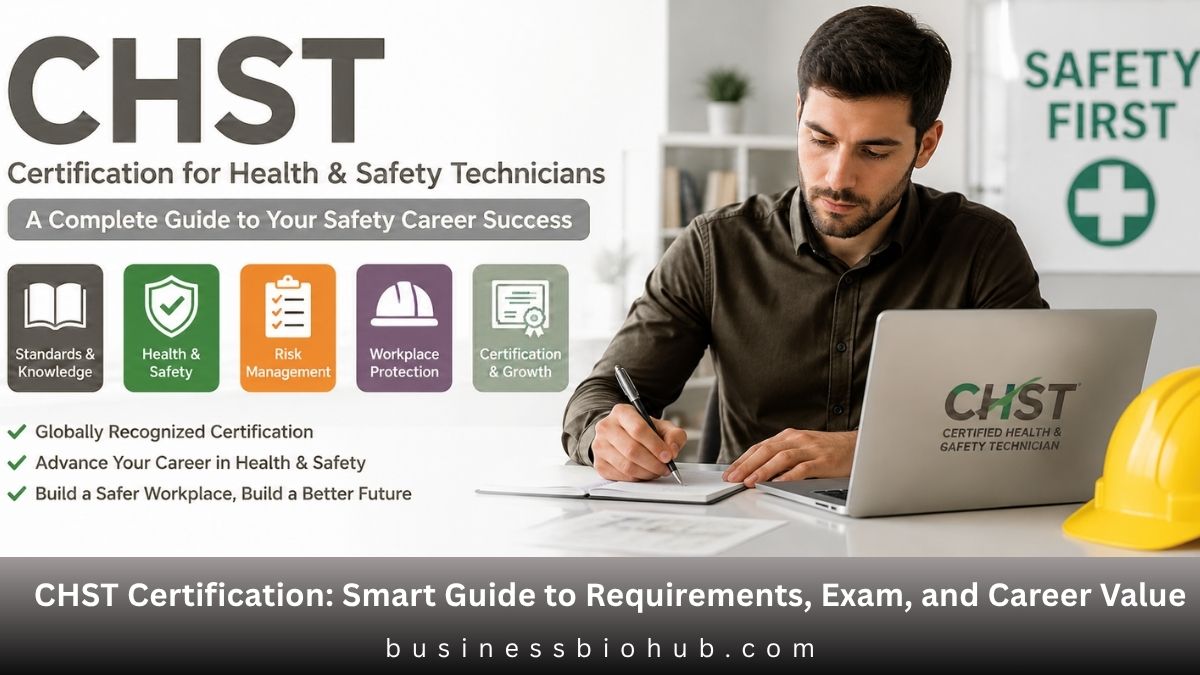
Construction projects involve constantly changing conditions, multiple contractors, heavy equipment, and safety risks, all of which require knowledgeable people on site. CHST, short for Construction Health and Safety Technician®, is a professional certification designed specifically for people who perform safety, health, and environmental responsibilities in construction.
The Board of Certified Safety Professionals (BCSP) administers the credential, which is intended for practitioners whose responsibilities may span one or more construction projects or job sites. Candidates can work for owners, general contractors, subcontractors, or organizations providing construction and safety services.
This article explains what CHST means, who qualifies for the certification, current requirements, exam details, costs, and how the credential can fit into a construction safety career.
What Is CHST?
CHST is a specialty professional certification focused on construction health and safety practice.
Unlike a general introductory safety course, the credential is intended for people with meaningful experience carrying out safety responsibilities in construction.
BCSP describes CHST holders as construction safety, health and environmental specialists whose responsibilities may represent all or part of their job. Their work may extend across a single large project, several projects, or multiple job sites.
The certification gives experienced practitioners a structured way to show that their construction-safety knowledge has been evaluated against an established professional standard.
The U.S. Department of Labor’s O*NET certification database also identifies CHST as a specialty certification associated with occupational safety and reports that a written examination and continuing renewal are required.
Who Is Eligible for CHST Certification?
One important feature of CHST is that BCSP does not currently specify a minimum formal education requirement.
The central requirement is relevant professional experience.
Candidates need:
- Three years of construction safety experience
- At least 35% of their job duties involving technical skills and knowledge related to safety, health, and environment
This makes CHST different from credentials that depend heavily on a particular university degree. It can therefore be relevant to experienced construction professionals who have developed substantial safety responsibilities through their work.
However, having worked on a construction site for three years does not automatically mean someone qualifies. The nature of the person’s responsibilities matters because BCSP specifically requires qualifying construction-safety duties.
What Does a CHST Professional Do?
No single CHST job description exists because construction organizations divide safety responsibilities differently.
A professional pursuing or holding CHST may work on activities such as identifying hazards, assessing jobsite risks, supporting safety programs, helping implement controls, communicating safety procedures, and monitoring adherence to established practices.
Depending on the organization, such responsibilities may appear in roles connected with:
- Construction safety
- Site safety coordination
- Health and safety
- Environmental health and safety
- Contractor safety
- Project safety
- Safety inspection
- Construction operations
Holding CHST does not automatically grant someone a particular job title or regulatory authority. Rather, it provides a professional credential specifically linked to demonstrated knowledge and experience in construction SH&E.
What Does the CHST Exam Cover?
BCSP periodically reviews its certification examinations so their content continues to reflect professional practice.
A revised CHST examination blueprint became effective on August 1, 2024. BCSP stated that the updated blueprint retained many concepts from the previous version while adding material and creating a more balanced examination framework.
For candidates, this means preparation should be based on the current BCSP CHST examination blueprint, rather than old study notes or outdated third-party exam guides.
Construction safety is broader than memorizing rules. A practitioner may need to understand how hazards develop, how to control risk, and how safety systems work in real construction environments.
BCSP’s blueprint update specifically referenced fall protection, mechanized equipment, biological hazards, and concrete work as updated concepts.
How Long Is the CHST Exam?
BCSP lists the current CHST exam as four hours.
BCSP uses Pearson VUE for its computer-based certification examinations, with testing locations available internationally. Pearson VUE identifies CHST as one of the BCSP certification examinations it delivers.
BCSP also states that candidates receive their official result after submitting the examination.
Candidates who need another attempt must follow BCSP’s retesting rules. The organization currently states that candidates can schedule an examination at least 6 weeks after their previous attempt.
How Much Does CHST Certification Cost?
According to BCSP’s current credential information, the standard costs include:
Application fee: $140
Examination fee: $300
Exam bundle: $550
Application + exam combination: $426
Application + exam bundle combination: $676
Eligibility extension: $100
Renewal fee: $145
The examination itself is listed as four hours long, while maintaining the credential requires 20 recertification points.
Treat these figures as current published BCSP pricing rather than permanent rates. Anyone planning to apply should verify the latest fees directly with the certifying organization.
Why Can CHST Matter in the Construction Industry?
Construction companies operate in an environment where poor risk management can affect workers, schedules, operations, and business performance.
For professionals working specifically in construction safety, CHST provides an industry-focused credential rather than a broad certification that is unrelated to their day-to-day environment.
BCSP says the certification recognizes competency and dedication to preventing construction injuries and illnesses. It also notes that many construction safety practitioners use CHST as part of their progression toward greater responsibilities in safety, health and environmental practice.
That distinction is important.
A credential should not be viewed as a replacement for practical judgment, jobsite experience, employer training or compliance with applicable safety regulations. Instead, CHST can form one part of a professional’s broader development.
CHST and Career Development
CHST may be especially relevant to someone who already works close to construction operations but wants a credential focused specifically on safety.
For example, an experienced practitioner could use certification to document an established level of construction safety experience while continuing to develop skills in risk identification, hazard control, communication, and safety management.
Evidence also shows that industry organizations continue to connect construction workforce development with BCSP certification pathways. In March 2026, BCSP announced a collaboration with the National Center for Construction Education and Research, highlighting connections between NCCER construction leadership programs and BCSP certification blueprints, including CHST.
That does not guarantee employment or promotion, but it illustrates CHST’s place within a broader professional-development ecosystem for construction.
CHST vs CSP: They Are Not the Same Credential
CHST and Certified Safety Professional® (CSP®) are not interchangeable certifications.
CHST is specifically oriented toward construction safety specialists at the technician level.
CSP has broader requirements. BCSP currently requires CSP candidates to have at least a bachelor’s degree, four years of qualifying professional safety experience, and an approved credential.
The best choice, therefore, depends on someone’s experience, responsibilities, and longer-term career direction.
For a practitioner working directly with construction-site safety, CHST may be more closely aligned with current duties. Someone pursuing broader professional-level safety management responsibilities may eventually consider other credentials for which they qualify.
Maintaining CHST Certification
Passing the examination is not the end of the process.
BCSP credential holders must maintain their certification and continue professional development. The organization requires certificants to earn and report recertification points over a five-year cycle.
For CHST, BCSP currently lists 20 recertification points and a $145 renewal fee.
This continuing requirement matters because construction practices, technology, regulations, and approaches to risk management evolve.
Is CHST Worth Pursuing?
CHST can be worth considering for an experienced construction professional whose job already includes substantial safety, health and environmental responsibilities.
It fits best with people who meet the experience requirement and want a construction-specific professional credential.
Before applying, candidates should consider three questions:
- Do my current duties satisfy BCSP’s experience requirements?
- Is construction safety a significant part of my long-term career?
- Am I prepared to study the current exam blueprint and maintain the credential afterward?
If the answer to these questions is yes, CHST can provide a structured next step in professional development.
View it realistically: certification does not guarantee a particular salary, promotion, or position. Career outcomes vary by experience, employer, location, industry conditions, and the responsibilities attached to a role.
Final Thoughts
CHST is a specialized credential for professionals working at the intersection of construction operations and workplace safety. Rather than being an entry-level certificate based only on completing a short course, it requires candidates to bring real construction-safety experience before attempting certification.
The current BCSP requirements call for three years of construction safety experience, with at least 35% of job duties involving technical SH&E knowledge. Candidates who qualify and pass the examination can use CHST to demonstrate a recognized level of professional competence while continuing their development through ongoing recertification.
For construction companies and practitioners alike, its real value lies in supporting a more structured, professional approach to managing health and safety responsibilities on active projects.
FAQs
What does CHST stand for?
CHST stands for Construction Health and Safety Technician®, a certification administered by the Board of Certified Safety Professionals.
Does CHST require a college degree?
BCSP currently lists no minimum education requirement for CHST. Candidates must instead satisfy its construction-safety experience requirement.
How much experience do you need for CHST?
Candidates need three years of construction safety experience, with at least 35% of their duties requiring technical knowledge of safety, health, and environmental standards.
How long is the CHST exam?
BCSP currently lists the CHST examination duration as four hours.
How much does the CHST exam cost?
The current BCSP listing shows a $140 application fee and a $300 standard examination fee. Pricing can change, so applicants should verify current fees before applying.
Does CHST expire?
The credential must be maintained. BCSP requires ongoing fees and recertification activities, with recertification requirements evaluated over five-year cycles.
Is CHST the same as CSP?
No. CHST focuses on construction safety specialists, while CSP is a broader professional safety certification with higher education and professional experience requirements.

Pasonet Explained: Why This Digital Name Is More Complicated Than It First Appears

1upHealth Revenue Cycle Automation Partnerships: What’s Real, What’s Emerging, and Why 2027 Changes the Stakes

Kögel Trailer GmbH Manufacturing or Wholesale? The Business Model Behind the German Trailer Company

Paul Smalley Studied at University: The Education Behind His Global Football Career

Fawn Radmanich Marketing Strategy Experience: Why Her 25-Year A/E/C Career Centers on Winning Complex Work

Emily Seitz Pawlak at TriHealth: The Revenue Cycle Executive Who Pushed Automation Beyond Billing

Jadene Elden, AI Automation and RCM at Southcoast Health: What the Public Record Actually Shows

Tina Esposito Advocate Health Bio: The Data Executive Shaping Analytics, AI and Patient Care

Michael Roe Operating Partner NexPhase: The Verified Record Behind the Name — and the michaelroe.net Question

Briana Biagi Banner Health Fallon NV Staff Directory: What Current Records Actually Show

Astrid Hannah: The Inspiring Story of John Hannah’s Daughter and Her Life Beyond Competitive Swimming

Best Pasticho Venezuelan Lasagna Near Me: A Complete Guide to Finding This Rich Latin Comfort Food
Natasha Podstepny LinkedIn Performant Healthcare Nashville: Inside Her Professional Journey

John Minoli: The Private Life and Career of Sheena Easton’s Fourth Husband

Jeroen Dik: How He Built a Powerful Legacy in Performance Tuning and Motorsport

Lihnk Explained: The Mysterious Search Term, Possible Meanings, and What Users Should Know

Colitre Explained: The Powerful Story Behind a Rare Name and Its Modern Identity

Nigora Whitehorn: The Inspiring Life, Marriage, and Story Behind Duncan Bannatyne’s Wife

Kemberly Blackledge LinkedIn Nashville General Hospital Chief Revenue Officer: How She Built a Powerful Healthcare Finance Career

Elegant Florals Emily Davis Business Description: A Refined Look at Floral Art, Event Design, and Botanical Creativity
Pasonet Explained: Why This Digital Name Is More Complicated Than It First Appears
1upHealth Revenue Cycle Automation Partnerships: What’s Real, What’s Emerging, and Why 2027 Changes the Stakes
Kögel Trailer GmbH Manufacturing or Wholesale? The Business Model Behind the German Trailer Company
Paul Smalley Studied at University: The Education Behind His Global Football Career
Fawn Radmanich Marketing Strategy Experience: Why Her 25-Year A/E/C Career Centers on Winning Complex Work
Emily Seitz Pawlak at TriHealth: The Revenue Cycle Executive Who Pushed Automation Beyond Billing
Jadene Elden, AI Automation and RCM at Southcoast Health: What the Public Record Actually Shows
Tina Esposito Advocate Health Bio: The Data Executive Shaping Analytics, AI and Patient Care
Michael Roe Operating Partner NexPhase: The Verified Record Behind the Name — and the michaelroe.net Question
Briana Biagi Banner Health Fallon NV Staff Directory: What Current Records Actually Show
-
 Celebrity4 months ago
Michael Scott Ryan: The Private Writer Known for His Connection to Jennifer Ehle
-
 Celebrity4 months ago
Daniel Guerard, The Private French Salon Owner Behind Lorraine Bracco’s Early Life Story
-
 Celebrity5 months ago
Caroline Hickman: The Private Life and Public Attention Around Steve Coogan’s Former Wife
-
 Celebrity3 months ago
Benn George, The Private British Businessman Behind a Powerful Chapter in Tiffany Darwish’s Life