
Business
Give Me Tips for Managing Stage Fright Before a Presentation: A Research-Backed Plan That Actually Works

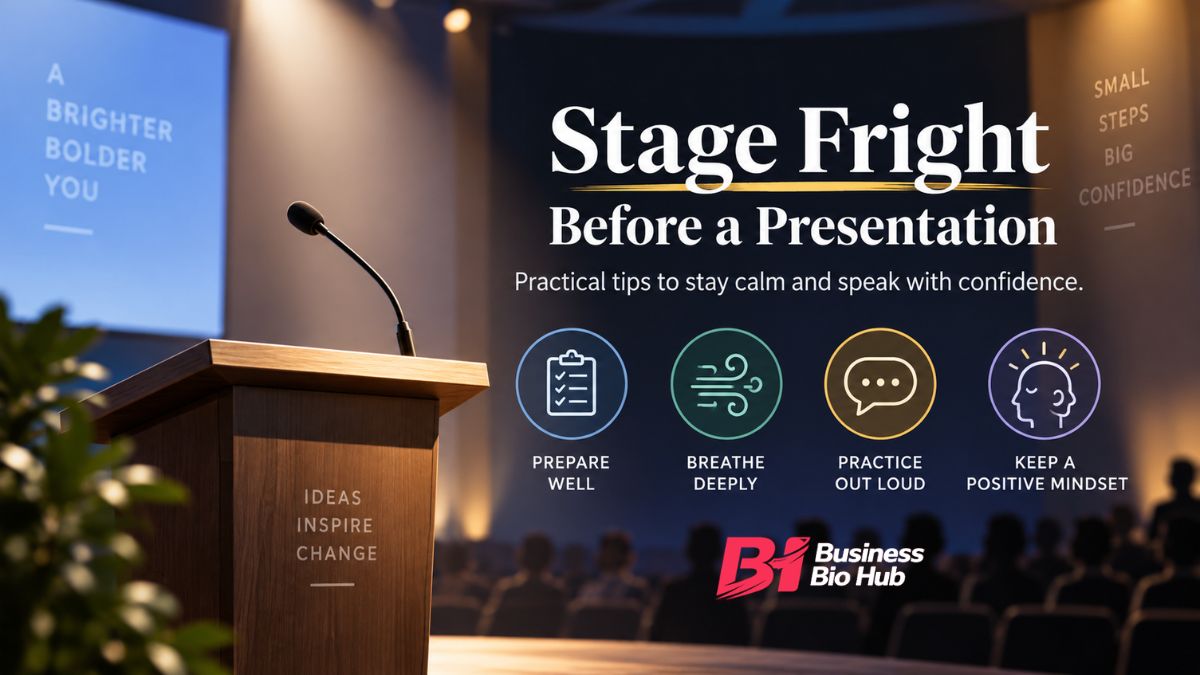
Your presentation is approaching. Your material is ready, but suddenly your heart speeds up, your hands feel clammy, your breathing becomes shallow, and information you knew perfectly yesterday seems harder to retrieve.
That reaction can feel like evidence that something is going wrong. Often, it is simply performance anxiety: the body’s stress response activating because the situation feels socially important. Public speaking is specifically listed by the U.S. National Institute of Mental Health as a situation that can trigger anxiety when a person expects to be observed, evaluated, or judged.
The useful question, then, is not “How do I eliminate every nervous feeling?” It is: How can I keep those feelings from controlling the presentation?
BLUF: The most effective way to manage stage fright before a presentation is to combine realistic rehearsal, gradual exposure, slow controlled breathing, simple cognitive reframing, and a clear opening plan. Trying to eliminate anxiety completely is less useful than preparing yourself to speak competently while some nervousness remains.
What Stage Fright Is Actually Doing to Your Body and Attention
Stage fright, commonly described as public-speaking anxiety or performance anxiety, can produce physical, cognitive, and behavioral reactions.
According to NIMH, anxiety in socially evaluative situations can involve sweating, trembling, a rapid heart rate, nausea, rigid posture, difficulty making eye contact, or the sensation that your mind has suddenly gone blank. Some people experience anxiety predominantly in performance situations such as speeches, competitions, or musical performances.
That distinction matters. Feeling nervous before an important presentation does not automatically mean you have an anxiety disorder.
Occasional anxiety is a normal response to stress. A clinical problem becomes more plausible when fear is persistent, difficult to control, leads to substantial avoidance, or significantly interferes with school, work, relationships, or everyday activities.
A quick stage-fright snapshot
- Physical response: faster heartbeat, sweating, trembling or tense muscles
- Breathing response: shallow or rapid breathing
- Cognitive response: racing thoughts, blanking, catastrophic predictions
- Attention response: excessive monitoring of your voice, hands or audience reactions
- Behavioral response: rushing, avoiding eye contact, reading directly from slides or avoiding presentations
- Useful counterstrategy: preparation plus repeated exposure rather than avoidance
Research on public-speaking anxiety consistently supports psychological interventions, particularly strategies containing exposure and cognitive-behavioral elements. A 2025 systematic review and meta-analysis covering 26 studies and 2,253 participants found an overall beneficial effect for psychological interventions targeting public-speaking anxiety, although results varied substantially among individual interventions.
Stop Practising the Slides and Start Practising the Performance
Many people prepare a presentation by repeatedly editing PowerPoint or reading their notes silently.
That is content preparation. It is not necessarily presentation preparation.
If speaking is what makes you anxious, your rehearsal needs to contain actual speaking.
Say the presentation aloud while standing up. Use your slides. Click through them yourself. Practise where you will pause. Time the presentation. Record one rehearsal. Then practise again after identifying the two or three moments where you became confused or rushed.
The principle resembles exposure, a well-established behavioral approach in anxiety treatment. Exposure involves gradually confronting situations that create fear instead of continually avoiding them. NIMH describes exposure therapy as a cognitive behavioral therapy method that progressively confronts feared situations, and meta-analyses of public-speaking anxiety have found meaningful benefits from exposure-based interventions.
Build a rehearsal ladder instead of jumping straight to the audience
Try progressively increasing the difficulty:
- Explain your presentation aloud when alone.
- Deliver it while standing and using the actual slides.
- Record yourself on a phone or laptop.
- Present to one trusted person.
- Present to two or three people.
- Rehearse in a meeting room or environment similar to the real venue.
- Practise answering several questions without scripting your responses.
The objective is not to produce a perfectly memorized speech. It is to make the experience of speaking while being observed increasingly familiar.
A meta-analysis involving 11 studies and 508 participants found significant reductions in public-speaking anxiety with both virtual-reality and real-world exposure approaches.
The Presentation-Day Plan: What to Do and When
| Time | Action | Why it helps |
|---|---|---|
| Previous day | Complete one realistic rehearsal | Builds familiarity and exposes weak transitions |
| Previous evening | Stop major rewriting | Prevents unnecessary last-minute cognitive load |
| 30–60 minutes before | Check slides, microphone, clicker and room setup | Removes avoidable uncertainties |
| 10–15 minutes before | Walk briefly and loosen tense muscles | Gives nervous energy a controlled outlet |
| 5 minutes before | Use slow, comfortable breathing | Can reduce escalating physical arousal |
| Opening minute | Use a rehearsed first sentence and first transition | Reduces the mental load at the hardest starting point |
| During presentation | Pause rather than rushing after a mistake | Creates time to retrieve your next point |
| Afterward | Record what worked as well as what did not | Prevents anxiety from rewriting the entire event as a failure |
Five minutes before speaking, make your breathing boring
When anxiety rises, people sometimes attempt huge, dramatic breaths. That can make breathing feel like another performance task.
Instead, use gentle, controlled breathing.
The NHS recommends allowing the breath to move comfortably toward the belly, breathing gently and regularly, and using slow counting if helpful. Its stress-breathing guidance suggests practising for several minutes rather than forcing excessively deep breaths.
A simple version is:
Breathe in gently → breathe out gently → keep the rhythm slow → repeat.
Do not obsess over achieving an exact count. The aim is controlled breathing, not winning a breathing competition.
Change the Sentence in Your Head Before Changing the Feeling
Stage fright often arrives with predictions:
“I’m going to forget everything.”
“Everyone will notice I’m nervous.”
“If I make one mistake, the presentation is ruined.”
Those statements treat uncertain possibilities as guaranteed outcomes.
A better response is not unrealistic positivity. It is more accurate thinking.
Instead of “I won’t be nervous,” use:
“I may feel nervous, and I can still explain this clearly.”
Instead of “I cannot make a mistake,” use:
“If I lose my place, I can pause, check my slide and continue.”
Instead of “Everyone is judging me,” use:
“My job is to help the audience understand the next point.”
There is experimental evidence for another useful reframing technique: interpreting pre-performance arousal as excitement rather than danger.
In a study published in the American Psychological Association’s Journal of Experimental Psychology: General, Alison Wood Brooks examined public speaking and other performance tasks. Participants encouraged to reinterpret anxiety as excitement showed improvements in psychological state and performance compared with participants instructed to calm themselves.
That does not mean repeating “I’m excited” magically eliminates severe anxiety. It suggests that changing how you interpret physiological arousal can sometimes make the same racing-heart sensation feel more manageable.
Editorial principle: A successful presenter does not need a perfectly calm nervous system. The speaker needs a reliable method for continuing when the nervous system becomes noisy.
Your First 60 Seconds Deserve More Preparation Than Your Fifteenth Slide
The beginning often feels hardest because anticipation ends and performance begins.
Make the opening mechanically easy.
Know your first sentence. Know your second idea. Know how you will transition into the main subject.
You do not necessarily need to memorize the whole presentation. In fact, excessive word-for-word memorization can create problems: forgetting one sentence may make you feel as though the entire sequence has disappeared.
Instead, memorize your route.
Think:
Opening → problem → evidence → recommendation → next step.
Those anchors give you somewhere to return if your wording changes.
Keep a rescue structure on one card
If notes are allowed, write only:
- opening sentence
- three main points
- one key figure or fact you must state accurately
- closing sentence
Avoid filling the page with a miniature manuscript.
When speakers panic, dense notes can become another object to search rather than a navigation aid.
When your mind suddenly goes blank
Do not immediately fill the silence with “um,” apologies or increasingly fast speech.
Pause.
Look at your slide or cue.
Take one comfortable breath.
Then restart from your last clear idea:
“The key point here is…”
A pause that feels enormous from inside your own body can be far less dramatic to the audience.
Repeated public-speaking exposure may also improve the way anxious speakers evaluate their own performance. One study found that participants with public-speaking anxiety initially rated themselves more negatively than outside observers did; following repeated exposure, that discrepancy decreased and observer-rated performance improved.
Shift Attention From “How Do I Look?” to “What Do They Need?”
An anxious presenter can become trapped in self-monitoring:
Are my hands shaking?
Did my voice crack?
Does that person look bored?
Was that sentence stupid?
Every unit of attention used to inspect yourself is attention unavailable for explaining the material.
Before speaking, define one audience-centered purpose:
“By the end of these ten minutes, I want them to understand X.”
Then organize your attention around delivering X.
The American Psychological Association has highlighted this shift in advice about public-speaking fear: presenters can benefit from remembering that the central objective is communicating the subject, rather than treating the event entirely as a test of themselves.
This changes the internal question from:
“How am I performing?”
to:
“Is the audience following this idea?”
That is a much more useful problem for a speaker to solve.
Seven Practical Rules Worth Using at Your Next Presentation
- Practise aloud. Silent review does not reproduce the task that makes you nervous.
- Rehearse the opening repeatedly. Familiarity during the first minute can prevent an early anxiety spike from dictating the entire presentation.
- Use gradual exposure. Start with a low-pressure rehearsal and progressively add observers or realistic conditions. Evidence supports exposure-based approaches for public-speaking anxiety.
- Breathe gently rather than dramatically. Slow, regular breathing is recommended by the NHS for stress and anxiety management.
- Allow pauses. Silence is preferable to racing through an important idea simply because adrenaline is pushing your pace.
- Prepare recovery routes. Know what you will do if technology fails, a question interrupts you or you forget a sentence.
- Do not make avoidance your main strategy. Avoidance can provide immediate relief, but persistent avoidance can maintain anxiety. NIMH recommends professional support when anxiety begins interfering significantly with everyday life.
When Ordinary Stage Fright Starts Looking Like a Larger Anxiety Problem
Pre-presentation nerves are common. Severe or persistent anxiety deserves a different response.
Consider speaking with a qualified health professional if fear repeatedly causes you to skip classes, avoid meetings, reject career opportunities, experience intense panic, or spend substantial periods worrying about being judged.
For social anxiety disorder, NIMH identifies cognitive behavioral therapy (CBT) as a well-studied psychotherapy and describes exposure therapy as one component frequently used to address feared situations. Medication can also be used in some cases, depending on individual circumstances and professional medical assessment.
Some prescription medicines, including beta-blockers, are sometimes used by clinicians for physical performance-anxiety symptoms such as rapid heartbeat or tremor. They are not a do-it-yourself presentation hack; medication decisions require consideration of medical history, contraindications, interactions and potential side effects.
Questions People Ask Before Stepping Up to Present
How can I calm stage fright immediately before a presentation?
Immediate stage-fright management is a combination of controlled breathing, familiar material and a simple opening routine. Spend several minutes breathing gently, review only your first sentence and main talking points, and avoid frantic last-minute rewriting. Slow breathing is recommended by the NHS as a practical technique for stress and anxiety.
Why does my mind go blank during presentations?
A blank mind during a presentation can occur when anxiety intensifies and attention becomes dominated by threat monitoring and self-consciousness. NIMH lists the feeling of the mind going blank among symptoms that can occur during socially evaluative situations. Using short cue notes and practising recovery pauses can reduce the practical impact.
Does practising really reduce fear of public speaking?
Repeated speaking practice can function as exposure when it realistically reproduces the feared situation. Controlled research and meta-analyses support exposure-based psychological approaches for reducing public-speaking anxiety. Increasing difficulty gradually—from speaking alone to speaking before others—is more relevant than simply rereading slides repeatedly.
Should I memorize my entire presentation?
Full memorization is usually unnecessary for a typical presentation. Knowing your argument, structure, opening, evidence and closing gives you multiple recovery points if your exact wording changes. A speaker who understands the route through the material can continue after a forgotten sentence rather than trying to reconstruct a memorized script.
Can I turn nervousness into excitement?
Reframing anxiety as excitement is a studied performance strategy rather than merely a motivational slogan. Experimental research involving public speaking found that participants instructed to reinterpret pre-performance anxiety as excitement reported a more opportunity-focused mindset and performed better than participants instructed simply to calm down.
When should I get professional help for stage fright?
Professional help becomes particularly relevant when presentation anxiety is persistent, severe or disruptive to normal life. Repeatedly avoiding work, education or social opportunities because of fear can indicate that the problem extends beyond ordinary nerves. NIMH recommends seeking professional support when anxiety begins interfering with everyday functioning.
The Goal Is Not Fearlessness—It Is Reliable Performance
The most useful change you can make before your next presentation is surprisingly modest: stop treating nervousness as proof that you are unprepared.
Prepare anyway.
Practise aloud. Create increasingly realistic rehearsals. Know your first sentence. Slow your breathing. Expect some adrenaline. Give yourself permission to pause. Focus on communicating one useful idea rather than monitoring every physical sensation.
The research behind exposure-based approaches points toward an important principle: confidence is often built after repeatedly doing the feared activity, not before doing it. Psychological interventions for public-speaking fear show meaningful benefits, including evidence that improvement can continue after structured treatment ends.
Your objective for the next presentation does not need to be, “I will feel no anxiety.”
A more practical target is:
“Even if I feel nervous, I know exactly what to do next.”
Editorial Disclaimer
This article provides educational information about ordinary stage fright, public-speaking anxiety and evidence-based coping approaches. It does not diagnose an anxiety disorder or replace individualized medical or psychological care. Symptoms, triggers and treatment needs vary between people, and persistent or disabling anxiety should be discussed with a qualified health professional.

Telehealth Psychiatric & Mental Health Care: Accessible Support for a Healthier Mind

West Palm Beach Detox: A Safe and Supportive Start to Lasting Recovery

Drug & Alcohol Rehab in West Palm Beach, FL: Start Your Journey to a Healthier Life

Drug & Alcohol Detox in South Carolina: A Complete Guide to Safe Recovery

Drug and Alcohol Detox Kentucky: Your Guide to Safe Recovery at Paducah Detox Center

Addiction Treatment in Plymouth: Understanding Addiction & Mental Health Treatment

Ohio Center for Adolescent Wellness: Your Guide to Teen Mental Health Services in Ohio

Massachusetts Center for Adolescent Wellness: Your Guide to Teen Mental Health & Addiction Treatment in MA

Foundation Diploma Singapore: A Practical Route Towards Higher Education

How to Stay Safe and Private While Using Public Wi-Fi

Paul Smalley Studied at University: The Education Behind His Global Football Career

Diamo Jewels Under the Lens: What Buyers Should Know Before Ordering in 2026

Billie Henry: Inside the Private Life Dawn French Fought to Keep Out of the Spotlight

Tina Esposito Advocate Health Bio: The Data Executive Shaping Analytics, AI and Patient Care

Kögel Trailer GmbH Manufacturing or Wholesale? The Business Model Behind the German Trailer Company

iPhone 17 Pro Max Phone Case: Best Protection Choices That Actually Matter in 2026

Pasonet Explained: Why This Digital Name Is More Complicated Than It First Appears

1upHealth Revenue Cycle Automation Partnerships: What’s Real, What’s Emerging, and Why 2027 Changes the Stakes

Industrial Entrepreneurs Memorandum: The 2026 IEM Rules Every Large Manufacturer Should Understand

EliseAI Head of Partnerships 2024–2026: The Leadership Shift Behind Its Expanding AI Partner Network
Telehealth Psychiatric & Mental Health Care: Accessible Support for a Healthier Mind
West Palm Beach Detox: A Safe and Supportive Start to Lasting Recovery
Drug & Alcohol Rehab in West Palm Beach, FL: Start Your Journey to a Healthier Life
Drug & Alcohol Detox in South Carolina: A Complete Guide to Safe Recovery
Drug and Alcohol Detox Kentucky: Your Guide to Safe Recovery at Paducah Detox Center
Addiction Treatment in Plymouth: Understanding Addiction & Mental Health Treatment
Ohio Center for Adolescent Wellness: Your Guide to Teen Mental Health Services in Ohio
Massachusetts Center for Adolescent Wellness: Your Guide to Teen Mental Health & Addiction Treatment in MA
Foundation Diploma Singapore: A Practical Route Towards Higher Education
How to Stay Safe and Private While Using Public Wi-Fi
-
 Celebrity4 months ago
Michael Scott Ryan: The Private Writer Known for His Connection to Jennifer Ehle
-
 Celebrity4 months ago
Benn George, The Private British Businessman Behind a Powerful Chapter in Tiffany Darwish’s Life
-
 Celebrity5 months ago
Daniel Guerard, The Private French Salon Owner Behind Lorraine Bracco’s Early Life Story
-
 Celebrity6 months ago
Caroline Hickman: The Private Life and Public Attention Around Steve Coogan’s Former Wife