
Business & Leadership
Jadene Elden, AI Automation and RCM at Southcoast Health: What the Public Record Actually Shows

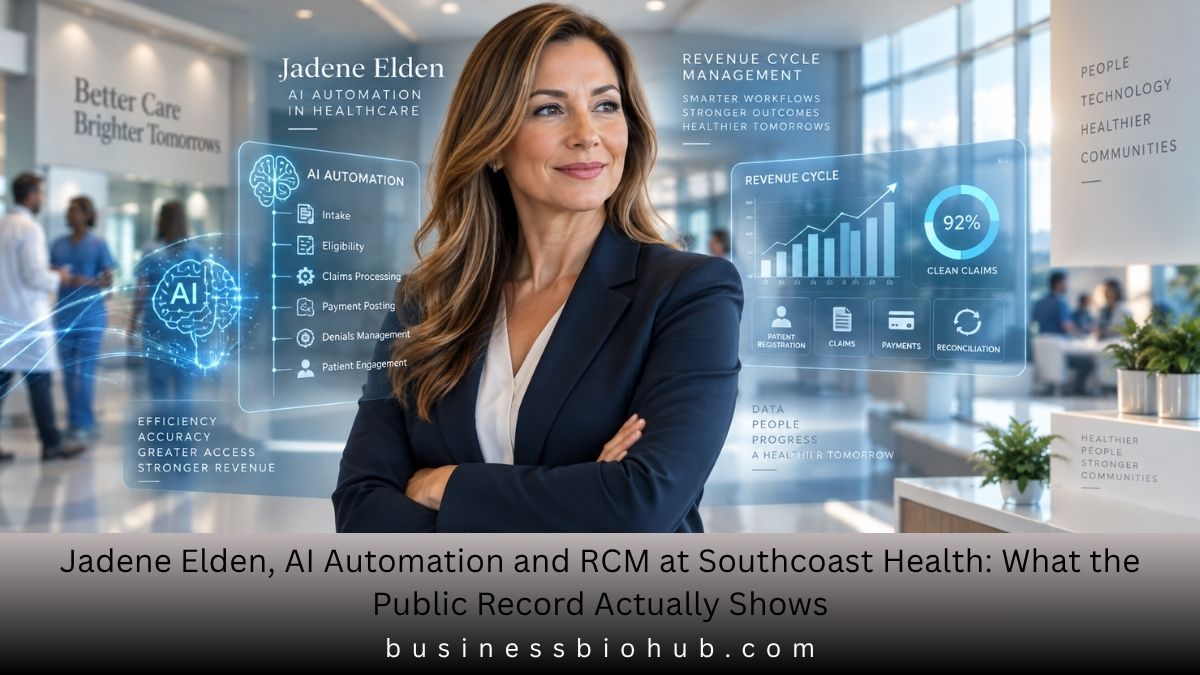
Healthcare revenue cycle management is becoming one of the most closely watched areas for artificial intelligence. Claims errors, authorization requirements, denials, patient billing and labor-intensive follow-up can directly affect a hospital system’s cash flow. Against that backdrop, searches linking Jadene Elden, AI automation, RCM and Southcoast Health raise a timely question: is there a documented AI transformation program behind those terms?
There is real evidence of change. Southcoast Health identifies Jadene Elden as Vice President of Revenue Cycle. The organization has documented Digital Self-Pay work, rolled out MyChart paperless billing, redesigned patient billing statements and, most significantly, stated in its 2026 Notice of Privacy Practices that generative AI may be used to help it obtain payment for services.
But one important claim remains unproven: no authoritative source located for this review publicly identifies a specifically named “Jadene Elden AI automation RCM program” or states that Elden personally directs a particular generative-AI platform for claims, billing or denials.
BLUF: Jadene Elden is definitively documented as Southcoast Health’s Vice President of Revenue Cycle, while Southcoast definitively acknowledges generative AI use that may support payment activities. However, the public record does not establish that Elden personally leads a named AI-automation RCM initiative or identify the specific AI technology used in revenue-cycle workflows.
Jadene Elden’s Role Is Clear—And It Sits at the Center of Revenue Operations
Southcoast Health’s current Patient and Family Advisory Council page lists Jadene Elden as VP Revenue Cycle among its staff advisors. The organization operates a Massachusetts health system that includes Charlton Memorial Hospital, St. Luke’s Hospital and Tobey Hospital, along with other Southcoast entities.
Revenue cycle leadership typically intersects with the processes that move a healthcare organization from patient registration through reimbursement: eligibility, billing, claim submission, payment, denial follow-up, patient balances and collections.
Elden’s own public industry participation provides a more specific picture of her priorities.
In January 2024, she joined revenue-cycle leaders from Care New England and UMass Memorial Health Care for a discussion focused on denials management, efficiency, denial prevention, cash performance and workforce retention.
Her comments to Knowtion Health also described a broad revenue-cycle operating model in which team members receive exposure to claim edits, billing, follow-up and denial management. She emphasized employee engagement, process feedback and giving staff opportunities to identify operational improvements.
That evidence matters because it establishes Elden as a genuine operational revenue-cycle leader rather than someone whose name has merely become associated with RCM through search-engine repetition.
Digital Self-Pay Provides the First Strong Link to Revenue-Cycle Modernization
One of the strongest pieces of primary evidence appears in Southcoast Health’s FY2024 Patient and Family Advisory Council report.
The report states that the Vice President of Revenue Cycle requested PFAC participation in a Digital Self-Pay workgroup, including feedback on communicating upcoming changes to patients.
That is significant.
Digital self-pay can affect patient balances, billing communications, digital statements, account management and payment collection—the patient-facing portion of revenue-cycle operations.
What the report does not say is equally important. It does not identify:
- an AI vendor;
- a large language model;
- robotic process automation software;
- autonomous billing agents;
- machine-learning denial prediction;
- generative-AI appeals;
- automated coding software.
Calling that specific workgroup an AI project would therefore go beyond the available evidence.
The accurate description is digital revenue-cycle modernization.
From Digital Self-Pay to MyChart Paperless Billing
Southcoast’s modernization became more visible in 2025.
The health system says that beginning May 1, 2025, MyChart became its platform for paperless billing, account notifications and digital payments. Patients can also use the system to make secure payments and establish interest-free payment plans.
Southcoast’s 2025 PFAC annual report reinforces this development. Under “Revenue Cycle Engagement,” it identifies the creation of the MyChart Paperless Billing Process as a key accomplishment and says PFAC supported its rollout. The report also documents work redesigning patient billing statements to make bills clearer and easier to understand.
That creates a traceable modernization sequence rather than a speculative AI narrative.
| Period | Verified development | What it establishes |
|---|---|---|
| January 2024 | Elden participates in denials-management discussion | Active leadership around RCM performance and denials |
| FY2024 | VP Revenue Cycle involves PFAC in Digital Self-Pay workgroup | Direct evidence of revenue-cycle digitization |
| May 1, 2025 | MyChart paperless billing and digital payments implemented | Patient financial workflows become more digital |
| 2025 PFAC reporting | Paperless billing rollout and billing-statement redesign documented | Revenue Cycle modernization continued |
| February 1, 2026 | Southcoast privacy notice acknowledges generative AI use that may support payment | Direct institutional evidence connecting AI and payment |
| Current public listing | Elden remains listed as VP Revenue Cycle | Her executive RCM role remains publicly documented |
The 2026 AI Disclosure Changes the Evidence Picture
The most consequential evidence arrives in Southcoast Health’s Notice of Privacy Practices, effective February 1, 2026.
Southcoast states that it may use generative AI tools and programs to assist with delivering care, obtaining payment for services and operating its business. It also says AI is used as an assistive technology rather than as a clinical or other decision-maker.
This establishes something that earlier digital-billing evidence alone could not establish:
Southcoast Health does publicly acknowledge that generative AI can be used in functions involving payment.
Payment is unquestionably connected with revenue-cycle management.
Yet the disclosure is organizational, not executive-specific. It does not say:
Jadene Elden implemented or leads the generative-AI payment program.
Nor does it identify which payment tasks use AI.
Possible healthcare use cases could theoretically include document handling, claim analysis, correspondence drafting, payment inquiries, workflow triage or administrative summarization—but attributing any of those specific functions to Southcoast without documentation would be speculation.
Southcoast Had AI Experience Long Before the Current RCM Debate
Southcoast Health’s use of artificial intelligence did not begin with its 2026 privacy disclosure.
The system previously worked with Loyal on Guide, an AI-driven conversational platform. Southcoast branded its chatbot SAM, originally using the technology to help website visitors find doctors, locations and general information. Loyal later documented online scheduling functionality through the chatbot.
Southcoast’s current website privacy policy still identifies SAM as an example of an AI tool available on the health system’s website.
That history establishes organizational familiarity with AI-enabled automation.
It still should not be conflated with Elden’s revenue-cycle operations. Patient-navigation AI, scheduling automation and revenue-cycle AI are different use cases unless documentation explicitly connects them.
Why AI Automation Is Moving So Quickly Into RCM
The broader industry context explains why searches connecting Elden, Southcoast and AI are increasing.
The 2025 CAQH Index, released in February 2026, reported that U.S. healthcare avoided an estimated $258 billion in administrative costs through electronic transactions and improved data exchange. More than 25% of provider organizations reported using AI tools somewhere in administrative workflows, while CAQH estimated another $21 billion in potential savings remained available through further automation.
Claims management remains a particularly strong pressure point.
Experian Health’s 2025 State of Claims research found that 67% of surveyed providers believed AI could improve claims processing, while only 14% reported actually using AI to reduce denials. Among organizations already using AI, 69% reported reduced denials and/or improved resubmission success.
Experian also reported that 41% of surveyed providers were experiencing denial rates of at least 10%, illustrating why revenue-cycle executives are under pressure to improve both prevention and rework.
For leaders such as Elden, the strategic issue is therefore larger than whether an organization can buy an AI tool. The challenge is deciding where automation adds measurable value without introducing new privacy, accuracy, workflow or governance risks.
The stronger interpretation of the evidence is not that AI replaces Southcoast’s revenue-cycle staff, but that increasingly digital financial workflows create more opportunities for tightly governed automation while human oversight remains central.
Where the Evidence Stops
Search results can easily combine several individually accurate facts into one unsupported narrative.
Here is the distinction that matters most:
| Claim | Evidence status |
|---|---|
| Jadene Elden works in senior revenue-cycle leadership at Southcoast Health | Confirmed |
| Elden has publicly discussed denials, claims workflows and process improvement | Confirmed |
| Southcoast operated a Revenue Cycle-linked Digital Self-Pay initiative | Confirmed |
| Southcoast moved to MyChart paperless billing and digital payments | Confirmed |
| Southcoast has used AI-enabled patient-facing technology | Confirmed |
| Southcoast says generative AI may assist with obtaining payment | Confirmed |
| Digital Self-Pay is definitively powered by AI | Not established |
| MyChart paperless billing is definitively an AI system | Not established |
| Jadene Elden personally leads a named AI-automation RCM project | Not established |
| A specific AI vendor manages Southcoast’s denials or claims under Elden | Not established |
That distinction is essential for accurate reporting.
FAQs
Who is Jadene Elden at Southcoast Health?
Jadene Elden is Vice President of Revenue Cycle at Southcoast Health according to Southcoast’s current Patient and Family Advisory Council listing. Her publicly documented work includes revenue-cycle operations, denials management, claim edits, billing, follow-up, process improvement and workforce development.
Is Jadene Elden leading an AI automation RCM program?
A specific Elden-led AI RCM program is not publicly confirmed by the authoritative sources reviewed. Southcoast acknowledges generative AI use that may help obtain payment, and Elden leads Revenue Cycle, but those two facts do not by themselves prove she personally directs a named AI initiative.
Does Southcoast Health use AI in payment operations?
Southcoast Health states that it may use generative AI tools and programs to help obtain payment for its services, in addition to assisting with care delivery and business operations. The organization says AI serves an assistive role and is not used as a clinical or other decision-maker.
What is Digital Self-Pay at Southcoast Health?
Digital Self-Pay is a documented Southcoast revenue-cycle initiative involving patient financial processes. Its FY2024 PFAC report states that the Vice President of Revenue Cycle requested patient-advisor involvement in the Digital Self-Pay workgroup and feedback on communicating upcoming changes. The source does not identify the project as AI-powered.
How has Southcoast modernized patient billing?
Southcoast moved to MyChart paperless billing, digital account notifications and digital payments beginning May 1, 2025. Its 2025 PFAC report also documents patient-billing-statement redesign and PFAC participation in the paperless-billing rollout, demonstrating a broader push toward digital patient financial engagement.
Why does AI matter so much in healthcare RCM?
AI matters in RCM because claims processing, denial prevention, prior authorization, billing and payment workflows contain large volumes of repetitive administrative work. CAQH reported that more than 25% of provider organizations were using AI in administrative workflows in 2025, while substantial additional savings opportunities remain through automation.
What the Evidence Says Now
The public record around Jadene Elden, AI automation, RCM and Southcoast Health is more substantial than a simple rumor—but more limited than the strongest version of the search phrase suggests.
Elden is clearly a senior Southcoast revenue-cycle executive. Her public commentary establishes direct involvement with denials management, claims workflows and operational improvement. Southcoast has also moved patient financial processes toward Digital Self-Pay, MyChart paperless billing and digital payments.
Most importantly, Southcoast’s 2026 privacy notice now explicitly acknowledges generative AI use that may support payment activities.
That is meaningful evidence that AI and revenue-related administration now coexist inside Southcoast’s broader operating model. What remains absent is authoritative documentation assigning a named AI RCM program, specific platform or particular automated claims function directly to Elden.
Until Southcoast Health, Elden or an identified technology partner publishes that connection, responsible reporting should preserve that boundary.
Editorial Disclaimer
This article distinguishes documented facts from reasonable industry context. Publicly available information can change, and internal Southcoast Health technology deployments may not be publicly disclosed. No claim is made that Jadene Elden personally manages a particular AI platform, vendor relationship or automated RCM program unless an authoritative source explicitly establishes that connection.

Pasonet Explained: Why This Digital Name Is More Complicated Than It First Appears

1upHealth Revenue Cycle Automation Partnerships: What’s Real, What’s Emerging, and Why 2027 Changes the Stakes

Kögel Trailer GmbH Manufacturing or Wholesale? The Business Model Behind the German Trailer Company

Paul Smalley Studied at University: The Education Behind His Global Football Career

Fawn Radmanich Marketing Strategy Experience: Why Her 25-Year A/E/C Career Centers on Winning Complex Work

Emily Seitz Pawlak at TriHealth: The Revenue Cycle Executive Who Pushed Automation Beyond Billing

Jadene Elden, AI Automation and RCM at Southcoast Health: What the Public Record Actually Shows

Tina Esposito Advocate Health Bio: The Data Executive Shaping Analytics, AI and Patient Care

Michael Roe Operating Partner NexPhase: The Verified Record Behind the Name — and the michaelroe.net Question

Briana Biagi Banner Health Fallon NV Staff Directory: What Current Records Actually Show

Astrid Hannah: The Inspiring Story of John Hannah’s Daughter and Her Life Beyond Competitive Swimming

Best Pasticho Venezuelan Lasagna Near Me: A Complete Guide to Finding This Rich Latin Comfort Food
Natasha Podstepny LinkedIn Performant Healthcare Nashville: Inside Her Professional Journey

John Minoli: The Private Life and Career of Sheena Easton’s Fourth Husband

Jeroen Dik: How He Built a Powerful Legacy in Performance Tuning and Motorsport

Lihnk Explained: The Mysterious Search Term, Possible Meanings, and What Users Should Know

Colitre Explained: The Powerful Story Behind a Rare Name and Its Modern Identity

Nigora Whitehorn: The Inspiring Life, Marriage, and Story Behind Duncan Bannatyne’s Wife

Kemberly Blackledge LinkedIn Nashville General Hospital Chief Revenue Officer: How She Built a Powerful Healthcare Finance Career

Elegant Florals Emily Davis Business Description: A Refined Look at Floral Art, Event Design, and Botanical Creativity
Pasonet Explained: Why This Digital Name Is More Complicated Than It First Appears
1upHealth Revenue Cycle Automation Partnerships: What’s Real, What’s Emerging, and Why 2027 Changes the Stakes
Kögel Trailer GmbH Manufacturing or Wholesale? The Business Model Behind the German Trailer Company
Paul Smalley Studied at University: The Education Behind His Global Football Career
Fawn Radmanich Marketing Strategy Experience: Why Her 25-Year A/E/C Career Centers on Winning Complex Work
Emily Seitz Pawlak at TriHealth: The Revenue Cycle Executive Who Pushed Automation Beyond Billing
Jadene Elden, AI Automation and RCM at Southcoast Health: What the Public Record Actually Shows
Tina Esposito Advocate Health Bio: The Data Executive Shaping Analytics, AI and Patient Care
Michael Roe Operating Partner NexPhase: The Verified Record Behind the Name — and the michaelroe.net Question
Briana Biagi Banner Health Fallon NV Staff Directory: What Current Records Actually Show
-
 Celebrity4 months ago
Michael Scott Ryan: The Private Writer Known for His Connection to Jennifer Ehle
-
 Celebrity4 months ago
Daniel Guerard, The Private French Salon Owner Behind Lorraine Bracco’s Early Life Story
-
 Celebrity5 months ago
Caroline Hickman: The Private Life and Public Attention Around Steve Coogan’s Former Wife
-
 Celebrity3 months ago
Benn George, The Private British Businessman Behind a Powerful Chapter in Tiffany Darwish’s Life