
Biographies
Ros Lugg: How She Became a Leading Voice in Literacy, Dyslexia Support and Structured Learning

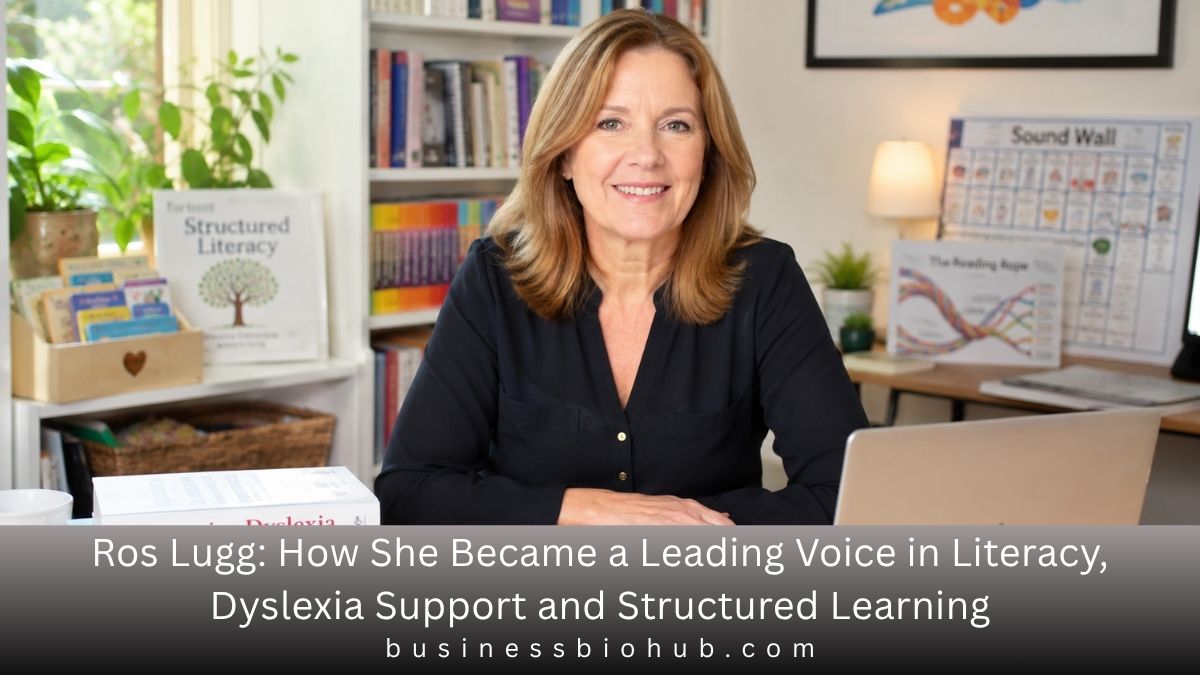
Ros Lugg is an educational specialist whose career has focused on helping children and adults develop stronger literacy, language and learning skills. Known particularly for founding The Learning Staircase and creating StepsWeb, she has built a reputation around structured literacy, dyslexia support and practical teaching methods designed for learners who may struggle in conventional educational settings. Her work reflects a combination of specialist training, classroom experience, educational resource development and a long-term interest in understanding how people learn to read, spell and retain information. Rather than concentrating on a single teaching technique, Ros Lugg has developed resources that bring together phonics, vocabulary, spelling, phonological awareness, memory and other essential components of literacy development.
Her professional journey is especially relevant at a time when schools, parents and educators are paying increasing attention to structured literacy and evidence-informed approaches to reading instruction. Ros Lugg has spent years working with learners who need additional support, particularly those affected by dyslexia and related literacy difficulties. Through software, workbooks, teacher resources and professional advocacy, she has attempted to make specialist literacy teaching more accessible to a wider audience. Her career also highlights an important educational principle: successful literacy development is rarely about a single isolated skill; instead, it depends on a carefully sequenced combination of reading, writing, listening, memory, and language experience.
Who Is Ros Lugg?
Ros Lugg is a UK- and New Zealand-trained educational specialist, literacy teacher and dyslexia assessor who has become closely associated with literacy intervention and structured learning. She is best known as the founder of The Learning Staircase, an education organization that provides resources and support for learners experiencing literacy difficulties. Over time, her work expanded beyond traditional teaching materials into educational technology, leading to the development of StepsWeb, an online literacy and language learning platform.
Her professional identity is strongly connected with specialist literacy teaching. Rather than working only with students who progress easily through standard classroom instruction, much of her career has focused on people who require more individualized, systematic and carefully structured support. These learners may have dyslexia, weak phonological awareness, spelling difficulties, limited reading fluency or gaps in basic literacy foundations. This background has shaped the teaching philosophy behind Ros Lugg’s educational resources, which break complex skills into manageable stages and provide repeated practice until learners gain confidence and automaticity.
Ros Lugg and the Foundation of The Learning Staircase
One of the most important milestones in Ros Lugg’s career was creating The Learning Staircase. The organization was established around the idea that learners who struggle with reading and spelling often need a more carefully sequenced approach than they receive through mainstream instruction alone. Its educational philosophy reflects the belief that literacy skills should be developed progressively, with each new stage building securely on earlier knowledge.
The name itself reflects this concept. Learning can be seen as a staircase, where each step provides the foundation for the next. If learners lack key early skills, they may find later academic demands increasingly difficult. Ros Lugg’s work has therefore emphasized identifying gaps, strengthening foundational knowledge and giving students sufficient practice before moving forward. This approach is particularly important for students with dyslexia or persistent literacy difficulties, because they may need more repetition, explicit instruction and multisensory reinforcement than other learners.
The Learning Staircase also became the foundation for a broader collection of literacy resources. These include teaching materials, workbooks and digital tools designed to support teachers, tutors, parents and learners. Ros Lugg’s involvement in building these resources helped move her work from one-to-one specialist teaching into a model capable of supporting larger numbers of students.
How Ros Lugg Created StepsWeb
Ros Lugg is perhaps best known for creating StepsWeb, an online structured literacy and language program. The platform was developed to provide systematic practice across multiple areas of literacy rather than treating reading, spelling, and vocabulary as completely separate subjects. It supports a broad range of learners, including students who need intervention and those with specific learning difficulties.
StepsWeb uses a progressive structure that allows learners to work through literacy skills in a carefully organized sequence. The program includes activities related to phonics, spelling, vocabulary, phonological awareness, word recognition, and language development. Repetition is an important part of the system because learners with literacy difficulties often require considerably more practice for new information to become automatic.
A major strength of StepsWeb is its ability to combine specialist teaching principles with digital delivery. Traditional literacy intervention can be highly effective, but specialist tuition is not always available to every learner. Online educational tools can increase accessibility by letting students practise independently while still following a structured sequence. For teachers, digital programs can also make it easier to track progress, identify weaknesses and provide targeted reinforcement.
The platform has reportedly been used by hundreds of thousands of learners, demonstrating how Ros Lugg’s original specialist teaching experience developed into an educational system capable of reaching a much broader community.
Her Qualifications and Dyslexia Expertise
Ros Lugg’s work is supported by specialist training in literacy difficulties and dyslexia assessment. She holds the Oxford and Cambridge Diploma in Specific Learning Disability (Dyslexia), a specialist qualification associated with advanced teaching and assessment in this field. This background is significant because dyslexia support requires more than general classroom teaching experience. Educators in this area need to understand how reading difficulties may affect decoding, spelling, phonological processing, memory, and learning efficiency.
Her assessment experience has also likely shaped how her educational resources are structured. A specialist assessor does not simply look at whether a learner can read or spell correctly; they consider patterns of strengths and weaknesses across different cognitive and literacy skills. Understanding these patterns can help educators determine why a student is struggling and what kind of instruction may be most effective.
This specialist perspective is visible in Ros Lugg’s broader educational approach. Instead of expecting learners to improve through repeated exposure alone, her work emphasizes explicit teaching, careful sequencing, and targeted practice. These principles are especially relevant for learners who have previously experienced frustration or failure with literacy.
Ros Lugg’s Contribution to Structured Literacy
Structured literacy has become an increasingly important concept in modern reading education. At its core, it involves teaching literacy skills in a systematic, explicit and cumulative way. Students are not expected to discover complex reading patterns independently. Instead, educators introduce skills directly, provide guided practice and gradually build toward more advanced language knowledge.
Ros Lugg’s work fits naturally within this framework. Her resources emphasize building a secure foundation before progressing to more advanced material. Phonics and phonological awareness are important elements, but her approach also recognizes that successful literacy involves much more than sounding out words. Learners also need strong vocabulary, spelling knowledge, comprehension, fluency and confidence.
This wider perspective is particularly useful because literacy difficulties rarely exist in isolation. A student who struggles to recognize words quickly may also struggle to understand longer passages because so much mental energy goes to decoding. Similarly, weak spelling may affect writing confidence and limit the vocabulary a learner is willing to use. By addressing interconnected skills, structured literacy programs can help students make more balanced, sustainable progress.
Educational Books and Workbook Resources
In addition to digital learning, Ros Lugg has helped create educational workbooks and literacy resources. The StepsWeb Workbook series provides structured activities that can complement digital learning and classroom instruction. These materials focus on important areas such as phonics, vocabulary, spelling and phonological awareness.
Printed resources remain valuable even in an increasingly digital education environment. Writing by hand, completing exercises on paper and physically interacting with learning materials can provide a different type of reinforcement from screen-based activities. For some learners, combining digital programs with traditional written work may offer the strongest educational experience.
Ros Lugg’s involvement in both software and printed learning materials suggests that she does not view technology as a complete replacement for traditional education. Instead, technology can be one component within a broader learning system. Teachers still play a crucial role in explaining concepts, providing feedback, encouraging students, and adapting instruction when learners encounter difficulties.
Why Ros Lugg Emphasizes Handwriting
Another notable aspect of Ros Lugg’s educational advocacy is her support for handwriting as an important learning skill. In an era dominated by laptops, tablets, and smartphones, handwriting is sometimes treated as outdated or secondary. However, Ros Lugg has argued that handwriting still plays an important role in learning, memory, and creativity.
Handwriting requires learners to coordinate physical movement with visual recognition and language processing. When students form letters and words by hand, they engage with written language differently than when they press keys. For younger learners especially, handwriting practice can reinforce letter recognition, spelling patterns, and fine motor development.
Her position also reflects a broader concern within education about balancing technological convenience with foundational learning skills. Digital tools can provide immediate feedback, personalized practice and greater accessibility, but they do not necessarily replace all the benefits of traditional learning methods. Ros Lugg’s work demonstrates an approach in which digital learning and handwriting can complement each other rather than compete.
Supporting Learners With Dyslexia and Literacy Difficulties
Perhaps the most important theme running through Ros Lugg’s career is her commitment to learners who find literacy difficult. Reading and spelling problems can affect far more than academic performance. Students who repeatedly struggle may lose confidence, avoid participating in class, or begin to believe they cannot learn.
Effective literacy intervention can therefore have emotional as well as educational benefits. When students finally understand patterns that previously seemed confusing, they often become more willing to participate and practice. A structured program can also make progress more visible because learners move through defined stages rather than working through disconnected activities.
Ros Lugg’s approach aims to create this sense of progression. Skills are introduced gradually, reinforced regularly and connected with earlier learning. For dyslexic learners, this can reduce the pressure of trying to absorb too much information at once. It also gives teachers and parents a clearer framework for identifying areas where additional support may be needed.
The Wider Impact of Ros Lugg’s Work
The wider significance of Ros Lugg’s career lies in the way she has combined specialist educational knowledge with scalable learning technology. Many experienced literacy specialists can make a profound difference to individual students, but their time is limited. By turning specialist teaching principles into structured resources and digital programs, those methods can reach far more learners.
Her work also reflects broader changes in education. Teachers increasingly use a mixture of classroom instruction, digital platforms, assessment data and individual intervention. Resources such as StepsWeb fit into this blended environment by offering structured practice that can be used alongside direct teaching.
At the same time, Ros Lugg’s continued emphasis on handwriting and traditional learning skills shows that innovation does not necessarily mean abandoning established educational methods. Her overall approach suggests that the strongest learning environment may come from combining effective technology with proven teaching techniques, careful assessment and human support.
What Makes Ros Lugg’s Educational Approach Distinctive?
What distinguishes Ros Lugg is not simply creating an educational program, but the specialist background behind it. Her experience in dyslexia assessment and literacy intervention gives her work a practical foundation. The resources associated with her career were developed around real learning challenges students face, rather than introducing technology for its own sake.
Another important feature is the emphasis on progression. Learners are encouraged to build skills step by step, strengthening foundational knowledge before moving toward more complex literacy demands. This method can be particularly valuable for students with gaps in their education or who need more repetition than standard classroom programs provide.
Her career also demonstrates that literacy education is multidimensional. Reading, spelling, vocabulary, handwriting, memory, and phonological awareness all contribute to a learner’s ability to communicate effectively. Treating these elements as connected parts of a larger system is central to Ros Lugg’s work.
Conclusion
Ros Lugg has established a meaningful career in literacy education through her work as a specialist teacher, dyslexia assessor, educational resource developer and creator of StepsWeb. By founding The Learning Staircase and developing structured learning materials, she has helped bring specialist literacy techniques to teachers, parents and learners beyond the traditional one-to-one tutoring environment.
Her contribution is particularly important for students who need additional support with reading, spelling and language development. Through systematic teaching, repeated practice and carefully sequenced learning, her resources aim to make literacy more manageable and achievable. At the same time, her support for handwriting demonstrates her belief that effective education should preserve valuable traditional skills while also embracing useful technology.
Ultimately, Ros Lugg’s professional story is closely connected with a simple but powerful educational goal: helping learners build the foundations they need to become more confident readers, writers and communicators. Her combination of structured literacy, dyslexia expertise, educational technology and practical teaching experience has made her a notable figure within specialist literacy education.

Telehealth Psychiatric & Mental Health Care: Accessible Support for a Healthier Mind

West Palm Beach Detox: A Safe and Supportive Start to Lasting Recovery

Drug & Alcohol Rehab in West Palm Beach, FL: Start Your Journey to a Healthier Life

Drug & Alcohol Detox in South Carolina: A Complete Guide to Safe Recovery

Drug and Alcohol Detox Kentucky: Your Guide to Safe Recovery at Paducah Detox Center

Addiction Treatment in Plymouth: Understanding Addiction & Mental Health Treatment

Ohio Center for Adolescent Wellness: Your Guide to Teen Mental Health Services in Ohio

Massachusetts Center for Adolescent Wellness: Your Guide to Teen Mental Health & Addiction Treatment in MA

Foundation Diploma Singapore: A Practical Route Towards Higher Education

How to Stay Safe and Private While Using Public Wi-Fi

Paul Smalley Studied at University: The Education Behind His Global Football Career

Billie Henry: Inside the Private Life Dawn French Fought to Keep Out of the Spotlight

Tina Esposito Advocate Health Bio: The Data Executive Shaping Analytics, AI and Patient Care

Kögel Trailer GmbH Manufacturing or Wholesale? The Business Model Behind the German Trailer Company

Pasonet Explained: Why This Digital Name Is More Complicated Than It First Appears

1upHealth Revenue Cycle Automation Partnerships: What’s Real, What’s Emerging, and Why 2027 Changes the Stakes

Industrial Entrepreneurs Memorandum: The 2026 IEM Rules Every Large Manufacturer Should Understand

Thompson Heath and Bond: What Happened to the London Insurance Broker and Where the Name Exists Today

BioCote Company Size, Employees, Growth and Industry: Inside the Specialist Antimicrobial Business Behind Global Product Protection

EliseAI Head of Partnerships 2024–2026: The Leadership Shift Behind Its Expanding AI Partner Network
Telehealth Psychiatric & Mental Health Care: Accessible Support for a Healthier Mind
West Palm Beach Detox: A Safe and Supportive Start to Lasting Recovery
Drug & Alcohol Rehab in West Palm Beach, FL: Start Your Journey to a Healthier Life
Drug & Alcohol Detox in South Carolina: A Complete Guide to Safe Recovery
Drug and Alcohol Detox Kentucky: Your Guide to Safe Recovery at Paducah Detox Center
Addiction Treatment in Plymouth: Understanding Addiction & Mental Health Treatment
Ohio Center for Adolescent Wellness: Your Guide to Teen Mental Health Services in Ohio
Massachusetts Center for Adolescent Wellness: Your Guide to Teen Mental Health & Addiction Treatment in MA
Foundation Diploma Singapore: A Practical Route Towards Higher Education
How to Stay Safe and Private While Using Public Wi-Fi
-
 Celebrity4 months ago
Michael Scott Ryan: The Private Writer Known for His Connection to Jennifer Ehle
-
 Celebrity4 months ago
Benn George, The Private British Businessman Behind a Powerful Chapter in Tiffany Darwish’s Life
-
 Celebrity5 months ago
Daniel Guerard, The Private French Salon Owner Behind Lorraine Bracco’s Early Life Story
-
 Celebrity6 months ago
Caroline Hickman: The Private Life and Public Attention Around Steve Coogan’s Former Wife