
Technology
1upHealth Revenue Cycle Automation Partnerships: What’s Real, What’s Emerging, and Why 2027 Changes the Stakes

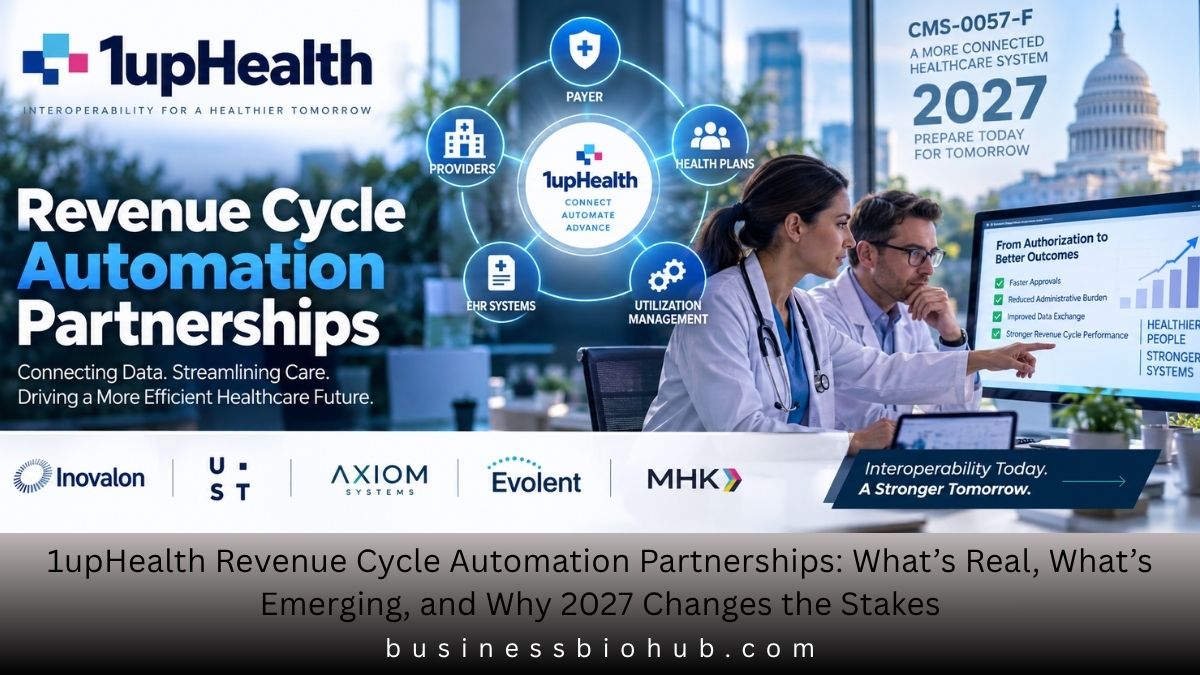
Healthcare organizations are entering a decisive implementation window. CMS-0057-F is pushing impacted payers toward standardized FHIR APIs, electronic prior authorization, payer-to-payer exchange and provider access, with major API requirements generally taking effect on January 1, 2027. That makes automation infrastructure a near-term operational priority rather than a long-range IT project.
1upHealth has positioned itself directly inside that shift. The Boston-based health-data interoperability company has expanded its payer platform, launched electronic prior authorization capabilities, created a formal partner program and connected with utilization-management systems that can automate previously fragmented workflows. Most recently, Inovalon, UST and AXIOM Systems joined its partner ecosystem in August 2026.
The important distinction is terminology. 1upHealth is not currently presenting itself as a conventional end-to-end revenue cycle management vendor handling coding, billing, patient collections and accounts receivable. Its publicly documented automation strategy is concentrated around interoperability, clinical-data acquisition, electronic prior authorization and payer administrative workflows—functions that can nevertheless have significant downstream revenue-cycle consequences.
BLUF: 1upHealth’s partnership strategy is definitively centered on automating payer interoperability and prior authorization rather than replacing a full revenue cycle management system. Its growing connections with Inovalon, UST, AXIOM Systems, Evolent, MHK and other healthcare platforms can reduce administrative friction upstream of claims and reimbursement.
Why “Revenue Cycle Automation” Needs a More Precise Definition Here
Revenue cycle management usually covers a broad financial chain: patient registration, eligibility, authorization, coding, claim creation, claim submission, payment posting, denial management and collections.
1upHealth operates mainly in a different—but increasingly connected—layer.
Its 1up Platform is designed to acquire, standardize, manage and exchange clinical and claims data. 1upHealth says the platform can replace one-off integrations and manual processes with scalable infrastructure, while its individual products support prior authorization, payer-to-payer exchange, provider access, patient access, provider directories and other interoperability functions.
That matters to revenue-cycle teams because authorization and reimbursement are closely connected. A fragmented prior-authorization process can introduce administrative delays before a claim is ever created. Missing information, incorrect routing or authorization uncertainty can also add work later in the payment process.
1upHealth therefore sits upstream of significant revenue-cycle activity, even though its current public product catalog should not be confused with a comprehensive RCM suite.
This distinction is particularly important for organizations researching the phrase “1upHealth revenue cycle automation partnerships.” Publicly available company materials currently provide much stronger evidence for interoperability and prior-authorization automation partnerships than for a standalone RCM partnership program.
The Partnership Grid: Who Connects to What
| Organization | Publicly documented relationship | Relevant capability | Potential operational effect |
|---|---|---|---|
| Inovalon | Joined 1up Partner Program in 2026 | Payer data, healthcare solutions and CMS-0057 interoperability | Faster deployment of payer interoperability infrastructure |
| UST | Joined 1up Partner Program in 2026 | AI and technology transformation | Implementation and transformation support around payer data workflows |
| AXIOM Systems | Joined 1up Partner Program in 2026 | Healthcare IT solutions | Integration and implementation support |
| Evolent | Connectivity established with 1up electronic PA network | Utilization management | Automated routing of prior-authorization requests |
| MHK | Connectivity established with 1up electronic PA network | Utilization management | Reduced need for manual UM routing |
| Cohere Health | Integration announced with 1upHealth in 2025 | UM transformation | Electronic prior-authorization connectivity |
| Itiliti Health | Integration announced in 2025 | Prior-authorization technology | PA workflow connectivity |
| Epic | EHR integration identified by 1upHealth | Provider/EHR workflow | Electronic exchange with provider systems |
| Meditech | EHR integration identified by 1upHealth | Provider/EHR workflow | Electronic exchange supporting PA processes |
Inovalon, UST and AXIOM Systems were announced as new members of the formal 1up Partner Program on August 20, 2026. 1upHealth says the program lets members extend its interoperability and CMS-compliance capabilities to payer clients without independently building the underlying infrastructure.
The second group is operationally different. In August 2026, 1upHealth reported established connectivity with major utilization-management vendors including Evolent and MHK. The company said it was targeting more than 30 UM vendors on the 1up Network by the end of 2026.
Earlier, when its electronic prior-authorization solution was announced in May 2025, 1upHealth identified integrations involving Epic, Meditech, Cohere Health and Itiliti Health.
Those distinctions matter: membership in the formal partner program, technical connectivity and product integration are related concepts, but they should not automatically be treated as identical commercial arrangements.
The Automation Engine Is Prior Authorization, Not Billing
Prior authorization is where the link between interoperability automation and revenue operations becomes clearest.
1upHealth’s electronic prior-authorization architecture is intended to provide a centralized integration point between providers, payers and the multiple utilization-management systems a health plan may use. The platform can route an incoming authorization request according to configurable rules and deliver it to the appropriate UM environment.
That replaces a workflow that can otherwise involve portal logins, phone calls, manual routing and repeated follow-up.
The financial case for eliminating those manual steps is substantial. The 2024 CAQH Index estimated a $515 million annual industry savings opportunity from adoption of the electronic prior-authorization standard and estimated that medical providers and staff could save roughly 14 minutes per authorization.
Why Revenue Teams Should Pay Attention
The connection to revenue cycle performance is indirect but meaningful.
Electronic authorization can improve the quality and speed of information available before care is delivered. It can reduce manual intake, make authorization status easier to track and create a standardized mechanism for approvals, denials and requests for additional information.
Those improvements do not automatically guarantee payment, prevent every denial or replace claims-management systems. They do, however, attack one of the administrative bottlenecks that can create avoidable friction between care delivery and reimbursement.
That distinction keeps the business case credible: 1upHealth can contribute to revenue-cycle efficiency without being an end-to-end revenue-cycle vendor.
CMS-0057-F Is Accelerating the Partner Model
The regulatory timetable explains why 1upHealth is expanding its network now.
CMS-0057-F requires impacted payers to implement new or enhanced FHIR-based capabilities including Provider Access, Payer-to-Payer Data Exchange and Prior Authorization APIs. Operational requirements began taking effect in 2026, while major API implementation requirements generally arrive January 1, 2027.
For prior authorization specifically, CMS requires the API to support information about whether authorization is necessary, required documentation and electronic request-and-response workflows. The payer’s response can approve the request, deny it with a specific reason or request additional information.
For impacted payers other than the specified exception for QHP issuers on federally facilitated exchanges, CMS also sets maximum response periods of 72 hours for expedited requests and seven calendar days for standard requests, subject to the patient’s medical needs and other applicable requirements.
One vendor rarely controls every component necessary to execute this workflow. Health plans may use multiple EHRs, policy engines, UM platforms and delegated decision-making systems.
That fragmentation explains 1upHealth’s network strategy.
Instead of attempting to become every system involved in prior authorization, the company is positioning its platform as an orchestration and interoperability layer connecting them.
From One-Off Integrations to a Network Effect
The strategic idea becomes more interesting when each new connection can potentially be reused.
In August 2026, 1upHealth described its prior-authorization model as a network rather than a sequence of payer-specific integrations. Its stated approach is essentially to build connectivity to a UM vendor once and make that connection usable across health plans operating on its platform.
That model attacks one of healthcare IT’s persistent cost problems: repeated bespoke integration.
The wider 1up Partner Program follows a similar principle. 1upHealth currently supports white-label, reseller, referral and strategic/OEM arrangements, allowing outside companies to combine their customer relationships or specialized capabilities with 1upHealth’s interoperability infrastructure. The company says partners can move from discovery through pilot deployment within an approximately eight-week implementation journey.
Inovalon is especially notable because 1upHealth has described the collaboration around CMS-0057, with Inovalon selecting 1upHealth as a preferred interoperability provider for relevant health-plan implementations.
This is less about selling another isolated API and more about becoming infrastructure underneath other healthcare products and services.
A 2025–2026 Timeline of the Expansion
May 29, 2025 — Electronic Prior Authorization Takes Shape
1upHealth formally launched its prior-authorization solution and said it was developing strategic relationships with utilization-management and PA-policy vendors. The announcement identified connectivity involving Epic, Meditech, Cohere Health and Itiliti Health.
July 9, 2025 — Orchestration Becomes the Strategy
The company publicly detailed its approach of sitting between providers and payers as a standards-based orchestration layer rather than attempting to own every component of authorization decision-making.
2025 — The 1up Partner Program Launches
The formal partner program was established to let consulting, technology and services organizations deliver 1upHealth interoperability capabilities alongside their own client offerings.
August 19, 2026 — Evolent and MHK Connectivity Is Disclosed
1upHealth announced that connectivity had been established with Evolent, MHK and other utilization-management vendors, alongside a stated goal of exceeding 30 UM vendors in its network by year-end.
August 20, 2026 — Inovalon, UST and AXIOM Systems Join
The three organizations became publicly announced additions to the formal partner ecosystem as CMS-0057 implementation pressure intensified.
September 1, 2026 — Automation Expands Into Clinical Data Acquisition
1upHealth launched 1up Clinical Connect, designed to continuously acquire clinical data from provider EHRs and combine it with claims information into longitudinal member records. Capital Health Plan was announced as the inaugural user.
This latest move shows that the automation thesis extends beyond prior authorization into continuous acquisition and activation of clinical information for quality, risk and care-management operations.
What 1upHealth Still Does Not Replace
The excitement around administrative automation should not erase product boundaries.
As of September 12, 2026, 1upHealth’s current public platform and partner materials emphasize interoperability, prior authorization, patient and provider access, payer-to-payer exchange, clinical-data acquisition, provider directories and formulary capabilities. They do not present a dedicated full-stack revenue-cycle suite covering every major provider billing function.
A hospital or physician group researching RCM automation would therefore still need to evaluate separate capabilities for areas such as:
- Medical coding
- Charge capture
- Claims scrubbing
- Accounts receivable
- Payment posting
- Patient billing and collections
- Comprehensive denial-management operations
1upHealth becomes relevant where those financial workflows depend on payer connectivity, authorization data, clinical information or standardized exchange.
That is arguably a more defensible role than stretching the term “revenue cycle automation” until it describes every healthcare administrative technology.
Why the Stakes Extend Beyond Administrative Savings
Prior authorization is not solely a financial issue.
The American Medical Association’s 2024 survey found that 93% of physicians reported prior authorization delays in necessary care and 29% reported that it had resulted in a serious adverse event for a patient in their care. More recent AMA reporting in 2026 continued to find widespread concern about delays and adverse effects, although individual percentages changed between survey years.
Automation therefore has two separate tests.
The first is whether it eliminates unnecessary administrative work.
The second is whether it preserves appropriate clinical oversight while making decisions and information move faster.
1upHealth has stated that its platform transports PA information rather than becoming the final clinical decision-maker. In its 2025 electronic-prior-authorization Q&A, the company explained that denial decisions originate from the appropriate UM system or delegated decision-making entity, while 1upHealth facilitates the exchange and formatting of that information.
That boundary will become increasingly important as healthcare organizations add AI-driven clinical review and automated policy tools.
The Real Opportunity Is Upstream of the Claim
The most accurate interpretation of 1upHealth revenue cycle automation partnerships is not that 1upHealth suddenly became a conventional billing company.
Something more structural is happening.
Prior authorization, payer-provider exchange and clinical-data acquisition are being converted from isolated manual processes into API-driven infrastructure. As 1upHealth connects more EHRs, utilization-management vendors, consultants and healthcare technology companies, a health plan can potentially automate a larger portion of the work that happens before reimbursement problems surface downstream.
The January 1, 2027 CMS-0057 API deadline gives that strategy immediate commercial relevance. But the longer-term question is bigger than compliance: whether reusable interoperability networks can finally replace healthcare’s expensive cycle of custom connections, manual routing and fragmented information exchange.
For revenue-cycle leaders, that means 1upHealth should be evaluated neither as a complete RCM replacement nor dismissed as merely a compliance API vendor. Its strongest role is becoming the data and workflow infrastructure connecting financial, administrative and clinical processes that historically struggled to communicate.
FAQs
Does 1upHealth provide revenue cycle automation?
1upHealth provides healthcare administrative and interoperability automation, but it is not currently marketed as a complete end-to-end RCM platform. Its documented products automate areas such as electronic prior authorization, clinical-data acquisition and payer data exchange, which can influence reimbursement operations upstream without replacing billing, coding, collections or complete denial-management systems.
Which companies are currently partnered with 1upHealth?
1upHealth’s publicly documented ecosystem includes several types of relationships. Inovalon, UST and AXIOM Systems joined the formal Partner Program in 2026. The company’s electronic prior-authorization network also has documented connectivity with Evolent and MHK, while earlier integrations included Cohere Health, Itiliti Health, Epic and Meditech.
How does 1upHealth automate prior authorization?
1upHealth automates prior authorization through FHIR-based APIs and workflow orchestration. An incoming request can be routed to the appropriate utilization-management system according to payer configuration, after which authorization status or decisions can flow back through the standardized infrastructure. The approach is designed to replace manual routing and fragmented point-to-point integrations.
What does CMS-0057-F have to do with 1upHealth?
CMS-0057-F is a major regulatory driver for 1upHealth’s payer interoperability business. The rule requires impacted payers to implement multiple FHIR-based APIs and modernize prior authorization, with key API compliance requirements generally taking effect January 1, 2027. 1upHealth has built products and partnerships specifically around those requirements.
Can 1upHealth reduce healthcare denials?
1upHealth can potentially reduce avoidable administrative friction associated with authorization, but it should not be claimed that the platform eliminates denials. Better routing, standardized documentation and faster data exchange may address causes of preventable workflow failures, while clinical and coverage decisions remain with payers and their delegated decision-making systems.
Why is the 1upHealth partner network important for health plans?
The 1upHealth partner network is designed to reduce repeated integration work. Instead of every payer independently creating custom connections to every healthcare system, 1upHealth is developing reusable interoperability infrastructure across EHR, UM and technology partners. That approach can shorten implementation effort while helping plans prepare for CMS-0057 requirements.
Editorial Disclaimer
This article reflects publicly accessible information verified through September 12, 2026. Partnership status, integrations, product capabilities and regulatory implementation details can change. References to potential operational or revenue-cycle benefits describe documented capabilities or reasonable workflow implications and should not be interpreted as guaranteed financial savings, reimbursement outcomes or contractual terms.

Pasonet Explained: Why This Digital Name Is More Complicated Than It First Appears

1upHealth Revenue Cycle Automation Partnerships: What’s Real, What’s Emerging, and Why 2027 Changes the Stakes

Kögel Trailer GmbH Manufacturing or Wholesale? The Business Model Behind the German Trailer Company

Paul Smalley Studied at University: The Education Behind His Global Football Career

Fawn Radmanich Marketing Strategy Experience: Why Her 25-Year A/E/C Career Centers on Winning Complex Work

Emily Seitz Pawlak at TriHealth: The Revenue Cycle Executive Who Pushed Automation Beyond Billing

Jadene Elden, AI Automation and RCM at Southcoast Health: What the Public Record Actually Shows

Tina Esposito Advocate Health Bio: The Data Executive Shaping Analytics, AI and Patient Care

Michael Roe Operating Partner NexPhase: The Verified Record Behind the Name — and the michaelroe.net Question

Briana Biagi Banner Health Fallon NV Staff Directory: What Current Records Actually Show

Astrid Hannah: The Inspiring Story of John Hannah’s Daughter and Her Life Beyond Competitive Swimming

Best Pasticho Venezuelan Lasagna Near Me: A Complete Guide to Finding This Rich Latin Comfort Food
Natasha Podstepny LinkedIn Performant Healthcare Nashville: Inside Her Professional Journey

John Minoli: The Private Life and Career of Sheena Easton’s Fourth Husband

Jeroen Dik: How He Built a Powerful Legacy in Performance Tuning and Motorsport
Lihnk Explained: The Mysterious Search Term, Possible Meanings, and What Users Should Know

Colitre Explained: The Powerful Story Behind a Rare Name and Its Modern Identity

Nigora Whitehorn: The Inspiring Life, Marriage, and Story Behind Duncan Bannatyne’s Wife

Kemberly Blackledge LinkedIn Nashville General Hospital Chief Revenue Officer: How She Built a Powerful Healthcare Finance Career

Elegant Florals Emily Davis Business Description: A Refined Look at Floral Art, Event Design, and Botanical Creativity
Pasonet Explained: Why This Digital Name Is More Complicated Than It First Appears
1upHealth Revenue Cycle Automation Partnerships: What’s Real, What’s Emerging, and Why 2027 Changes the Stakes
Kögel Trailer GmbH Manufacturing or Wholesale? The Business Model Behind the German Trailer Company
Paul Smalley Studied at University: The Education Behind His Global Football Career
Fawn Radmanich Marketing Strategy Experience: Why Her 25-Year A/E/C Career Centers on Winning Complex Work
Emily Seitz Pawlak at TriHealth: The Revenue Cycle Executive Who Pushed Automation Beyond Billing
Jadene Elden, AI Automation and RCM at Southcoast Health: What the Public Record Actually Shows
Tina Esposito Advocate Health Bio: The Data Executive Shaping Analytics, AI and Patient Care
Michael Roe Operating Partner NexPhase: The Verified Record Behind the Name — and the michaelroe.net Question
Briana Biagi Banner Health Fallon NV Staff Directory: What Current Records Actually Show
-
 Celebrity4 months ago
Michael Scott Ryan: The Private Writer Known for His Connection to Jennifer Ehle
-
 Celebrity4 months ago
Daniel Guerard, The Private French Salon Owner Behind Lorraine Bracco’s Early Life Story
-
 Celebrity5 months ago
Caroline Hickman: The Private Life and Public Attention Around Steve Coogan’s Former Wife
-
 Celebrity3 months ago
Benn George, The Private British Businessman Behind a Powerful Chapter in Tiffany Darwish’s Life