
News
Sopra Steria Lawsuit Against DWP: Inside the £370 Million Synergy Contract Challenge

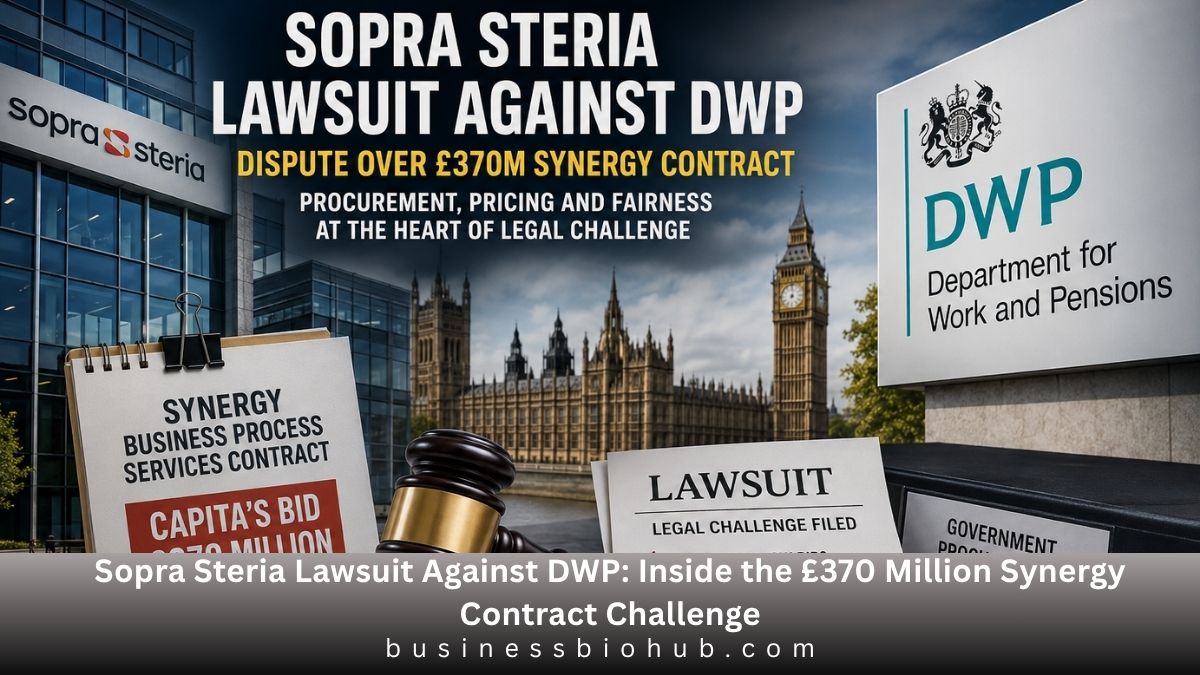
The dispute over one of Whitehall’s largest shared-services procurements has moved beyond a commercial disagreement, raising questions about unusually low bids, government cost modeling, procurement fairness and the future of critical HR and payroll services.
The Sopra Steria lawsuit against the Department for Work and Pensions (DWP) is a procurement challenge arising from the government’s decision to award the Synergy Business Process Services contract to Capita. Sopra Steria, whose subsidiary SSCL already provides significant shared services to the government, alleges that Capita’s winning proposal was abnormally low and that aspects of the procurement process breached public contracting rules. DWP and Capita reject the allegations.
As of 1 September 2026, no court has ruled that the DWP acted unlawfully. The case is heading toward a seven-week trial in the Technology and Construction Court, beginning on 17 January 2028, while alternative dispute resolution efforts continue.
What the Sopra Steria–DWP lawsuit is actually about
The dispute centres on the Synergy Business Process Services (BPS) program.
DWP led the procurement on behalf of four major government departments:
- Department for Work and Pensions
- Ministry of Justice
- Home Office
- Department for Environment, Food and Rural Affairs
The future supplier is expected to support functions including HR, payroll, recruitment, finance, procurement, and service desk operations. The original September 2024 tender anticipated a contract lasting up to ten years and estimated its total value at £958.7 million excluding VAT. The procurement used a competitive procedure with negotiation under the Public Contracts Regulations 2015.
Capita announced in March 2026 that it had been selected. The company described the contract as worth £370 million over ten years, including extension periods, while making clear that this IFRS 15 transaction price excluded additional change and expansion services that might arise later.
That pricing difference became central to Sopra Steria’s challenge.
Why the £370 million figure attracted scrutiny
Sopra Steria alleges that Capita’s tender was “abnormally low.”
Court filings reported by The Register indicate that DWP had developed a Should Cost Model of approximately £642 million. Sopra Steria argues that Capita’s £370 million proposal was around 42% below that model and was based on staffing substantially below existing levels.
The percentage matters because government procurement guidance exists specifically to prevent a simple preference for exceptionally low proposals.
Regulation 69 of the Public Contracts Regulations 2015 requires contracting authorities to seek an explanation when a tender appears abnormally low for the services being purchased.
Government’s Sourcing Playbook goes further for complex outsourcing projects. It states that bids more than 10% below either the average bid or the Should Cost Model estimate should be referred for central commercial scrutiny. The Should Cost Model helps protect the government against low-cost bid bias.
None of this automatically establishes that Capita’s bid was legally defective.
A supplier can legitimately produce a materially cheaper solution through automation, different staffing structures, technology, economies of scale or accepting different commercial risks. The legal issue is therefore not simply whether £370 million looks unusually low. The harder question is whether DWP investigated the pricing properly and treated competing bidders consistently before making its decision.
Sopra Steria also challenges what happened after the bidding.
The price dispute is only part of the case.
Sopra Steria has also alleged that after Capita became the preferred bidder, DWP entered into further discussions or renegotiations related to Capita’s proposal. At the same time, Sopra Steria did not receive an equivalent opportunity.
According to reported court filings, Sopra Steria claims this became particularly significant when changes were being considered elsewhere within the Synergy program, including alterations to implementation and go-live arrangements.
DWP denies breaching procurement rules. Capita has likewise maintained that it participated in a robust competitive process.
The eventual court inquiry is therefore likely to examine process rather than price alone: what was clarified, when it was clarified, whether changes were material and whether both bidders were treated fairly.
The confidential “Comparison Document” complicates the dispute.
One of the most unusual elements emerged from a document DWP says was accidentally made accessible to people working for Shared Services Connected Limited (SSCL), Sopra Steria’s subsidiary.
DWP acknowledges that, in August 2025, a link to what the court documents call the “Comparison Document” was inadvertently made available to one SSCL employee and one contractor.
The department says an Ethical Wall Agreement had been established to prevent conflicts between SSCL’s role as an existing government service provider and Sopra Steria’s role as a bidder.
DWP subsequently alleged that passing the document to Sopra Steria breached that agreement. Sopra Steria disputes the allegation and says it does not accept that the Ethical Wall Agreement was breached.
The parties also disagree over the document’s significance.
Sopra Steria alleges that it contained comparisons of both bids and was circulated among officials involved in the program. DWP says it was created for transition planning rather than bid evaluation, that its author did not know the procurement outcome and that the document contained errors.
Those competing accounts remain allegations and defenses, not judicial findings.
Why Sopra Steria was not simply another unsuccessful bidder
Sopra Steria’s position is unusually complicated because it already has a substantial operational relationship with Whitehall.
SSCL was created in 2013 as a joint venture between Sopra Steria and the Cabinet Office. The government sold its remaining 25% stake to Sopra Steria in 2023 for £82.3 million, making SSCL wholly owned by the technology group.
SSCL currently provides finance, HR, payroll, procurement and related services across government.
In April 2025, it received a three-year extension worth more than £300 million to continue providing critical services while Synergy developed replacement arrangements. That extension keeps parts of the incumbent operation running until at least 2028.
This creates an unusual transition: the incumbent supplier challenging the procurement may still be delivering services while the government prepares to transfer future operations to the successful bidder.
The contract-value numbers require care.
Descriptions of this case have variously referred to a £370 million, £ 600 million-plus, £873 million, and £958.7 million procurement.
They should not be treated as interchangeable.
The original tender notice estimated the potential ten-year procurement at £958.7 million. Capita subsequently described its IFRS 15 transaction price as £370 million, excluding future change and expansion services. A later Contracts Finder record reports an award value of £606.61 million and a procurement value of up to £873.41 million.
The published records therefore use different valuation bases and scopes. The comparison relevant to Sopra Steria’s low-bid allegation is the one reported in the court papers: roughly £370 million against DWP’s £642 million Should Cost Model.
Parliament has begun asking the same value-for-money questions.
The litigation is unfolding alongside broader scrutiny of the government’s Shared Services Strategy.
In July 2026, the House of Commons Public Accounts Committee said neither Synergy nor the Cabinet Office had convincingly demonstrated the merits of outsourcing the Synergy services to Capita.
Most significantly, the committee asked the government to confirm whether the Capita contract had been awarded at about 40% below its Should Cost Model and to explain what additional assurances it had obtained about Capita’s ability to deliver.
The committee’s concerns are not a legal judgment on Sopra Steria’s case. They do, however, show that the pricing question has moved beyond a dispute between two outsourcing companies and become an issue of parliamentary interest.
What happens next?
The Technology and Construction Court has provisionally listed the case for seven weeks, starting on 17 January 2028.
The parties are expected to continue pursuing alternative dispute resolution before then, meaning a negotiated settlement remains possible.
“We are aware of the legal challenge and are cooperating fully with the relevant processes.”
That was DWP’s public position after the challenge emerged.
If the case reaches judgment, the significance could extend beyond a single outsourcing contract. The court may have to examine how aggressively government departments must investigate unexpectedly cheap bids, how much weight Cost Models should carry in practice, and how negotiations with preferred bidders can proceed without undermining equal treatment.
For now, however, the essential distinction is simple.
Sopra Steria has made serious allegations regarding the Synergy procurement, but they have not been proven. DWP denies wrongdoing, Capita stands by the procurement, and the central legal questions remain unresolved until settlement or judgment.

Pasonet Explained: Why This Digital Name Is More Complicated Than It First Appears

1upHealth Revenue Cycle Automation Partnerships: What’s Real, What’s Emerging, and Why 2027 Changes the Stakes

Kögel Trailer GmbH Manufacturing or Wholesale? The Business Model Behind the German Trailer Company

Paul Smalley Studied at University: The Education Behind His Global Football Career

Fawn Radmanich Marketing Strategy Experience: Why Her 25-Year A/E/C Career Centers on Winning Complex Work

Emily Seitz Pawlak at TriHealth: The Revenue Cycle Executive Who Pushed Automation Beyond Billing

Jadene Elden, AI Automation and RCM at Southcoast Health: What the Public Record Actually Shows

Tina Esposito Advocate Health Bio: The Data Executive Shaping Analytics, AI and Patient Care

Michael Roe Operating Partner NexPhase: The Verified Record Behind the Name — and the michaelroe.net Question

Briana Biagi Banner Health Fallon NV Staff Directory: What Current Records Actually Show

Astrid Hannah: The Inspiring Story of John Hannah’s Daughter and Her Life Beyond Competitive Swimming

Best Pasticho Venezuelan Lasagna Near Me: A Complete Guide to Finding This Rich Latin Comfort Food
Natasha Podstepny LinkedIn Performant Healthcare Nashville: Inside Her Professional Journey

John Minoli: The Private Life and Career of Sheena Easton’s Fourth Husband

Jeroen Dik: How He Built a Powerful Legacy in Performance Tuning and Motorsport

Lihnk Explained: The Mysterious Search Term, Possible Meanings, and What Users Should Know

Colitre Explained: The Powerful Story Behind a Rare Name and Its Modern Identity
Nigora Whitehorn: The Inspiring Life, Marriage, and Story Behind Duncan Bannatyne’s Wife

Kemberly Blackledge LinkedIn Nashville General Hospital Chief Revenue Officer: How She Built a Powerful Healthcare Finance Career

Elegant Florals Emily Davis Business Description: A Refined Look at Floral Art, Event Design, and Botanical Creativity
Pasonet Explained: Why This Digital Name Is More Complicated Than It First Appears
1upHealth Revenue Cycle Automation Partnerships: What’s Real, What’s Emerging, and Why 2027 Changes the Stakes
Kögel Trailer GmbH Manufacturing or Wholesale? The Business Model Behind the German Trailer Company
Paul Smalley Studied at University: The Education Behind His Global Football Career
Fawn Radmanich Marketing Strategy Experience: Why Her 25-Year A/E/C Career Centers on Winning Complex Work
Emily Seitz Pawlak at TriHealth: The Revenue Cycle Executive Who Pushed Automation Beyond Billing
Jadene Elden, AI Automation and RCM at Southcoast Health: What the Public Record Actually Shows
Tina Esposito Advocate Health Bio: The Data Executive Shaping Analytics, AI and Patient Care
Michael Roe Operating Partner NexPhase: The Verified Record Behind the Name — and the michaelroe.net Question
Briana Biagi Banner Health Fallon NV Staff Directory: What Current Records Actually Show
-
 Celebrity4 months ago
Michael Scott Ryan: The Private Writer Known for His Connection to Jennifer Ehle
-
 Celebrity4 months ago
Daniel Guerard, The Private French Salon Owner Behind Lorraine Bracco’s Early Life Story
-
 Celebrity5 months ago
Caroline Hickman: The Private Life and Public Attention Around Steve Coogan’s Former Wife
-
 Celebrity3 months ago
Benn George, The Private British Businessman Behind a Powerful Chapter in Tiffany Darwish’s Life