
Technology & Tools
Head of ADAS Responsibilities Scope: The Powerful Leadership Role Shaping Safer and Smarter Vehicles

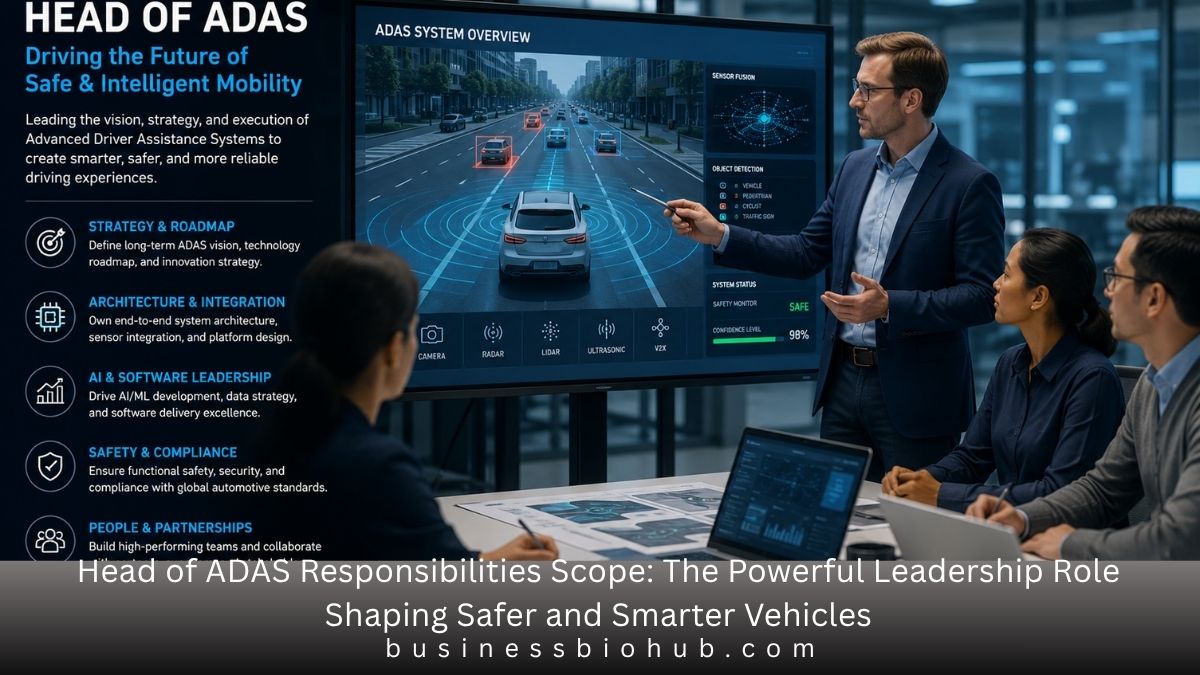
The automotive industry is moving rapidly toward vehicles that can understand their surroundings, support drivers, prevent accidents, and perform increasingly complex driving functions with limited human intervention. Behind many of these developments is a senior technical leader who brings together artificial intelligence, sensors, embedded software, vehicle systems, safety engineering, and commercial priorities. Understanding the scope of the Head of ADAS’s responsibilities matters for anyone interested in automotive engineering leadership, autonomous driving technology, or the future of intelligent mobility. The Head of ADAS, or Head of Advanced Driver Assistance Systems, generally defines the technical direction of driver-assistance technologies and ensures engineering teams can turn ambitious ideas into safe, reliable, production-ready vehicle features. Rather than focusing on a single software component or sensor, this leader typically takes an end-to-end view of the ADAS ecosystem, coordinating technology strategy, system architecture, validation, regulatory requirements, suppliers, engineering resources, and product delivery.
What Does a Head of ADAS Actually Do?
A Head of ADAS operates at the intersection of technology leadership, product strategy, engineering management, and vehicle safety. The role typically involves deciding how a company will develop technologies such as adaptive cruise control, automatic emergency braking, lane-keeping assistance, blind-spot monitoring, parking assistance, traffic-sign recognition, driver monitoring, and more advanced automated-driving functions. While individual ADAS engineers may work on perception algorithms, radar processing, embedded software, testing, or sensor calibration, the Head of ADAS must understand how these areas work together. This makes the position significantly broader than a conventional engineering-management role. The leader must ensure that software, hardware, sensors, vehicle control systems, artificial intelligence, data infrastructure, and validation processes operate as a unified system. At the same time, the Head of ADAS must balance innovation with practical concerns including budget, development schedules, customer requirements, production limitations, cybersecurity, reliability, and regulatory compliance.
Strategic Vision and Technology Roadmap
One of the most important parts of the ADAS head’s responsibilities is developing a long-term technology roadmap. Automotive technology changes quickly, and companies cannot simply react to every new trend. A senior ADAS leader must determine which technologies are commercially realistic, technically achievable, safe, and strategically valuable. This often means developing plans to transition from conventional driver-assistance features to more sophisticated levels of automation across several vehicle generations. The Head of ADAS evaluates developments in computer vision, machine learning, sensor fusion, vehicle computing, artificial intelligence, mapping, simulation, and connectivity before deciding where to invest engineering resources. Technology roadmaps must also account for hardware limitations and vehicle production cycles, which can span several years. Consequently, decisions an ADAS leader makes today may influence platforms that will not reach customers until much later. Strong strategic judgment is therefore essential because selecting the wrong architecture, sensor strategy, or computing platform can lead to costly development problems.
Ownership of ADAS System Architecture
Modern driver-assistance systems are built from many interconnected components, and maintaining a clear architecture is another major leadership responsibility. The Head of ADAS may oversee decisions involving cameras, radar units, ultrasonic sensors, LiDAR where applicable, electronic control units, centralized computing platforms, communication networks, software frameworks, and vehicle-control interfaces. Effective architecture governance ensures that these components can exchange information efficiently and remain scalable as new features are introduced. The leader must also consider whether to develop certain technologies internally, obtain them from suppliers, or create them through partnerships. A poorly designed architecture can limit future innovation, increase engineering complexity, and create unnecessary dependencies. By contrast, a flexible architecture can support multiple vehicle platforms and deploy software improvements more efficiently. The Head of ADAS therefore works closely with system architects, software engineers, hardware teams, vehicle-integration specialists, and product leaders to establish technical principles that guide development across the organization.
Artificial Intelligence and Perception Development
Artificial intelligence has become central to advanced driver-assistance technology. Vehicles must interpret enormous amounts of information from cameras and other sensors to identify objects, understand road conditions, recognize lane boundaries, detect pedestrians, predict movement, and make appropriate driving decisions. Within ADAS responsibilities, managing the development of perception and AI capabilities can be a major focus. The leader does not necessarily develop every algorithm personally, but must understand machine learning, neural networks, computer vision, sensor fusion, data quality, model performance, and edge computing well enough to make strategic decisions. They may oversee teams that collect driving data, label datasets, train models, improve perception accuracy, measure false positives and false negatives, and deploy models onto vehicle computing platforms. A strong Head of ADAS also encourages innovation while ensuring that experimental AI approaches eventually meet strict automotive reliability requirements.
Sensor Integration and Sensor Fusion
No single vehicle sensor provides complete information in every driving condition. Cameras can offer detailed visual information; radar can measure distance and velocity effectively; ultrasonic sensors are useful at short ranges; and LiDAR can provide detailed three-dimensional environmental information in applications where it is used. The Head of ADAS helps determine how these technologies should work together. Sensor fusion combines information from multiple sensing systems to create a more reliable understanding of the vehicle’s surroundings. Managing this process requires coordination between hardware engineers, perception developers, signal-processing specialists, calibration engineers, and vehicle teams. The Head of ADAS must consider sensor placement, field of view, environmental performance, cost, processing requirements, redundancy, and manufacturability. Sensor decisions can significantly affect both vehicle capability and overall production cost, making this part of the role both technically and commercially important.
Data Infrastructure and Engineering Platforms
Advanced driving systems require enormous quantities of data. Development vehicles can generate large datasets, including camera footage, radar measurements, vehicle signals, GPS data, driver behavior, and environmental conditions. Managing the infrastructure required to collect, store, process, search, and analyze this data is increasingly part of senior ADAS leadership. A Head of ADAS may work closely with cloud, IT, data engineering, and AI teams to develop scalable data pipelines and machine-learning infrastructure. Engineering teams need reliable tools to identify relevant driving scenarios, train models, reproduce failures, compare software versions, and evaluate performance. The leader may also guide decisions regarding cloud computing, high-performance computing clusters, simulation environments, automated testing systems, and MLOps platforms. Efficient infrastructure can significantly shorten development cycles because engineers can identify problems more quickly and test improvements across large collections of driving scenarios.
Software Development and Continuous Delivery
Software is one of the most important components of modern ADAS platforms, and the Head of ADAS must help establish disciplined development processes. Large automotive software programs can involve hundreds of engineers working across different locations and organizations. Without standardized workflows, integration problems can quickly become difficult to control. Senior ADAS leadership therefore commonly supports continuous integration, automated testing, software configuration management, release governance, and CI/CD practices adapted for automotive environments. The goal is to allow teams to develop quickly without compromising quality or safety. Software changes should be traceable, properly reviewed, thoroughly tested, and evaluated against defined requirements. The Head of ADAS must also coordinate release schedules so that perception software, control algorithms, middleware, operating systems, hardware interfaces, and vehicle components remain compatible throughout development.
Validation, Simulation, SiL and HiL Testing
Developing an ADAS feature is only part of the challenge. Proving that it performs reliably across a wide range of environments is equally important. Validation therefore occupies a significant portion of ADAS’s responsibilities. Modern development programs combine physical road testing with simulation and laboratory-based techniques such as Software-in-the-Loop (SiL) and Hardware-in-the-Loop (HiL) testing. SiL allows engineers to test software functionality in virtual environments, while HiL connects real electronic hardware to simulated vehicle and environmental conditions. These approaches make it possible to reproduce difficult scenarios and run thousands of tests without physically driving every case. The Head of ADAS helps set the validation strategy, test-coverage expectations, performance metrics, release criteria, and escalation processes. Teams often pay particular attention to unusual or dangerous edge cases because an ADAS system must remain predictable even when driving conditions become complex.
Functional Safety and Regulatory Compliance
Safety is fundamental to every advanced driver-assistance system. ADAS technology can influence steering, braking, acceleration, and driver warnings, meaning failures may have serious consequences. For this reason, the Head of ADAS must create a culture in which functional safety, system reliability, and disciplined engineering are core development requirements rather than final-stage checks. The leader typically works with safety specialists and quality teams to ensure engineering processes comply with applicable automotive standards, including functional safety frameworks such as ISO 26262, where relevant. Automotive development organizations may also use structured process-assessment frameworks such as Automotive SPICE. Beyond formal standards, ADAS leadership must consider safety concepts, redundancy, fault detection, fallback behavior, driver engagement, cybersecurity, and human-machine interaction. Every advanced feature must clearly define what the system can do, where it can operate, and how drivers should respond when the system reaches its limits.
Supplier and Partner Management
Automotive companies rarely develop every ADAS component entirely in-house. Specialized suppliers may provide sensors, processors, software modules, development tools, maps, testing systems, and other technologies. Supplier governance is therefore an important leadership responsibility. The Head of ADAS may participate in technical evaluations, supplier selection, contract discussions, architecture reviews, performance monitoring, and integration planning. Effective supplier management requires more than negotiating costs. The company must clearly define technical interfaces, performance requirements, intellectual-property boundaries, delivery schedules, safety responsibilities, and validation expectations. Problems can emerge when responsibilities between internal teams and external suppliers are unclear. A capable ADAS leader establishes transparent ownership structures to resolve technical issues quickly without disrupting vehicle development programs.
Building and Leading Multidisciplinary Teams
ADAS development requires expertise from many engineering disciplines, making talent leadership a central responsibility. A Head of ADAS may oversee software developers, AI researchers, system engineers, test engineers, safety specialists, data scientists, hardware engineers, architects, project managers, and technical leads. Recruiting talented specialists is only the beginning. The leader must establish clear responsibilities, encourage collaboration, remove organizational barriers, and develop future technical leaders. Successful ADAS organizations often require a balance between deep technical specialization and strong cross-functional communication. The Head of ADAS must create an environment where engineers can challenge assumptions, report technical risks early, and collaborate across organizational boundaries. Mentoring, talent development, workforce planning, and organizational design become particularly important when ADAS programs expand globally.
Commercial and Product Responsibilities
Although the role is deeply technical, the Head of ADAS must also understand business priorities. A technically impressive feature may not be commercially viable if its hardware costs are too high or customers do not value it. The leader therefore works with product management, vehicle-program teams, finance, purchasing, and senior executives to evaluate development priorities. Decisions often involve compromises between performance, cost, development time, safety, scalability, and customer experience. The Head of ADAS may also communicate directly with automotive customers or internal vehicle brands to understand feature requirements and future demand. This commercial perspective keeps engineering investment connected to the wider business strategy and product roadmap, rather than becoming an isolated technology program.
Skills Required for an Effective Head of ADAS
A successful Head of ADAS requires a rare combination of deep technical understanding and executive leadership ability. Strong knowledge of automotive electronics, embedded software, AI, perception, system architecture, validation, functional safety, and vehicle integration provides an important technical foundation. However, technical expertise alone is insufficient. The leader must also communicate complex issues clearly, manage large budgets, prioritize competing projects, negotiate with suppliers, guide senior engineers, and make decisions with incomplete information. Strategic thinking, systems engineering knowledge, leadership, communication, risk management, and commercial awareness are therefore equally valuable. As ADAS systems become more software-defined and AI-driven, leaders who can connect traditional automotive engineering with modern software and data practices will become increasingly important.
Why the Head of ADAS Role Matters for the Future of Mobility
The importance of the Head of ADAS continues to grow as vehicles become increasingly intelligent and software-driven. Driver-assistance systems are no longer isolated premium features; they are becoming fundamental parts of vehicle safety, comfort, and competitive differentiation. Customers increasingly expect vehicles to include intelligent parking, collision prevention, lane assistance, adaptive speed control, and other automated functions. At the same time, regulators and safety organizations continue to monitor how these systems behave under real-world conditions closely. The Head of ADAS must therefore balance rapid technological progress with responsible deployment. They play a critical role in deciding how quickly automation should advance, which technologies to adopt, and whether a system is sufficiently mature for production.
Conclusion
The head of ADAS’s responsibilities extend far beyond managing a single engineering department. It covers technology strategy, architecture governance, artificial intelligence, sensor integration, data infrastructure, software delivery, simulation, testing, functional safety, supplier management, talent development, and commercial alignment. The Head of ADAS bridges ambitious autonomous-driving ideas and the disciplined engineering required to integrate reliable technology into production vehicles. As cars become increasingly dependent on software, sensors, artificial intelligence, and centralized computing, this leadership position will become even more strategically significant. An effective Head of ADAS must combine technical depth, safety awareness, business judgment, and strong people leadership while keeping innovation practical, scalable, and responsible. Ultimately, the role is about transforming complex technologies into driver-assistance systems that can make modern transportation smarter, safer, and more capable.

Telehealth Psychiatric & Mental Health Care: Accessible Support for a Healthier Mind

West Palm Beach Detox: A Safe and Supportive Start to Lasting Recovery

Drug & Alcohol Rehab in West Palm Beach, FL: Start Your Journey to a Healthier Life

Drug & Alcohol Detox in South Carolina: A Complete Guide to Safe Recovery

Drug and Alcohol Detox Kentucky: Your Guide to Safe Recovery at Paducah Detox Center

Addiction Treatment in Plymouth: Understanding Addiction & Mental Health Treatment

Ohio Center for Adolescent Wellness: Your Guide to Teen Mental Health Services in Ohio

Massachusetts Center for Adolescent Wellness: Your Guide to Teen Mental Health & Addiction Treatment in MA

Foundation Diploma Singapore: A Practical Route Towards Higher Education

How to Stay Safe and Private While Using Public Wi-Fi

Paul Smalley Studied at University: The Education Behind His Global Football Career

Diamo Jewels Under the Lens: What Buyers Should Know Before Ordering in 2026

Billie Henry: Inside the Private Life Dawn French Fought to Keep Out of the Spotlight

Tina Esposito Advocate Health Bio: The Data Executive Shaping Analytics, AI and Patient Care

Kögel Trailer GmbH Manufacturing or Wholesale? The Business Model Behind the German Trailer Company

iPhone 17 Pro Max Phone Case: Best Protection Choices That Actually Matter in 2026

Pasonet Explained: Why This Digital Name Is More Complicated Than It First Appears

1upHealth Revenue Cycle Automation Partnerships: What’s Real, What’s Emerging, and Why 2027 Changes the Stakes

Industrial Entrepreneurs Memorandum: The 2026 IEM Rules Every Large Manufacturer Should Understand

EliseAI Head of Partnerships 2024–2026: The Leadership Shift Behind Its Expanding AI Partner Network
Telehealth Psychiatric & Mental Health Care: Accessible Support for a Healthier Mind
West Palm Beach Detox: A Safe and Supportive Start to Lasting Recovery
Drug & Alcohol Rehab in West Palm Beach, FL: Start Your Journey to a Healthier Life
Drug & Alcohol Detox in South Carolina: A Complete Guide to Safe Recovery
Drug and Alcohol Detox Kentucky: Your Guide to Safe Recovery at Paducah Detox Center
Addiction Treatment in Plymouth: Understanding Addiction & Mental Health Treatment
Ohio Center for Adolescent Wellness: Your Guide to Teen Mental Health Services in Ohio
Massachusetts Center for Adolescent Wellness: Your Guide to Teen Mental Health & Addiction Treatment in MA
Foundation Diploma Singapore: A Practical Route Towards Higher Education
How to Stay Safe and Private While Using Public Wi-Fi
-
 Celebrity4 months ago
Michael Scott Ryan: The Private Writer Known for His Connection to Jennifer Ehle
-
 Celebrity4 months ago
Benn George, The Private British Businessman Behind a Powerful Chapter in Tiffany Darwish’s Life
-
 Celebrity5 months ago
Daniel Guerard, The Private French Salon Owner Behind Lorraine Bracco’s Early Life Story
-
 Celebrity6 months ago
Caroline Hickman: The Private Life and Public Attention Around Steve Coogan’s Former Wife