
Business & Leadership
Michael Han VP MultiCare Health System Responsibilities: What He Actually Led—and Why the Role Mattered

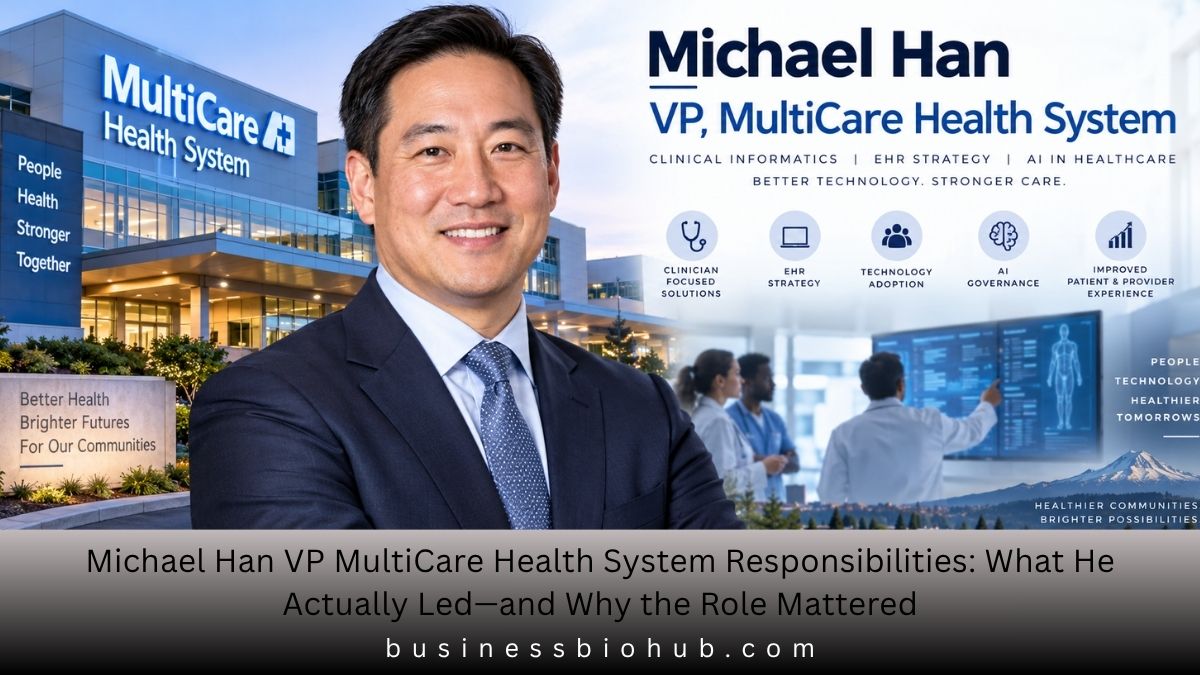
For anyone searching Michael Han VP MultiCare Health System responsibilities, there is an important 2026 update to understand first: Michael Han, MD, MBA, is no longer MultiCare Health System’s Vice President and Chief Medical Information Officer. Ambience Healthcare announced on April 23, 2026, that Han had joined the company as Chief Medical Officer. The announcement described MultiCare as his most recent previous role.
That distinction matters because several executive directories and older profiles still associate Han with MultiCare. His work there, however, remains highly relevant to understanding how a large health system manages clinician-facing technology, electronic health records, AI adoption and clinical informatics.
While serving as Enterprise Chief Medical Information Officer and Vice President, Han operated at the intersection of medicine and technology. In a 2026 interview, he said his responsibility covered physician- and advanced-practice-provider-facing software, including its governance, implementation and adoption.
Bottom line: Michael Han’s MultiCare responsibilities centered on clinical informatics, EHR strategy, enterprise application governance, clinician-facing software implementation and adoption, and healthcare AI oversight. He worked with physician and IT leadership to evaluate technology, improve clinical workflows and patient-provider experience, and establish governance around emerging AI applications.
The Crucial 2026 Status Update Behind the Search
The phrase “Michael Han VP MultiCare Health System” describes a real executive position Han held, but it should now be treated historically.
Ambience Healthcare announced his appointment as Chief Medical Officer on April 23, 2026. Its official announcement said Han had “most recently” served as Enterprise Chief Medical Information Officer at MultiCare, where he led clinical informatics, EHR strategy and enterprise application governance. Becker’s Hospital Review separately described him that same month as MultiCare’s former vice president and CMIO.
That makes articles describing him as MultiCare’s current VP potentially outdated unless they clearly identify the period being discussed.
Michael Han at a Glance
- Full name: Michael Han, MD, MBA
- Professional background: Physician executive, urologist and clinical informatics leader
- Former MultiCare role: Enterprise Chief Medical Information Officer and Vice President
- Core MultiCare domain: Clinical informatics and clinician-facing technology
- Board certifications: Urology and clinical informatics
- Current role as of September 2026: Chief Medical Officer, Ambience Healthcare
- Education: Brown University, University of Michigan Medical School and The Wharton School
- Earlier leadership: Providence and Pacific Medical Centers
What Michael Han Was Responsible for at MultiCare
Han gave one of the clearest descriptions of his own responsibilities during a Becker’s Healthcare podcast recorded at the Health IT, Digital Health and RCM meeting.
He said he was responsible for all physician- and advanced-practice-provider-facing software in terms of governance, implementation and adoption. He also emphasized applications capable of improving both patient and physician experience.
The Real Job Was Bridging Physicians and Technology Teams
One of the defining features of Han’s work was the idea that clinical technology should not simply be handed down by an IT department.
During his MultiCare tenure, Han argued that physician leadership and IT leadership needed to work together when selecting and deploying new technology. He used MultiCare’s ambient documentation project as an example: physician leaders helped secure clinician participation while informatics and IT leadership handled technology and governance requirements.
That partnership is important because technically functional software can still fail if physicians dislike the workflow, do not trust its output or regard it as another administrative burden.
Han’s responsibility therefore extended beyond selecting software. The role required aligning three groups that can have very different priorities: clinicians focused on patient care, technology teams focused on integration and reliability, and executives focused on measurable organizational value.
A central principle of Han’s MultiCare approach was that IT and medical leadership needed to prioritize, implement and drive adoption of new technology together.
Ambient AI Became a Test Case for His Leadership Model
Ambient clinical documentation became one of the clearest public examples of Han’s responsibilities in action.
MultiCare conducted a head-to-head evaluation involving three ambient-documentation vendors. Becker’s reported in February 2026 that roughly 550 physicians and advanced practice providers were enrolled in the comparison. The health system examined measures including time spent in charts, after-hours work, productivity and coding outcomes.
Provider well-being became a particularly significant finding. Becker’s reported Han saying that the share of participating physicians and APPs experiencing at least one burnout symptom fell from 60% before use of an ambient documentation tool to 16% afterward. The same report said work enjoyment rose from 11% to 37% among participants.
These figures should be understood as results reported from MultiCare’s evaluation rather than universal claims about every ambient AI system.
The project illustrates several responsibilities associated with Han’s position simultaneously: vendor assessment, clinical participation, adoption strategy, outcome measurement, governance and executive decision-making.
AI Governance Was Moving From Experiment to Enterprise Oversight
Deploying AI is only part of the problem for a hospital system. Someone must also determine whether a tool continues to behave safely after deployment.
By February 2026, Han was publicly discussing a broader governance model. Becker’s reported that MultiCare wanted a centralized view for monitoring AI technologies across areas such as bias, safety, model drift and return on investment.
That approach helps explain why a CMIO role carries strategic importance.
Clinical AI can affect documentation, diagnostic workflows, physician workload, patient interactions and organizational spending. Governance therefore has to address questions such as:
- Is the application producing reliable results?
- Are clinicians actually adopting it?
- Does performance change after deployment?
- Are unexpected safety or bias concerns emerging?
- Is the technology improving the intended workflow?
- Does its clinical or operational value justify continued investment?
Han’s MultiCare responsibilities placed him close to those decisions because they required both medical judgment and technical understanding.
From Stroke Detection to Everyday Documentation
Han’s technology remit was not limited to generative AI.
In a January 2026 podcast appearance, he said some of MultiCare’s earlier clinical AI applications involved early stroke detection in emergency care. He then contrasted those targeted applications with the rapidly expanding use of ambient clinical documentation.
That progression captures a wider shift occurring inside health systems: AI is moving from specialized clinical use cases toward technology that clinicians may interact with during routine patient encounters.
For the person responsible for clinician-facing software, that creates a larger operational burden. Adoption may involve hundreds of physicians and APPs rather than a small specialized team. Workflow design, training, reliability, governance and measurable outcomes become central questions rather than secondary technical details.
How Han’s MultiCare Experience Connects to His Current Position
The responsibilities Han carried at MultiCare also help explain his move to Ambience Healthcare.
Ambience appointed him Chief Medical Officer to lead its clinical strategy as the company expands beyond ambient documentation into broader clinical workflow, revenue-integrity and operational applications. The company specifically cited his experience with large-scale clinical informatics, EHR strategy and application governance.
His current responsibilities are therefore different from his MultiCare duties, but the connection is clear.
At MultiCare, he represented the health-system side of technology evaluation and deployment. At Ambience, he now works on the technology-company side, helping guide clinical strategy and product development for systems intended to be used by healthcare organizations.
Why the MultiCare Responsibilities Still Matter
A modern CMIO is not simply the physician in charge of an electronic record.
Han’s publicly described responsibilities demonstrate how the position can function as a bridge between clinical operations, enterprise technology and executive strategy. A decision about documentation software, for example, can affect physician time, clinician satisfaction, patient interaction, coding, productivity, technology spending and risk management simultaneously.
That is why governance and adoption were as important as software selection in Han’s account of the role.
The strongest technology does little for a health system when clinicians cannot integrate it effectively into real care. Conversely, enthusiastic adoption without appropriate governance can expose an organization to clinical, financial or safety risks.
Han’s MultiCare work sat directly between those two problems.
FAQs
What were Michael Han’s responsibilities at MultiCare Health System?
Michael Han was responsible for clinical informatics and clinician-facing technology at MultiCare. His publicly described duties included governance, implementation and adoption of physician- and APP-facing software. Ambience Healthcare additionally states that he led MultiCare’s EHR strategy and enterprise application governance.
Is Michael Han still Vice President at MultiCare Health System?
No. Current authoritative information indicates Michael Han left MultiCare and became Chief Medical Officer of Ambience Healthcare on April 23, 2026. Ambience describes MultiCare as his most recent prior position, while Becker’s subsequently identified him as MultiCare’s former CMIO.
What did Michael Han do with artificial intelligence at MultiCare?
Michael Han helped oversee clinical AI evaluation and governance. Publicly discussed projects included early stroke-detection applications and a large evaluation of ambient clinical documentation tools. He also emphasized monitoring AI for safety, bias, performance drift and organizational return on investment.
Did Michael Han oversee MultiCare’s electronic health record strategy?
Yes. Ambience Healthcare’s official biography states that during his Enterprise CMIO role at MultiCare, Han led clinical informatics, EHR strategy and enterprise application governance across the health system. That responsibility connected clinical workflow decisions with the technologies used by physicians and other providers.
What is Michael Han doing now?
Michael Han is Chief Medical Officer at Ambience Healthcare. The company says he leads clinical strategy and works across clinical, product and commercial teams as Ambience expands its AI platform into clinical workflow, patient engagement, revenue integrity and other health-system applications.
The Bigger Meaning of Han’s MultiCare Role
Searching for Michael Han VP MultiCare Health System responsibilities ultimately reveals something larger than one executive job description.
Han’s work showed how healthcare technology leadership increasingly depends on understanding medicine, software, workflow, clinician behavior and organizational governance at the same time. His MultiCare responsibilities extended from EHR and application strategy to adoption, AI evaluation and the practical question of whether technology actually improves the experience of delivering care.
The key factual update is equally important: those are former MultiCare responsibilities, not his current position as of September 2026. His move to Ambience Healthcare in April 2026 closed that chapter while carrying the same clinical-informatics expertise into a healthcare AI company.
Editorial Disclaimer
This article distinguishes between Michael Han’s former responsibilities at MultiCare Health System and his current role based on publicly available information verified through September 11, 2026. Responsibilities not documented by reliable sources have not been attributed to him, and private compensation, personal assets and other unsupported financial estimates are intentionally excluded.

Pasonet Explained: Why This Digital Name Is More Complicated Than It First Appears

1upHealth Revenue Cycle Automation Partnerships: What’s Real, What’s Emerging, and Why 2027 Changes the Stakes

Kögel Trailer GmbH Manufacturing or Wholesale? The Business Model Behind the German Trailer Company

Paul Smalley Studied at University: The Education Behind His Global Football Career

Fawn Radmanich Marketing Strategy Experience: Why Her 25-Year A/E/C Career Centers on Winning Complex Work

Emily Seitz Pawlak at TriHealth: The Revenue Cycle Executive Who Pushed Automation Beyond Billing

Jadene Elden, AI Automation and RCM at Southcoast Health: What the Public Record Actually Shows

Tina Esposito Advocate Health Bio: The Data Executive Shaping Analytics, AI and Patient Care

Michael Roe Operating Partner NexPhase: The Verified Record Behind the Name — and the michaelroe.net Question

Briana Biagi Banner Health Fallon NV Staff Directory: What Current Records Actually Show

Astrid Hannah: The Inspiring Story of John Hannah’s Daughter and Her Life Beyond Competitive Swimming

Best Pasticho Venezuelan Lasagna Near Me: A Complete Guide to Finding This Rich Latin Comfort Food
Natasha Podstepny LinkedIn Performant Healthcare Nashville: Inside Her Professional Journey

John Minoli: The Private Life and Career of Sheena Easton’s Fourth Husband

Jeroen Dik: How He Built a Powerful Legacy in Performance Tuning and Motorsport

Lihnk Explained: The Mysterious Search Term, Possible Meanings, and What Users Should Know

Colitre Explained: The Powerful Story Behind a Rare Name and Its Modern Identity

Nigora Whitehorn: The Inspiring Life, Marriage, and Story Behind Duncan Bannatyne’s Wife

Kemberly Blackledge LinkedIn Nashville General Hospital Chief Revenue Officer: How She Built a Powerful Healthcare Finance Career

Elegant Florals Emily Davis Business Description: A Refined Look at Floral Art, Event Design, and Botanical Creativity
Pasonet Explained: Why This Digital Name Is More Complicated Than It First Appears
1upHealth Revenue Cycle Automation Partnerships: What’s Real, What’s Emerging, and Why 2027 Changes the Stakes
Kögel Trailer GmbH Manufacturing or Wholesale? The Business Model Behind the German Trailer Company
Paul Smalley Studied at University: The Education Behind His Global Football Career
Fawn Radmanich Marketing Strategy Experience: Why Her 25-Year A/E/C Career Centers on Winning Complex Work
Emily Seitz Pawlak at TriHealth: The Revenue Cycle Executive Who Pushed Automation Beyond Billing
Jadene Elden, AI Automation and RCM at Southcoast Health: What the Public Record Actually Shows
Tina Esposito Advocate Health Bio: The Data Executive Shaping Analytics, AI and Patient Care
Michael Roe Operating Partner NexPhase: The Verified Record Behind the Name — and the michaelroe.net Question
Briana Biagi Banner Health Fallon NV Staff Directory: What Current Records Actually Show
-
 Celebrity4 months ago
Michael Scott Ryan: The Private Writer Known for His Connection to Jennifer Ehle
-
 Celebrity4 months ago
Daniel Guerard, The Private French Salon Owner Behind Lorraine Bracco’s Early Life Story
-
 Celebrity5 months ago
Caroline Hickman: The Private Life and Public Attention Around Steve Coogan’s Former Wife
-
 Celebrity3 months ago
Benn George, The Private British Businessman Behind a Powerful Chapter in Tiffany Darwish’s Life