
Business & Leadership
B2B Prospect-Verification Analyst: The Quiet Role Deciding Whether Your Sales Pipeline Is Real or Waste

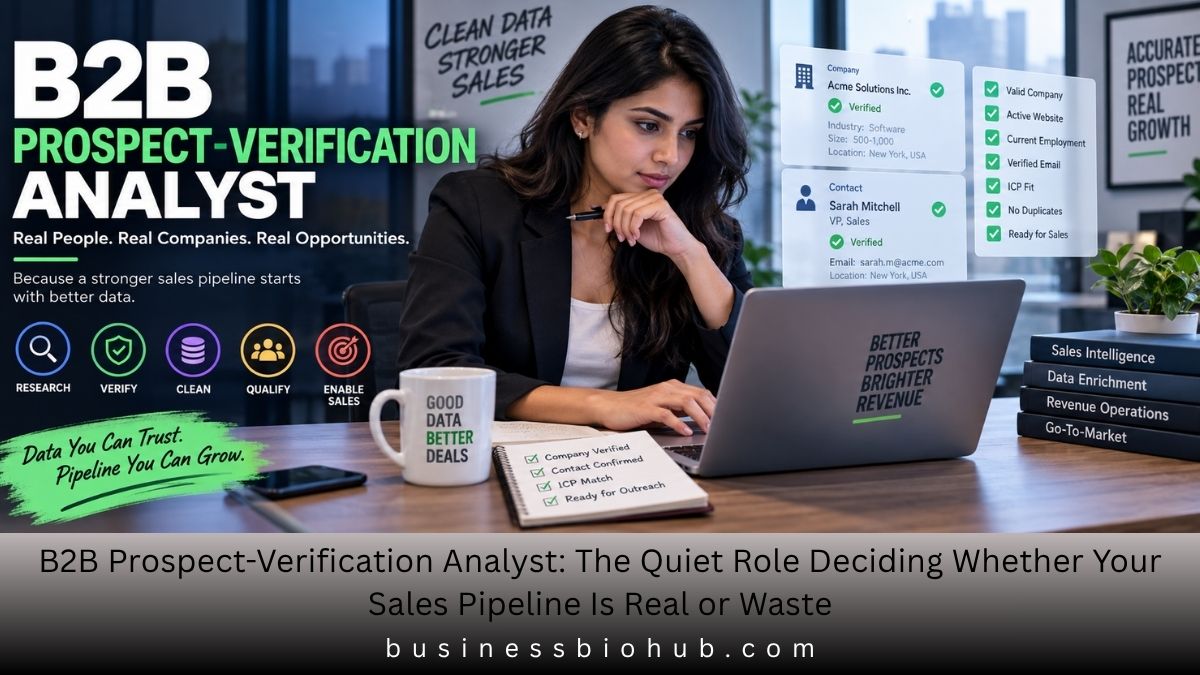
A sales database can look impressive while quietly failing underneath. A company may have changed size, a decision-maker may have left six months ago, an email may be undeliverable, or a contact may never have matched the ideal customer profile in the first place.
That problem matters more as B2B teams automate research, enrichment and outbound activity. Automation can process thousands of records quickly, but speed does not establish whether a company, job title, email address or buying signal is accurate.
The B2B prospect-verification analyst sits at that quality-control point. Current lead-research and data-enrichment job descriptions show professionals being asked to research companies, identify decision-makers, validate contact details, remove outdated records and prepare sales-ready datasets before SDR outreach begins.
A B2B prospect-verification analyst is a sales-data quality specialist who checks whether prospective companies and decision-makers genuinely match an ideal customer profile, verifies their current business information and contact data, resolves conflicting records, and prevents inaccurate or irrelevant prospects from entering outbound sales workflows.
What a B2B Prospect-Verification Analyst Actually Verifies
The title is relatively new and is not currently treated by the U.S. Bureau of Labor Statistics as a standalone occupational classification. In practice, its responsibilities overlap with B2B lead research, data enrichment, sales operations, market research and revenue operations.
The distinction is important.
A conventional lead-generation researcher may primarily find prospects. A prospect-verification analyst is responsible for deciding whether those prospects can survive a defined evidence standard before salespeople act on them.
The verification work usually happens at three levels
Company verification establishes whether the account itself is valid and suitable. An analyst may confirm:
- Legal or trading company name
- Active company website and domain
- Headquarters or operating geography
- Industry and business model
- Employee or company-size range
- Relevant products or services
- Whether the company fits the ideal customer profile
- Duplicate or subsidiary relationships
Person verification focuses on whether the target contact still belongs to the account and has a role connected to the buying decision.
Common checks include:
- Full professional name
- Current employer
- Current job title
- Department or function
- Seniority
- Geographic relevance
- Decision-making responsibility
- Public professional profile consistency
Contact verification asks whether a communication channel appears usable and appropriately associated with that person.
This may involve checking business email addresses, corporate telephone numbers or other approved business-contact fields before a record is moved into an outreach platform.
The Prospect Record Should Behave Like Evidence, Not a Guess
The strongest verification workflows separate an observed fact from an inference.
Suppose a software company advertises several new sales-operations vacancies. That public hiring activity can be recorded as an observed event. It may reasonably suggest organisational change, but it does not prove that the company is shopping for a new CRM.
That distinction matters when AI systems are involved.
Modern prospecting platforms increasingly combine company research, decision-maker identification and contact verification. Origami, for example, describes workflows that research accounts, identify buyers and verify contact information before records move further into campaign execution.
The analyst’s value is therefore not simply collecting more fields. It is preserving the chain between claim, evidence and action.
A practical verification status system
| Prospect field | Verification question | Strong evidence | Possible analyst status |
|---|---|---|---|
| Company | Does this organisation currently operate? | Official website and current business evidence | Verified |
| Employment | Does the person currently work there? | Current professional or company source | Verified / conflicting |
| Job title | Is the stated position current? | Recent professional/company record | Verified |
| ICP fit | Does the account meet target criteria? | Industry, size, location and use-case evidence | Qualified / rejected |
| Is the business address deliverable? | Approved verification process | Verified / uncertain | |
| Phone | Is the number associated with the business/contact? | Current validated source | Verified / uncertain |
| Buying signal | Did the event really occur? | Dated public source | Observed |
| Buyer intent | Does the event prove purchase intention? | Direct evidence required | Usually unverified |
The final distinction is especially important: a signal is not automatically intent.
Why Sales Teams Are Putting More Attention on Verification
Bad prospect data creates several different costs at once.
The most obvious is wasted SDR time. A representative researching an incorrect company, chasing somebody who has changed employers or sending email to an unusable address is spending capacity without creating a realistic sales opportunity.
There is also a database problem. Once questionable information enters a CRM, it can be copied into enrichment tools, sequencing systems, reports and attribution models.
LinkedIn has previously highlighted the operational consequences of outdated account and contact information and developed data-validation functionality designed to identify discrepancies between CRM data and current professional information.
The underlying research profession is also becoming increasingly data-dependent. The U.S. Bureau of Labor Statistics says market research analysts gather and analyse information about consumers, competitors and business conditions, and projects employment in that broader occupation to grow 7% from 2025 to 2035.
That BLS category should not be treated as an official classification for prospect-verification analysts, but it shows why research, commercial data and analytical judgement remain important business capabilities.
A useful verification rule is simple: automation may discover the record, but evidence should determine whether the record is trusted.
The Skills That Separate Verification From Simple List Building
A strong B2B prospect-verification analyst needs more than the ability to search LinkedIn or operate an email-verification platform.
Research judgement
Two databases can disagree about the same person. One may show an old job title while another shows a new employer.
The analyst must decide which source is fresher, whether the entities are actually the same person and whether uncertainty should remain unresolved instead of being quietly converted into a supposed fact.
Ideal customer profile interpretation
Verification is useless if the analyst proves that a contact exists but ignores whether the account should have been targeted at all.
The role therefore requires understanding:
- Target industries
- Company-size boundaries
- Geographic exclusions
- Relevant functions
- Seniority requirements
- Account exclusions
- Existing customers
- Competitors
- Disqualified segments
Spreadsheet and CRM discipline
Current B2B data-enrichment roles commonly require analysts to manage large datasets, remove duplicate or outdated records, update CRM information and prepare campaign-ready lead lists.
That makes spreadsheet proficiency, filtering, deduplication, field standardisation and CRM hygiene fundamental rather than optional administrative skills.
Tool-assisted research without blind trust
Platforms such as LinkedIn Sales Navigator, Apollo, Clay, Lusha and email-verification services can accelerate research. Current hiring advertisements explicitly mention several of these tools together.
But an analyst should understand that a provider result is still a data point.
Conflicting sources need resolution. Unknown fields should be marked unknown. A predicted email pattern should not automatically be described as verified.
A Verification Workflow Built for Human Review and AI Automation
A mature process normally starts before prospect discovery.
First, the organisation defines its ideal customer profile and exclusions. Without this step, an analyst cannot determine whether a company deserves verification.
Next comes account resolution. The analyst confirms that the organisation being researched is the intended company rather than another business with a similar name.
Decision-maker research follows. The analyst identifies relevant departments, job functions and seniority levels instead of collecting every employee who appears searchable.
Contact enrichment comes later.
That order matters because verifying expensive contact information for a company that never matched the ICP is wasted work.
A useful operating sequence
- Define ICP requirements and hard exclusions.
- Resolve the correct company entity.
- Verify industry, geography, size and business relevance.
- Identify likely decision-maker functions.
- Confirm current employment and title.
- Enrich approved business-contact fields.
- Validate contact information.
- Deduplicate the prospect against existing CRM records.
- Record the supporting source or verification date.
- Assign a confidence or verification status.
- Send only accepted records into the sales workflow.
- Recheck records when evidence becomes stale.
The analyst should also distinguish verification date from record creation date. A contact discovered in January but reverified in September has a different quality profile from one that has not been checked since January.
Compliance Is Part of Prospect Quality, Not an Afterthought
Accurate information is not automatically lawful information.
Rules vary by country, communication method, organisation type and the personal data being processed.
In the United States, the Federal Trade Commission states that the CAN-SPAM Act applies to commercial email and makes no general B2B-email exception. Commercial messages must comply with requirements relating to sender identification, subject lines, postal-address information and opt-out mechanisms.
UK rules require even more careful classification. The Information Commissioner’s Office explains that electronic-marketing rules can differ between corporate subscribers and sole traders or certain partnerships. It also states that UK GDPR requirements still apply when personal data is processed for B2B marketing.
The ICO further states that organisations using personal information obtained from public sources for direct marketing still need to comply with UK GDPR requirements and inform business contacts about relevant processing.
A verification analyst therefore should not interpret publicly visible as synonymous with unrestricted use.
The goal is not to maximise every metric independently.
For example, an analyst could increase verification rates by targeting only extremely easy accounts while ignoring the companies sales actually wants to reach. Quality measurement therefore has to remain connected to commercial strategy.
Quick Snapshot: B2B Prospect-Verification Analyst
- Primary purpose: Turn raw prospect records into evidence-supported, sales-ready data.
- Typical team: Sales operations, RevOps, lead generation, growth or outbound sales.
- Core outputs: Verified accounts, decision-makers and approved contact information.
- Key skill: Resolving contradictory or incomplete business information.
- Common tools: CRM platforms, spreadsheets, professional networks and enrichment services.
- Main risk controlled: Bad, stale, duplicated or irrelevant prospect data.
- Important principle: Unknown information should remain unknown until credible evidence supports it.
- Compliance responsibility: Follow applicable privacy and direct-marketing requirements for the target jurisdiction.
The Role Is Moving From Data Entry Toward Evidence Operations
AI can already discover companies, summarise websites, identify likely job functions and automate enrichment.
That does not eliminate verification.
It changes where human effort is most valuable.
The analyst increasingly becomes responsible for defining acceptance rules, handling edge cases, investigating conflicts and reviewing whether automated systems have confused prediction with fact.
A sophisticated organisation may eventually automate much of the routine work:
AI discovery → entity resolution → enrichment → automated validation → analyst exception review → CRM approval
In that model, humans spend less time manually copying data and more time examining records where confidence is low or the commercial value is high.
That is a much closer relationship to quality assurance than traditional list building.
Questions People Ask About B2B Prospect Verification
What is a B2B prospect-verification analyst?
A B2B prospect-verification analyst is a sales-data specialist who confirms whether target companies and professional contacts are accurate, current and relevant before they enter an outbound-sales workflow. The work commonly combines company research, decision-maker verification, data enrichment, deduplication, ICP qualification and CRM quality control.
Is a B2B prospect-verification analyst the same as a lead-generation specialist?
A B2B prospect-verification analyst is not necessarily identical to a lead-generation specialist. Lead generation emphasises finding potential prospects, while verification emphasises proving that those records meet defined quality requirements. In many organisations, however, one employee may perform both functions, and current job advertisements often combine research, enrichment and verification responsibilities.
What tools does a prospect-verification analyst use?
A prospect-verification analyst typically uses professional research networks, company websites, sales-intelligence services, email-verification systems, spreadsheets and CRM software. Current roles mention tools including LinkedIn Sales Navigator, Apollo, Clay, Lusha and GoHighLevel, although the exact technology stack varies by employer.
How does a prospect-verification analyst know whether a lead is qualified?
A qualified B2B prospect is one that satisfies the organisation’s predefined ideal customer profile and passes required verification checks. Typical criteria include industry, company size, geography, business model, relevant decision-maker function and current employment. Qualification should be based on explicit rules rather than an analyst’s unsupported assumption.
How much does a B2B prospect-verification analyst earn?
There is no authoritative U.S. salary series specifically for the title B2B prospect-verification analyst. The Bureau of Labor Statistics reports a May 2025 median annual wage of $78,760 for market research analysts, an adjacent but broader occupation. That figure should not be presented as the salary for prospect-verification work itself.
Can AI replace prospect-verification analysts?
AI can automate substantial parts of prospect discovery, enrichment, comparison and prioritisation, but verification still requires policies for evidence, confidence, conflicting sources and compliance. The likely shift is toward analyst-supervised automation, where machines process routine records and humans review uncertainty, high-value accounts and exceptions.
The Real Product Is Trust in the Sales Record
B2B organisations do not ultimately need larger contact lists. They need enough confidence in each prospect to justify spending sales time on it.
That changes the standard.
A record is not valuable merely because it contains a person’s name, company, email address and title. It becomes useful when the company fits the commercial target, the person appears genuinely relevant, the information is current, the contact data has passed appropriate checks and the organisation can explain where important facts came from.
That is the practical purpose of the B2B prospect-verification analyst: turning prospecting from a collection exercise into a controlled evidence process.
Editorial Disclaimer
This article explains an emerging B2B sales-data function rather than a formally standardised occupational classification. Job titles, responsibilities, technology stacks, salaries and legal obligations vary by employer and jurisdiction. Salary comparisons use adjacent official occupational data only, while privacy and marketing-compliance decisions should be checked against current rules applicable to the organisation, recipient and communication method.

Pasonet Explained: Why This Digital Name Is More Complicated Than It First Appears

1upHealth Revenue Cycle Automation Partnerships: What’s Real, What’s Emerging, and Why 2027 Changes the Stakes

Kögel Trailer GmbH Manufacturing or Wholesale? The Business Model Behind the German Trailer Company

Paul Smalley Studied at University: The Education Behind His Global Football Career

Fawn Radmanich Marketing Strategy Experience: Why Her 25-Year A/E/C Career Centers on Winning Complex Work

Emily Seitz Pawlak at TriHealth: The Revenue Cycle Executive Who Pushed Automation Beyond Billing

Jadene Elden, AI Automation and RCM at Southcoast Health: What the Public Record Actually Shows

Tina Esposito Advocate Health Bio: The Data Executive Shaping Analytics, AI and Patient Care

Michael Roe Operating Partner NexPhase: The Verified Record Behind the Name — and the michaelroe.net Question

Briana Biagi Banner Health Fallon NV Staff Directory: What Current Records Actually Show

Astrid Hannah: The Inspiring Story of John Hannah’s Daughter and Her Life Beyond Competitive Swimming

Best Pasticho Venezuelan Lasagna Near Me: A Complete Guide to Finding This Rich Latin Comfort Food
Natasha Podstepny LinkedIn Performant Healthcare Nashville: Inside Her Professional Journey

John Minoli: The Private Life and Career of Sheena Easton’s Fourth Husband

Jeroen Dik: How He Built a Powerful Legacy in Performance Tuning and Motorsport
Lihnk Explained: The Mysterious Search Term, Possible Meanings, and What Users Should Know

Colitre Explained: The Powerful Story Behind a Rare Name and Its Modern Identity

Nigora Whitehorn: The Inspiring Life, Marriage, and Story Behind Duncan Bannatyne’s Wife

Kemberly Blackledge LinkedIn Nashville General Hospital Chief Revenue Officer: How She Built a Powerful Healthcare Finance Career

Elegant Florals Emily Davis Business Description: A Refined Look at Floral Art, Event Design, and Botanical Creativity
Pasonet Explained: Why This Digital Name Is More Complicated Than It First Appears
1upHealth Revenue Cycle Automation Partnerships: What’s Real, What’s Emerging, and Why 2027 Changes the Stakes
Kögel Trailer GmbH Manufacturing or Wholesale? The Business Model Behind the German Trailer Company
Paul Smalley Studied at University: The Education Behind His Global Football Career
Fawn Radmanich Marketing Strategy Experience: Why Her 25-Year A/E/C Career Centers on Winning Complex Work
Emily Seitz Pawlak at TriHealth: The Revenue Cycle Executive Who Pushed Automation Beyond Billing
Jadene Elden, AI Automation and RCM at Southcoast Health: What the Public Record Actually Shows
Tina Esposito Advocate Health Bio: The Data Executive Shaping Analytics, AI and Patient Care
Michael Roe Operating Partner NexPhase: The Verified Record Behind the Name — and the michaelroe.net Question
Briana Biagi Banner Health Fallon NV Staff Directory: What Current Records Actually Show
-
 Celebrity4 months ago
Michael Scott Ryan: The Private Writer Known for His Connection to Jennifer Ehle
-
 Celebrity4 months ago
Daniel Guerard, The Private French Salon Owner Behind Lorraine Bracco’s Early Life Story
-
 Celebrity5 months ago
Caroline Hickman: The Private Life and Public Attention Around Steve Coogan’s Former Wife
-
 Celebrity3 months ago
Benn George, The Private British Businessman Behind a Powerful Chapter in Tiffany Darwish’s Life