
Business
Volvo–Brindley Contract Termination: What Really Happened in the Wolverhampton Dealer Split

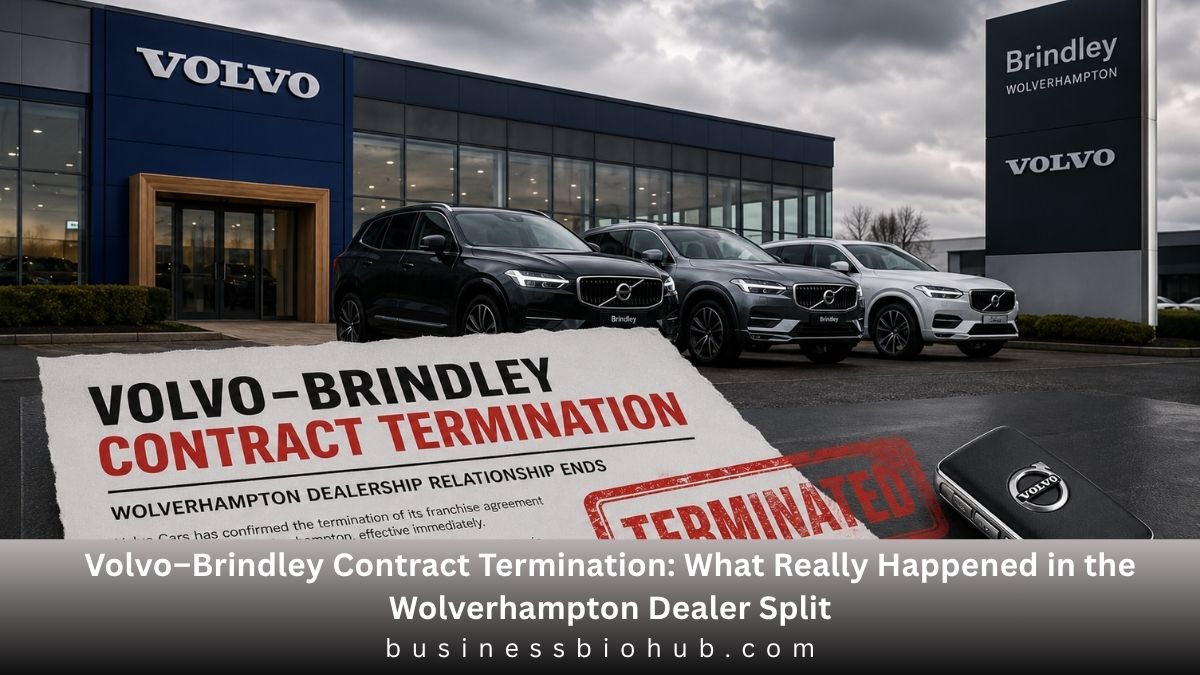
Based on the public evidence available, the Volvo–Brindley contract termination was not a straightforward case of a poorly performing dealership losing its franchise. Brindley Group says Volvo Car UK had already given its Wolverhampton operation two years’ notice after the dealer declined a request to sell the business to a third party. Then, in late 2025, while Brindley was reorganizing two Wolverhampton showrooms and temporarily operating Volvo from alternative accommodation, Volvo brought that termination forward with immediate effect. Volvo confirmed Brindley was leaving its authorized network but did not publicly identify a contractual breach or endorse Brindley’s explanation for why the relationship ended.
That distinction matters. Much of the subsequent discussion has treated motive as settled fact. It is not.
What Happened Between Volvo and Brindley?
The dispute became public on 5 December 2025, when the specialist publication Car Dealer Magazine reported that Brindley Group had been issued with an immediate termination notice for its Volvo agreement.
By then, the relationship was already approaching its planned end.
According to Brindley chairman Che Watson, Volvo had previously issued the company with a two-year termination notice after Brindley declined Volvo’s request to sell its dealership to the manufacturer’s preferred buyer. Watson said the business had continued operating the franchise through the notice period and was entering its final six months.
Brindley was simultaneously restructuring its Wolverhampton premises.
The group said its Hyundai business had outgrown its Penn Road location. It planned to relocate Hyundai and introduce Chery into the former Hyundai premises. Because the respective sites needed work to meet different manufacturers’ corporate identity requirements, construction began in late November 2025.
During that work, Volvo was moved into temporary accommodation.
Watson’s interpretation was explicit:
“Volvo have taken exception to this arrangement.”
He said that this was followed by immediate termination.
But this should not be converted into a stronger claim than the available evidence supports. Brindley described what it believed had triggered Volvo’s decision. Volvo did not publicly confirm that the temporary showroom was the contractual reason for termination.
The Earlier Two-Year Notice Is Central to Understanding the Dispute
The immediate termination made headlines, but it was the second stage of the breakdown.
Brindley stated that it had originally been given two years’ notice after refusing to sell the dealership to Volvo’s preferred buyer. Watson was careful not to claim definitively that the earlier disagreement caused the later acceleration.
He said the termination “may or may not” have been connected with the rejected sale proposal.
That caution is significant.
Nearly seven months later, Brindley’s own 2025 financial reporting provided a more formal version of the company’s position. Coverage of accounts filed at Companies House reported that Brindley had previously received termination notice after declining Volvo’s request to sell the operation to a third party and that Volvo subsequently accelerated the termination date in response to Brindley’s preparations for its future strategic direction.
This later description supports the broad timeline Brindley presented publicly in December 2025.
It still does not reveal the precise contractual provision Volvo relied upon.
The underlying dealer agreement has not been made public, and verified details of any alleged breach of contract have not been disclosed.
Did Volvo Terminate Brindley Because the Dealer Was Underperforming?
No publicly disclosed evidence establishes that.
Brindley’s chairman claimed the Wolverhampton business had consistently achieved Volvo targets and ranked strongly on the manufacturer’s balanced scorecard. That is a statement from one side of the dispute and should be attributed accordingly rather than repeated as independently proven fact.
Volvo’s response was notably restrained.
A Volvo spokesperson confirmed:
Brindley Wolverhampton was “no longer part of the Volvo network”.
Volvo thanked the Brindley team for its contribution and told affected customers to use another authorized retailer or contact Volvo Car UK directly. The company did not publicly accuse Brindley of poor sales performance, customer service failings, or financial weakness in the statement reported at the time.
That does not prove performance played no role in private discussions. It only means that such a claim cannot responsibly be presented as fact based on the information currently available.
Brindley’s Financial Results Complicate the Failure Narrative
The group’s subsequent accounts provide useful context.
For the 12 months ending November 2025, W. Brindley Garages (Holdings) Limited reported pre-tax profit of approximately £3.29 million, up around 2% from £3.23 million, while turnover rose about 3.5% to £309.41 million. Fleet sales increased from 3,897 to 5,209 units, and aftersales gross profit rose 5.4%.
Those numbers cover the wider Brindley organization, not the Volvo franchise in isolation. They therefore cannot tell us whether the Volvo operation itself was sufficiently profitable.
They do establish something narrower but important: Brindley was not publicly presenting the characteristics of a dealer group collapsing under obvious group-wide financial distress when the Volvo relationship ended.
Instead, the termination occurred during active franchise restructuring.
The Chinese-Brand Expansion Was More Than Background Noise
The Volvo dispute coincided with a fundamental change in Brindley’s brand portfolio.
By the end of its 2025 financial year, the group represented established manufacturers including Hyundai, Kia, Honda, Mazda and MG, while adding newer Chinese-market entrants such as Omoda, Jaecoo, Chery, Changan and XPENG. Brindley’s directors later described the arrival of Chinese manufacturers as rapidly reshaping the UK competitive landscape.
The company therefore had a practical reason to use its showroom estate differently once Volvo’s departure was already scheduled.
And its current network makes the physical transition clearer.
Brindley today lists Chery Wolverhampton at 55 Penn Road, while Hyundai Wolverhampton operates from West Street, off Stafford Road. Volvo is absent from Brindley’s current brand list.
That geography matters because later descriptions of the dispute risk making the transition sound like a simple shift from a Volvo showroom to a Chery dealership.
Brindley’s original explanation was more complicated: Hyundai was moving, Chery was entering the former Hyundai premises, both sites needed building work, and Volvo was temporarily displaced during the process. Its current locations broadly match that account.
What Changed Immediately for Volvo Customers?
This was where the contractual dispute became a consumer issue.
Brindley said that once the immediate termination took effect, it could no longer:
- perform Volvo warranty work;
- carry out work under Volvo Service Plans;
- deliver new Volvo orders as an authorized retailer;
- provide certain manufacturer-authorized functions such as Volvo software services.
The dealership said ordinary vehicle servicing could continue, but it would no longer have the capabilities or status of an authorized Volvo outlet. Watson directed customers requiring official Volvo support to authorized retailers in Birmingham, Stourbridge, Stoke and Shrewsbury.
Volvo likewise told affected owners and buyers to contact their nearest authorized retailer or Volvo Car UK.
For customers, therefore, the disagreement was not merely corporate theatre. Authorized status affects warranty administration, manufacturer-backed servicing, and other services that an independent workshop may not be able to replicate.
Volvo’s Wider Retail Strategy Adds Context — But Not a Proven Motive
The split also occurred during a period of significant change in Volvo’s UK retail model.
Volvo had been pursuing a more direct relationship with consumers, describing the UK as an important market for its transition toward direct sales while continuing to work with retailer partners. The company has subsequently stressed the importance of an omnichannel model in which digital channels and physical retailers both remain central to the customer experience.
By 2026, Volvo was still publicly celebrating retailer performance across new cars, used cars, customer retention and aftersales. Its 2025 Retailer of the Year program recognized businesses, including Waylands Oxford, Listers Leamington Spa, and other partners across the network.
This wider restructuring makes manufacturer–retailer alignment strategically important, but it would be speculative to claim that Volvo’s direct-sales program itself caused Brindley’s termination.
No verified public statement establishes that connection.
Brindley Did Not Retreat After Volvo
Perhaps the most revealing development came after the dispute.
Rather than shrinking its portfolio, Brindley continued adding brands. By September 2026, its official website listed Changan, Chery, Genesis, Honda, Hyundai, Jaecoo, Kia, Lepas, Mazda, Maxus, MG, Omoda and XPENG among its represented marques.
In August 2026, the group also opened what Motor Trade News reported as the first Lepas dealership in the UK, in Wolverhampton. Lepas is another brand within the Chery International portfolio.
Commercially, that makes the Volvo termination look less like the end of Brindley’s Wolverhampton strategy and more like a pivot within it.
The loss of an established premium franchise was undoubtedly significant. But the freed capacity became part of a broader repositioning toward manufacturers seeking rapid UK dealer-network expansion.
Was Either Side Clearly “Wrong”?
The public record does not support a definitive judgment.
From Brindley’s perspective, the company had already been told that its Volvo relationship would end, was preparing its sites for life after the franchise, and regarded temporary accommodation during building work as a normal operational arrangement. The dealership also maintained that it had been meeting Volvo’s performance requirements.
Volvo’s detailed contractual position remains private. Volvo confirmed the network termination but did not publicly debate Brindley’s version point by point.
Without the franchise agreement, correspondence between the parties or a legal judgment, claims that Volvo acted unlawfully, vindictively or in breach of contract would go beyond the evidence.
Likewise, Volvo’s published statement does not support claims that Brindley was removed because it was an inadequate dealer.
What Remains Unverified
Several questions cannot currently be answered confidently from the public record:
- The exact contractual clause used to accelerate termination.
- Whether Volvo formally regarded the temporary premises as a breach of retailer standards.
- The identity of the third-party buyer Volvo allegedly wanted Brindley to sell to.
- The proposed commercial terms of any potential dealership sale.
- Detailed profitability of Brindley’s Volvo franchise independently of the wider group.
- Any private settlement, compensation or financial consequences arising directly from the early termination.
Verified financial data for the termination itself has not been publicly disclosed.
No reputable reporting reviewed for this article establishes a court judgment resolving the disagreement, so the public narrative remains largely one of competing commercial positions rather than a legally adjudicated dispute.
The Bigger Meaning of the Volvo–Brindley Split
The episode matters not simply because one manufacturer lost one retailer.
It illustrates how quickly the economics of British motor retail are changing.
An established European manufacturer was refining its relationships with retailers and its consumer sales model. At the same time, a long-standing regional dealer group was filling its showrooms with manufacturers—particularly Chinese entrants—seeking physical representation, local customer relationships and rapid market penetration.
Brindley lost Volvo, but its 2025 accounts subsequently showed higher turnover and pre-tax profit, and its franchise portfolio continued expanding during 2026. Volvo, meanwhile, retained a substantial authorized retailer network and continued publicly emphasizing retailer performance and customer standards.
The evidence therefore points less toward a simple winner-and-loser story than toward two businesses whose strategies had ceased to align.
The immediate termination was dramatic. The underlying separation had begun much earlier.
And unless either party releases the underlying contractual correspondence, the most defensible conclusion remains precise: Brindley says Volvo first moved to end the relationship after Brindley declined a proposed sale, and later accelerated that termination while Brindley reorganized its Wolverhampton sites. Volvo confirmed the franchise ended, but has not publicly disclosed the detailed contractual basis for doing so.

Pasonet Explained: Why This Digital Name Is More Complicated Than It First Appears

1upHealth Revenue Cycle Automation Partnerships: What’s Real, What’s Emerging, and Why 2027 Changes the Stakes

Kögel Trailer GmbH Manufacturing or Wholesale? The Business Model Behind the German Trailer Company

Paul Smalley Studied at University: The Education Behind His Global Football Career

Fawn Radmanich Marketing Strategy Experience: Why Her 25-Year A/E/C Career Centers on Winning Complex Work

Emily Seitz Pawlak at TriHealth: The Revenue Cycle Executive Who Pushed Automation Beyond Billing

Jadene Elden, AI Automation and RCM at Southcoast Health: What the Public Record Actually Shows

Tina Esposito Advocate Health Bio: The Data Executive Shaping Analytics, AI and Patient Care

Michael Roe Operating Partner NexPhase: The Verified Record Behind the Name — and the michaelroe.net Question

Briana Biagi Banner Health Fallon NV Staff Directory: What Current Records Actually Show

Astrid Hannah: The Inspiring Story of John Hannah’s Daughter and Her Life Beyond Competitive Swimming

Best Pasticho Venezuelan Lasagna Near Me: A Complete Guide to Finding This Rich Latin Comfort Food

Natasha Podstepny LinkedIn Performant Healthcare Nashville: Inside Her Professional Journey

John Minoli: The Private Life and Career of Sheena Easton’s Fourth Husband
Jeroen Dik: How He Built a Powerful Legacy in Performance Tuning and Motorsport

Lihnk Explained: The Mysterious Search Term, Possible Meanings, and What Users Should Know
Colitre Explained: The Powerful Story Behind a Rare Name and Its Modern Identity
Nigora Whitehorn: The Inspiring Life, Marriage, and Story Behind Duncan Bannatyne’s Wife
Kemberly Blackledge LinkedIn Nashville General Hospital Chief Revenue Officer: How She Built a Powerful Healthcare Finance Career

Elegant Florals Emily Davis Business Description: A Refined Look at Floral Art, Event Design, and Botanical Creativity
Pasonet Explained: Why This Digital Name Is More Complicated Than It First Appears
1upHealth Revenue Cycle Automation Partnerships: What’s Real, What’s Emerging, and Why 2027 Changes the Stakes
Kögel Trailer GmbH Manufacturing or Wholesale? The Business Model Behind the German Trailer Company
Paul Smalley Studied at University: The Education Behind His Global Football Career
Fawn Radmanich Marketing Strategy Experience: Why Her 25-Year A/E/C Career Centers on Winning Complex Work
Emily Seitz Pawlak at TriHealth: The Revenue Cycle Executive Who Pushed Automation Beyond Billing
Jadene Elden, AI Automation and RCM at Southcoast Health: What the Public Record Actually Shows
Tina Esposito Advocate Health Bio: The Data Executive Shaping Analytics, AI and Patient Care
Michael Roe Operating Partner NexPhase: The Verified Record Behind the Name — and the michaelroe.net Question
Briana Biagi Banner Health Fallon NV Staff Directory: What Current Records Actually Show
-
 Celebrity4 months ago
Michael Scott Ryan: The Private Writer Known for His Connection to Jennifer Ehle
-
 Celebrity4 months ago
Daniel Guerard, The Private French Salon Owner Behind Lorraine Bracco’s Early Life Story
-
 Celebrity5 months ago
Caroline Hickman: The Private Life and Public Attention Around Steve Coogan’s Former Wife
-
 Celebrity3 months ago
Benn George, The Private British Businessman Behind a Powerful Chapter in Tiffany Darwish’s Life