
Business
Douglas H. Brown Healthcare Executive RCM RPA Posts: Why His Revenue-Cycle Research Is Drawing Attention

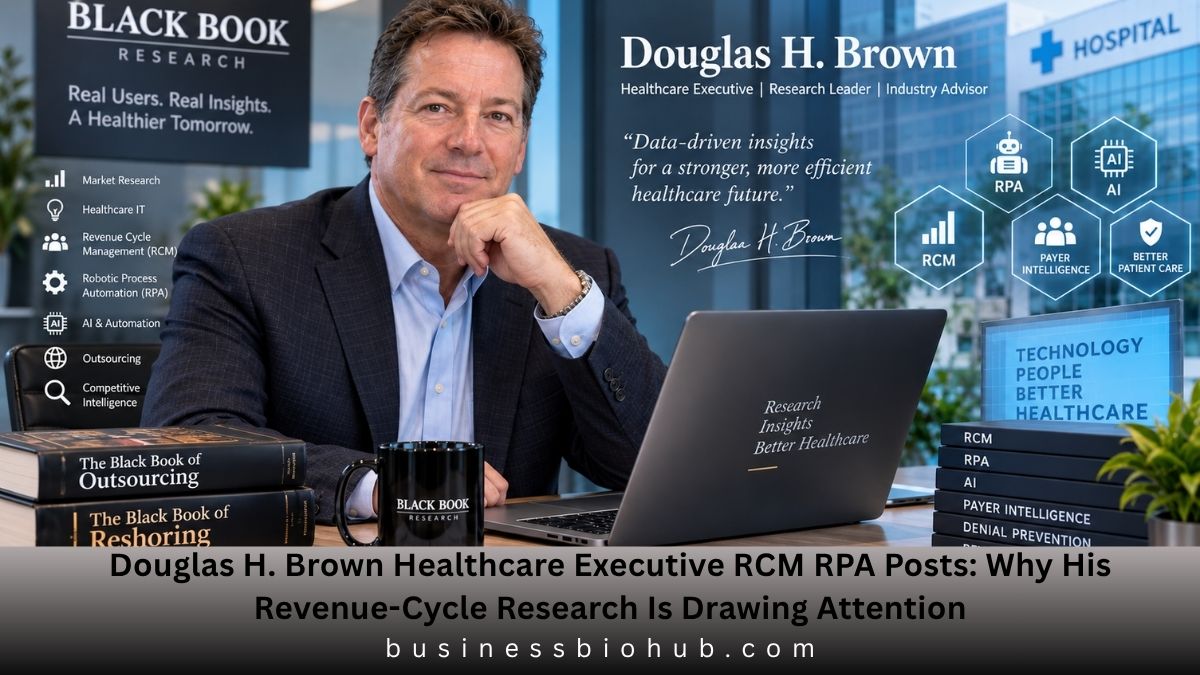
Healthcare revenue-cycle management is no longer simply about sending claims, posting payments and collecting balances. Hospitals are being pushed to manage denials earlier, respond to payer behavior faster, automate repetitive administrative work and prove that artificial intelligence can operate with meaningful oversight.
That shift helps explain growing search interest around Douglas H. Brown healthcare executive RCM RPA posts. The name points to Douglas H. Brown—widely known professionally as Doug Brown—whose work at Black Book Research has put him close to major conversations involving healthcare IT, revenue cycle management (RCM), robotic process automation (RPA), outsourcing and artificial intelligence.
His public commentary is especially relevant because Black Book’s research is built around feedback from healthcare executives and technology users rather than one vendor’s product message. In 2026, Brown’s RCM commentary increasingly frames revenue cycle not merely as back-office billing, but as an enterprise financial-control function.
BLUF: Douglas H. Brown is the healthcare technology and market-research executive associated with Black Book Research. His RCM and RPA posts focus on automation, denial prevention, EHR integration, payer intelligence, AI governance and financial performance. His published research increasingly argues that healthcare organizations must judge automation by measurable operational outcomes, not technology adoption alone.
Who Is Douglas H. Brown in Healthcare Technology?
Douglas H. Brown is associated with Black Book Market Research LLC, an active Florida company established in 2012. Florida Department of State records confirm the company remains active, while corporate records identify Douglas H. Brown in its leadership structure. Industry publications commonly describe him as the Founder or Managing Partner of Black Book Research.
Brown’s professional history extends beyond market research. Wiley describes Douglas Brown as an executive with experience in healthcare, information technology, business development and outsourcing. He co-authored The Black Book of Outsourcing, originally published in 2005, and later authored The Black Book of Reshoring, published by Wiley in March 2026.
His LinkedIn presence also identifies extensive work around healthcare systems management, competitive intelligence, IT and outsourcing. That professional mix is important because much of his healthcare commentary sits where finance, technology, operations and vendor strategy intersect.
Douglas H. Brown Quick Profile
| Detail | Verified Information |
|---|---|
| Name | Douglas H. Brown, commonly known professionally as Doug Brown |
| Primary Organization | Black Book Research / Black Book Market Research LLC |
| Current Public Titles | Founder, Managing Partner and corporate leadership titles appear across authoritative records |
| Industry Focus | Healthcare IT, market intelligence, outsourcing, RCM, AI and technology benchmarking |
| Professional Credential | MHA is used in healthcare-industry references |
| Published Work | The Black Book of Outsourcing; The Black Book of Reshoring |
| RCM Research | Revenue-cycle technology, services, outsourcing, AI and automation |
| Public Platform | Frequent LinkedIn posts and Black Book research releases |
Sources describing Brown as Douglas Brown, MHA, Managing Partner of Black Book Research include healthcare technology announcements involving major health IT vendors.
The RPA Post That Put Automation Metrics Into Focus
One of Brown’s most directly relevant public posts concerns Black Book’s Robotic Process Automation in Healthcare Revenue Cycle Management research.
The 2025 research examined RPA adoption across hospitals, physician groups and health systems. Black Book said its report drew on polling of 473 healthcare RCM executives and evaluated more than 40 RPA solution providers.
Brown highlighted three particularly notable figures in a LinkedIn post:
| RPA Finding | Black Book Figure |
|---|---|
| Provider organizations already using RPA in at least one revenue-cycle function | 21% |
| Organizations expected to expand RPA into denials, prior authorization or financial clearance by late 2026 | 83% |
| Respondents identifying strong EHR integration as critical to RPA selection | 91% |
These figures were presented through Brown’s public post promoting Black Book’s RPA research.
The operational use cases go well beyond automatically moving information between screens. Black Book identifies claims processing, eligibility verification, payment posting, denial workflows and compliance-related processes as significant RPA opportunities.
Why EHR Integration Matters More Than the Bot
The 91% integration figure provides one of the clearest clues to Brown’s broader technology position.
A healthcare organization can automate a repetitive task without fixing the workflow around it. That creates a danger: automation may simply accelerate a fragmented process.
Black Book’s RPA framework therefore evaluates areas such as automation coverage, cycle-time reduction, workflow orchestration, cost-to-collect performance, denial prevention, security, exception management and human oversight.
In practical terms, the strongest automation strategy is not “deploy as many bots as possible.” It is to determine whether automation reduces workload, prevents revenue leakage and operates reliably inside existing financial and clinical systems.
Editorial view: The real RPA question for healthcare executives is no longer whether software can automate a task. It is whether that automation produces a measurable financial improvement without creating new exceptions, audit problems or hidden human work.
From RPA to Agentic and Generative AI
Brown’s more recent posts show how the RCM conversation has advanced beyond conventional robotic process automation.
In a 2026 post discussing Black Book’s Agentic + Generative AI in Revenue Cycle Management Benchmark, Brown said the research surveyed 774 hospital and medical-group revenue-cycle leaders during Q4 2025 and Q1 2026.
The benchmark examined whether AI can function as an operating capability rather than simply appearing as another software feature.
Four areas received particular attention:
- responsiveness to changing payer rules;
- automation that produces a genuine reduction in workload;
- explainability and audit trails;
- governance covering approvals, security and rollback procedures.
That distinction is becoming crucial. Hospitals may have access to AI-enabled RCM software while still lacking the governance mechanisms necessary to use it at enterprise scale.
Brown’s research increasingly treats human oversight, auditability and governance as part of the technology itself rather than optional compliance additions.
Revenue Cycle Is Moving Into the CFO’s Control Room
Perhaps the clearest evolution in Douglas H. Brown’s RCM posts appears in his 2026 discussion of what Black Book describes as the revenue cycle’s “boardroom moment.”
Brown’s public commentary positions RCM as a system for governing financial performance across the organization rather than a narrow billing department responsibility.
His June 2026 post identified several priorities:
Payer Intelligence
Hospitals need better visibility into payer behavior so teams can identify reimbursement problems and changing rules before they produce significant accounts-receivable exposure.
Denial Prevention
The emphasis is moving from resolving rejected claims after the fact toward preventing avoidable denials earlier in the revenue cycle.
Prior Authorization Readiness
Prior authorization is increasingly treated as a financial-control process because failures at the front end can directly delay or prevent reimbursement.
Patient Financial Clearance
Eligibility, estimates and financial responsibility are being pushed closer to patient access rather than being addressed only after treatment.
AI Governance
Health systems require explainability, auditability and human oversight when AI influences financially sensitive workflows.
CFO-Level Cash Visibility
Brown’s commentary stresses cash forecasting, payer yield and revenue predictability—metrics that connect revenue-cycle performance directly with executive financial management.
This framing is backed by Black Book’s wider 2026 hospital RCM work. Its report evaluated 420 vendors across 49 RCM categories, using more than 1,300 validated provider-side participants, 18 qualitative KPIs per category and hundreds of detailed measures.
His Posts Also Warn Against Simplistic Vendor Consolidation
Another important theme is that fewer vendors do not automatically produce better revenue-cycle performance.
Brown has discussed growing hospital interest in consolidating disconnected RCM technologies. However, Black Book’s research also warns that weaknesses in individual functions—such as denial prevention, prior authorization, revenue integrity or patient financial engagement—can still create measurable financial exposure.
That creates a more demanding procurement standard.
Healthcare leaders may want one broader platform, but they still need evidence showing that every critical component performs effectively.
The same logic applies to RPA and AI. A sophisticated enterprise platform can still underperform if its automation has poor EHR integration, produces excessive exceptions or fails to generate clear financial returns.
A Long-Running RCM Theme, Not a Sudden Technology Pivot
Brown’s focus on revenue-cycle technology predates the current AI boom.
As early as 2013, Black Book research cited by healthcare publications highlighted concerns that outdated billing and collection systems were creating financial pressure for physician practices. Brown argued at the time that integrated cloud EHR and revenue-cycle technology could help independent practices improve their financial position.
By 2014, Brown was publicly discussing hospital movement toward broader end-to-end RCM outsourcing arrangements.
The progression is therefore clear:
| Period | Major RCM Theme |
|---|---|
| 2013 | Integrated EHR, practice management and RCM |
| 2014 | End-to-end RCM outsourcing |
| 2025 | Robotic process automation across revenue workflows |
| Early 2026 | Agentic and generative AI benchmarking |
| Mid-2026 | Revenue-cycle governance, payer intelligence and CFO-level financial control |
This history matters because it shows that Brown’s recent RPA and AI commentary is part of a longer analysis of healthcare financial technology rather than a sudden reaction to generative AI.
Frequently Asked Questions About Douglas H. Brown and RCM
Who is Douglas H. Brown in healthcare?
Douglas H. Brown is a healthcare technology, market-research and outsourcing executive associated with Black Book Research. Public records identify Douglas H. Brown in Black Book Market Research LLC’s leadership, while healthcare-industry sources describe Doug Brown as Founder or Managing Partner of Black Book Research.
What does Douglas H. Brown say about RPA in healthcare RCM?
Brown’s RPA commentary emphasizes measurable automation of repetitive revenue-cycle processes. His 2025 post highlighted Black Book findings that 21% of surveyed provider organizations had implemented RPA in at least one RCM function, while 83% expected broader adoption in selected workflows by late 2026.
What revenue-cycle functions can RPA automate?
Healthcare RPA can automate rule-based administrative work including claims processing, eligibility verification, payment posting and portions of denial-management workflows. Black Book’s research also examines automation in financial clearance and other high-volume revenue-cycle processes.
Why does Douglas Brown emphasize EHR integration?
EHR integration is essential because isolated automation can create fragmented workflows rather than eliminating them. Brown’s published RPA findings reported that 91% of respondents considered seamless integration with core EHR technology an important RPA-selection requirement.
Is Douglas H. Brown focused only on RPA?
No. Brown’s current research extends across RCM, healthcare AI, outsourcing, interoperability, cybersecurity, EHR technology and broader competitive intelligence. His 2026 RCM posts increasingly focus on agentic AI, payer intelligence, prior authorization, denial prevention, governance and CFO-level revenue visibility.
What is Black Book Research?
Black Book Research is a healthcare technology and services market-research organization focused on user-based benchmarking and vendor evaluation. Its 2026 hospital RCM study alone examined 420 vendors across 49 revenue-cycle categories using feedback from more than 1,300 validated provider-side participants.
Why Brown’s RCM Posts Matter More in 2026
The strongest theme running through Douglas H. Brown’s recent RCM and RPA posts is accountability.
RPA must do more than automate clicks. AI must do more than generate recommendations. Managed services must do more than supply labor. Revenue-cycle platforms must do more than contain a long list of features.
For hospitals facing payer friction, denial pressure, administrative labor costs and unpredictable reimbursement, the purchasing question is increasingly whether technology can demonstrate measurable performance in production.
That is why the Douglas H. Brown healthcare executive RCM RPA posts search is more meaningful than it may initially appear. His published commentary provides a running record of the healthcare revenue cycle moving from basic administrative automation toward governed, integrated financial infrastructure—where automation, AI, people and payer data are expected to produce outcomes that CFOs can actually measure.
Editorial Disclaimer
This profile is based on publicly accessible corporate records, publisher information, industry reporting, Black Book Research material and Douglas Brown’s public professional posts available at the time of verification. Titles such as Founder, Managing Partner and CEO may appear differently across corporate and editorial sources. Private financial information, personal asset estimates and unsupported biographical claims have intentionally been excluded.

Pasonet Explained: Why This Digital Name Is More Complicated Than It First Appears

1upHealth Revenue Cycle Automation Partnerships: What’s Real, What’s Emerging, and Why 2027 Changes the Stakes

Kögel Trailer GmbH Manufacturing or Wholesale? The Business Model Behind the German Trailer Company

Paul Smalley Studied at University: The Education Behind His Global Football Career

Fawn Radmanich Marketing Strategy Experience: Why Her 25-Year A/E/C Career Centers on Winning Complex Work

Emily Seitz Pawlak at TriHealth: The Revenue Cycle Executive Who Pushed Automation Beyond Billing

Jadene Elden, AI Automation and RCM at Southcoast Health: What the Public Record Actually Shows

Tina Esposito Advocate Health Bio: The Data Executive Shaping Analytics, AI and Patient Care

Michael Roe Operating Partner NexPhase: The Verified Record Behind the Name — and the michaelroe.net Question

Briana Biagi Banner Health Fallon NV Staff Directory: What Current Records Actually Show

Astrid Hannah: The Inspiring Story of John Hannah’s Daughter and Her Life Beyond Competitive Swimming

Best Pasticho Venezuelan Lasagna Near Me: A Complete Guide to Finding This Rich Latin Comfort Food
Natasha Podstepny LinkedIn Performant Healthcare Nashville: Inside Her Professional Journey

John Minoli: The Private Life and Career of Sheena Easton’s Fourth Husband

Jeroen Dik: How He Built a Powerful Legacy in Performance Tuning and Motorsport

Lihnk Explained: The Mysterious Search Term, Possible Meanings, and What Users Should Know

Colitre Explained: The Powerful Story Behind a Rare Name and Its Modern Identity

Nigora Whitehorn: The Inspiring Life, Marriage, and Story Behind Duncan Bannatyne’s Wife

Kemberly Blackledge LinkedIn Nashville General Hospital Chief Revenue Officer: How She Built a Powerful Healthcare Finance Career

Quartz Events Sponsor Matching Companies: What the B2B Matchmaking Model Really Offers
Pasonet Explained: Why This Digital Name Is More Complicated Than It First Appears
1upHealth Revenue Cycle Automation Partnerships: What’s Real, What’s Emerging, and Why 2027 Changes the Stakes
Kögel Trailer GmbH Manufacturing or Wholesale? The Business Model Behind the German Trailer Company
Paul Smalley Studied at University: The Education Behind His Global Football Career
Fawn Radmanich Marketing Strategy Experience: Why Her 25-Year A/E/C Career Centers on Winning Complex Work
Emily Seitz Pawlak at TriHealth: The Revenue Cycle Executive Who Pushed Automation Beyond Billing
Jadene Elden, AI Automation and RCM at Southcoast Health: What the Public Record Actually Shows
Tina Esposito Advocate Health Bio: The Data Executive Shaping Analytics, AI and Patient Care
Michael Roe Operating Partner NexPhase: The Verified Record Behind the Name — and the michaelroe.net Question
Briana Biagi Banner Health Fallon NV Staff Directory: What Current Records Actually Show
-
 Celebrity4 months ago
Michael Scott Ryan: The Private Writer Known for His Connection to Jennifer Ehle
-
 Celebrity4 months ago
Daniel Guerard, The Private French Salon Owner Behind Lorraine Bracco’s Early Life Story
-
 Celebrity5 months ago
Caroline Hickman: The Private Life and Public Attention Around Steve Coogan’s Former Wife
-
 Celebrity3 months ago
Benn George, The Private British Businessman Behind a Powerful Chapter in Tiffany Darwish’s Life