
General Informational
EB2 Priority Date in September 2026: India Is Unavailable While China Holds at 2021

For thousands of employment-based green card applicants, the EB2 priority date is more than a date printed on an immigration notice. It determines where a case stands in the immigrant-visa queue—and, ultimately, when permanent residence can move forward.
September 2026 is especially important because the United States is approaching the September 30 end of fiscal year 2026. The Department of State has already made EB-2 India unavailable, while warning that strong EB-2 demand could force further restrictions elsewhere before the fiscal year closes.
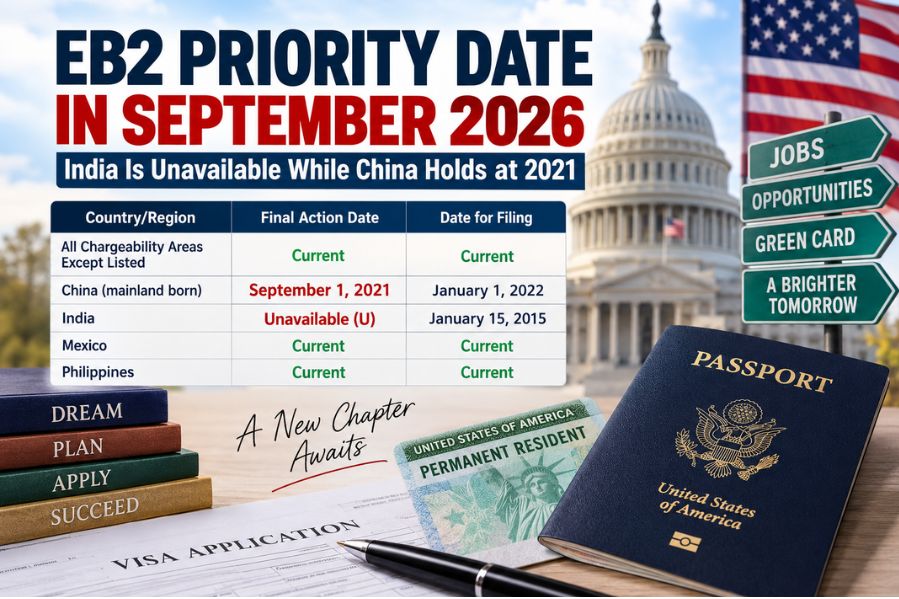
For applicants from China, the September 2026 Final Action Date remains September 1, 2021. For most other countries—including Mexico and the Philippines—the EB-2 category is current. India, however, is marked “U,” meaning unavailable.
BLUF: The EB2 priority date is definitively an applicant’s place in the employment-based immigrant-visa queue. For September 2026, EB-2 Final Action is Current for most countries, September 1, 2021 for China, and Unavailable for India. Indian EB-2 green cards therefore cannot receive final approval during September 2026.
September 2026 EB-2 Numbers Show Three Very Different Realities
The Department of State publishes two separate employment-based charts each month: Final Action Dates and Dates for Filing. They serve different purposes and should never be treated as interchangeable.
Here is the September 2026 EB-2 position:
| Chargeability Area | Final Action Date | Date for Filing |
|---|---|---|
| All Chargeability Areas Except Listed | Current | Current |
| China – mainland born | September 1, 2021 | January 1, 2022 |
| India | Unavailable | January 15, 2015 |
| Mexico | Current | Current |
| Philippines | Current | Current |
Source: September 2026 Department of State Visa Bulletin.
“Current,” shown as C, means immigrant visa numbers are available to qualified applicants regardless of priority date.
“Unavailable,” shown as U, means immigrant visa numbers are not authorized for issuance in that category during the applicable month.
When an actual cut-off date appears, the applicant’s priority date generally must be earlier than—not equal to—the listed date for final action to occur.
What Your EB2 Priority Date Actually Represents
A priority date establishes a person’s chronological position for a numerically limited immigrant visa.
For a conventional employer-sponsored EB-2 case requiring permanent labor certification, the priority date generally becomes the date the U.S. Department of Labor accepts the labor certification application for processing. USCIS decisions applying 8 C.F.R. § 204.5(d) confirm this rule.
For an EB-2 petition that does not require labor certification, such as many National Interest Waiver (NIW) cases, the priority date generally derives from the properly filed Form I-140 petition instead. USCIS guidance distinguishes petitions requiring labor certification from those that do not when establishing employment-based priority dates.
That distinction matters enormously.
An NIW applicant who filed an I-140 in 2025 cannot simply use the filing date of an earlier academic achievement, visa application, employment start date, or arrival in the United States. The legally recognized priority date is tied to the qualifying immigrant petition process.
EB-2 at a Glance
- Immigration category: Employment-Based Second Preference
- Primary eligibility groups: Advanced-degree professionals and persons of exceptional ability
- NIW option: Certain applicants may seek waiver of the normal job-offer and labor-certification requirements
- Queue identifier: Priority date
- Monthly allocation authority: U.S. Department of State
- Adjustment-of-status authority: USCIS
- Current official bulletin: September 2026
- Fiscal year ends: September 30, 2026
The Department of State allocates EB-2 approximately 28.6% of the worldwide employment-based preference level, plus numbers not required by EB-1. For fiscal year 2026, DOS determined the worldwide employment-based preference limit to be 186,317.
India Reached the FY2026 EB-2 Limit Before September
India’s “U” designation did not suddenly appear in September.
The July 2026 Visa Bulletin announced that India’s pro-rated EB-2 limit had been reached, making EB-2 India unavailable for the remainder of FY2026. The designation continued through August and September.
The sequence is revealing:
| Month | India EB-2 Final Action |
|---|---|
| May 2026 | July 15, 2014 |
| July 2026 | Unavailable |
| August 2026 | Unavailable |
| September 2026 | Unavailable |
In May, India had a Final Action Date of July 15, 2014. By July, high demand and visa-number use had exhausted India’s available FY2026 EB-2 allocation.
The Department of State said in July that it was likely India’s EB-2 Final Action Date would advance in October to at least the date published in the May 2026 bulletin. That would point to at least July 15, 2014, but DOS explicitly conditioned the projection on Indian demand and the FY2027 employment-based annual limit. It is therefore a forecast—not a guaranteed October cut-off.
China Is Open, but the Queue Still Stops in September 2021
China presents a different problem.
Unlike India, EB-2 China is not unavailable. Its September 2026 Final Action Date is September 1, 2021, while its Date for Filing is January 1, 2022.
Consider an applicant chargeable to China with an EB-2 priority date of:
- August 15, 2021: Earlier than September 1, 2021, so the priority-date requirement for final action is satisfied.
- September 1, 2021: Not earlier than the cut-off, so it does not satisfy that September Final Action Date.
- December 10, 2021: Not eligible for final action, although the priority date falls before the January 1, 2022 Date for Filing.
That last example highlights one of the most common Visa Bulletin misunderstandings: being eligible to file and being eligible for green card approval are different milestones.
Filing an I-485 and Receiving Approval Are Not the Same Event
The Dates for Filing chart identifies applicants who may be far enough along in the queue to begin certain processing steps. The Final Action Dates chart controls when an immigrant visa number can actually be allocated for final approval.
For adjustment-of-status applicants inside the United States, there is another critical step: USCIS announces which Visa Bulletin chart applicants may use for filing Form I-485 each month.
Applicants should therefore not see India’s September Date for Filing of January 15, 2015 and automatically assume they can file an I-485.
USCIS instructs applicants to check its monthly adjustment-of-status filing guidance to determine whether the Final Action Dates chart or Dates for Filing chart applies.
Final approval remains dependent on a visa being available under the applicable final-action rules.
Retrogression Explains Why a “Current” Case Can Move Backward
Priority dates do not always move forward.
When demand exceeds the number of immigrant visas legally available, the Department of State may move a cut-off date backward. That is known as visa retrogression. A category can also become completely unavailable when its annual numerical allocation is exhausted.
USCIS has explained that when an otherwise approvable adjustment case is affected by retrogression before final adjudication, the case may remain pending until an immigrant visa becomes available again.
This means an approved I-140 does not itself guarantee immediate green card approval.
Neither does a previously current priority date guarantee that the category will remain current the following month.
The September 2026 bulletin itself warns that increased EB-2 demand and visa-number use could require retrogression or even category unavailability before the fiscal year ends.
Priority-Date Retention Can Become Extremely Valuable
Applicants sometimes have more than one employment-based immigrant petition.
USCIS policy recognizes priority-date retention in certain EB-1, EB-2 and EB-3 circumstances, potentially allowing an applicant to use an earlier qualifying priority date rather than beginning at the back of the queue with every new petition. However, retention is governed by specific regulations and exceptions; it is not automatic in every situation.
For applicants facing long backlogs—particularly India and China—an older retained priority date can materially change when an immigrant visa becomes available.
FAQs.
What is the EB2 priority date?
The EB2 priority date is the date establishing an applicant’s place in the EB-2 immigrant-visa queue. For PERM-based cases, it is generally the date DOL accepted the labor certification. For qualifying cases without labor certification, it is generally tied to the properly filed immigrant petition.
What is the EB-2 priority date for India in September 2026?
There is no September 2026 EB-2 Final Action Date for India. The category is marked Unavailable (U) because India’s FY2026 pro-rated EB-2 allocation was reached. The separate Date for Filing remains January 15, 2015.
What is the EB-2 priority date for China in September 2026?
EB-2 China has a Final Action Date of September 1, 2021 and a Date for Filing of January 1, 2022 in the September 2026 Visa Bulletin. A priority date normally must be earlier than the applicable cut-off.
Is EB-2 current for the rest of the world?
Yes. In September 2026, EB-2 is listed as Current for All Chargeability Areas Except Those Listed, as well as Mexico and the Philippines. Qualified applicants in those columns are not restricted by an EB-2 priority-date cut-off for final action that month.
Will EB-2 India reopen in October 2026?
The Department of State previously said it was likely India’s Final Action Date would return in October to at least the level announced for May 2026—July 15, 2014. However, DOS explicitly said the result depends on demand and the FY2027 numerical limit, so the actual October date must be confirmed in the October Visa Bulletin.
September Is a Deadline Month, Not a Reliable Predictor of October
The September 2026 EB-2 numbers show why applicants should treat the Visa Bulletin as a monthly allocation system rather than a predictable countdown clock.
India has exhausted its FY2026 EB-2 availability. China remains anchored at a September 2021 Final Action Date. Most other countries remain current. And because a new federal fiscal year begins on October 1, 2026, the October bulletin could reset important parts of the picture.
What matters is not whether a priority date moved last month. What matters is whether your priority date is earlier than the applicable cut-off, your country of chargeability is correct, and USCIS or DOS is authorized to take the next action on your case in the current month.
Editorial Disclaimer
This article is informational and reflects official government material available as of September 7, 2026. Visa Bulletin cut-offs, USCIS filing-chart selections and immigration policies can change. It is not individualized legal advice; applicants with case-specific questions should verify the current Department of State and USCIS guidance or consult a qualified U.S. immigration attorney.

Pasonet Explained: Why This Digital Name Is More Complicated Than It First Appears

1upHealth Revenue Cycle Automation Partnerships: What’s Real, What’s Emerging, and Why 2027 Changes the Stakes

Kögel Trailer GmbH Manufacturing or Wholesale? The Business Model Behind the German Trailer Company

Paul Smalley Studied at University: The Education Behind His Global Football Career

Fawn Radmanich Marketing Strategy Experience: Why Her 25-Year A/E/C Career Centers on Winning Complex Work

Emily Seitz Pawlak at TriHealth: The Revenue Cycle Executive Who Pushed Automation Beyond Billing

Jadene Elden, AI Automation and RCM at Southcoast Health: What the Public Record Actually Shows

Tina Esposito Advocate Health Bio: The Data Executive Shaping Analytics, AI and Patient Care

Michael Roe Operating Partner NexPhase: The Verified Record Behind the Name — and the michaelroe.net Question

Briana Biagi Banner Health Fallon NV Staff Directory: What Current Records Actually Show

Astrid Hannah: The Inspiring Story of John Hannah’s Daughter and Her Life Beyond Competitive Swimming

Best Pasticho Venezuelan Lasagna Near Me: A Complete Guide to Finding This Rich Latin Comfort Food

Natasha Podstepny LinkedIn Performant Healthcare Nashville: Inside Her Professional Journey

John Minoli: The Private Life and Career of Sheena Easton’s Fourth Husband

Jeroen Dik: How He Built a Powerful Legacy in Performance Tuning and Motorsport

Lihnk Explained: The Mysterious Search Term, Possible Meanings, and What Users Should Know

Colitre Explained: The Powerful Story Behind a Rare Name and Its Modern Identity

Nigora Whitehorn: The Inspiring Life, Marriage, and Story Behind Duncan Bannatyne’s Wife

Kemberly Blackledge LinkedIn Nashville General Hospital Chief Revenue Officer: How She Built a Powerful Healthcare Finance Career

Elegant Florals Emily Davis Business Description: A Refined Look at Floral Art, Event Design, and Botanical Creativity
Pasonet Explained: Why This Digital Name Is More Complicated Than It First Appears
1upHealth Revenue Cycle Automation Partnerships: What’s Real, What’s Emerging, and Why 2027 Changes the Stakes
Kögel Trailer GmbH Manufacturing or Wholesale? The Business Model Behind the German Trailer Company
Paul Smalley Studied at University: The Education Behind His Global Football Career
Fawn Radmanich Marketing Strategy Experience: Why Her 25-Year A/E/C Career Centers on Winning Complex Work
Emily Seitz Pawlak at TriHealth: The Revenue Cycle Executive Who Pushed Automation Beyond Billing
Jadene Elden, AI Automation and RCM at Southcoast Health: What the Public Record Actually Shows
Tina Esposito Advocate Health Bio: The Data Executive Shaping Analytics, AI and Patient Care
Michael Roe Operating Partner NexPhase: The Verified Record Behind the Name — and the michaelroe.net Question
Briana Biagi Banner Health Fallon NV Staff Directory: What Current Records Actually Show
-
 Celebrity4 months ago
Michael Scott Ryan: The Private Writer Known for His Connection to Jennifer Ehle
-
 Celebrity4 months ago
Daniel Guerard, The Private French Salon Owner Behind Lorraine Bracco’s Early Life Story
-
 Celebrity5 months ago
Caroline Hickman: The Private Life and Public Attention Around Steve Coogan’s Former Wife
-
 Celebrity3 months ago
Benn George, The Private British Businessman Behind a Powerful Chapter in Tiffany Darwish’s Life