
Business & Innovation
Ore Capital Explained: Investment, Mining Finance, and the Business Meaning Behind the Name

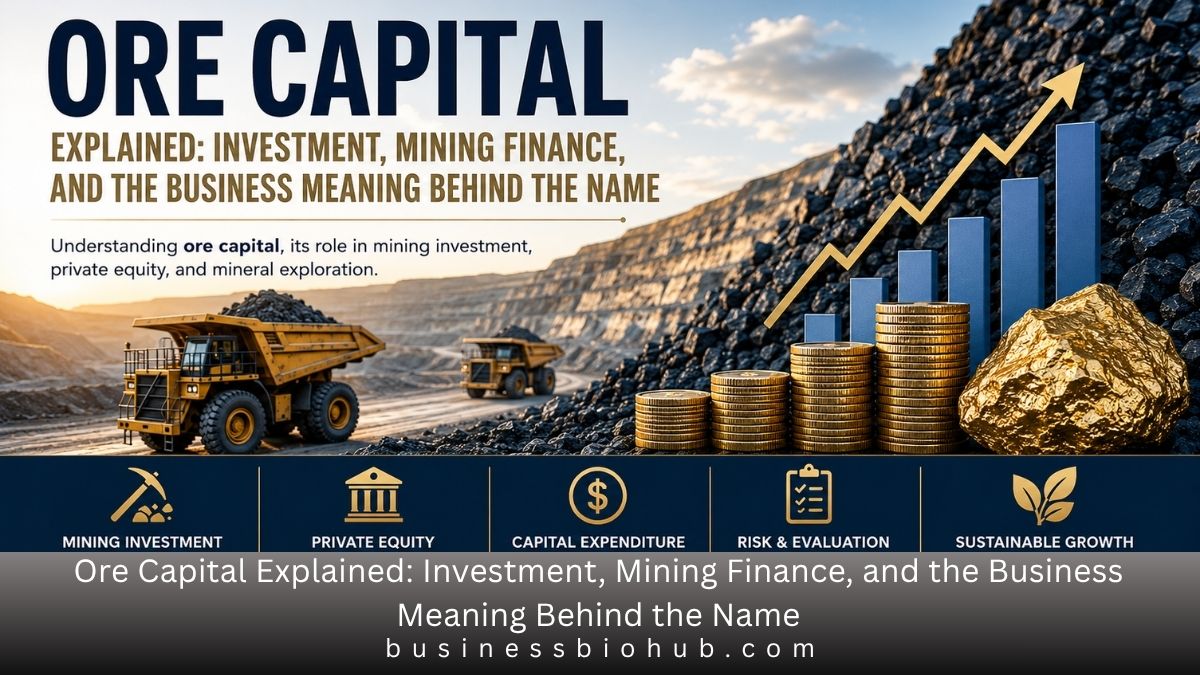
The term ore capital can have more than one meaning depending on where and how it is used. In one context, it may refer to an investment company involved in mining, mineral exploration, private equity, or venture capital. In another, it may describe the capital required to develop ore deposits, finance mining projects, purchase equipment, build processing facilities, or support companies operating within the natural resources sector. Businesses also use similar names in financial education, wealth management, and startup investment. Because of this variety, understanding ore capital requires looking beyond the name itself and examining the relationship between investment, mineral resources, business development, and financial strategy. The phrase is especially relevant in industries where major amounts of money must be committed long before a project begins generating revenue. Mining is one of the clearest examples, as exploration, environmental studies, infrastructure, machinery, labor, processing, and transportation can all require significant funding before commercial production begins.
What Does Ore Capital Mean?
Broadly, ore capital refers to the money, investment resources, or financial backing tied to mineral exploration and mining-related opportunities. Ore is naturally occurring rock or material containing minerals that can potentially be extracted economically. Turning an ore deposit into a functioning commercial operation, however, is a complicated and expensive process. Companies may need financing for geological surveys, drilling, feasibility studies, licensing, land access, equipment, construction, processing systems, and ongoing operating costs. In this sense, capital serves as the financial foundation that helps move a mineral resource from an early exploration idea to a commercially viable project. The term can also function as a company or brand name, which is why searches for it may return private equity firms, investment businesses, mining-focused organizations, or financial education companies. The exact meaning, therefore, depends on whether the phrase is used as an industry concept or as the name of a particular business.
Ore Capital and Mining Investment
Mining is a capital-intensive industry, meaning companies often need substantial financial resources before they can earn meaningful revenue from a deposit. Early exploration can involve geological mapping, sampling, drilling programs, laboratory testing, and resource modeling. If a deposit appears commercially attractive, the project may move into more advanced stages involving engineering, environmental assessments, permitting, infrastructure design, and feasibility studies. Each step may require additional funding, and investors are expected to evaluate whether the potential reward justifies the associated financial and operational risks. This is where ore capital becomes especially important. Investment capital can support companies that would otherwise struggle to advance promising mineral discoveries. In many cases, investors are not simply funding a mine; they are financing a long sequence of technical, regulatory, and commercial milestones. Management quality, project location, mineral type, expected production costs, commodity prices, and access to infrastructure can all influence investment decisions.
Private Equity and Venture Capital in the Mineral Sector
Private equity and venture capital can play an important role in financing natural resource businesses. A firm associated with ore capital may look for opportunities in exploration companies, early-stage mineral assets, development projects, or established mining businesses seeking expansion capital. Unlike traditional bank lending, private investors may accept higher risk in exchange for ownership, equity, strategic influence, or the potential for substantial long-term returns. Mining investments can be highly uncertain because a promising geological target does not automatically become an economically successful mine. Investors therefore examine resource quality, geological potential, management experience, jurisdiction, project economics, and market demand before committing capital. In some situations, an investment firm may also help a mining company improve its corporate structure, access additional financing, attract industry partners, or position itself for future growth.
Why Mineral Exploration Requires Significant Capital
Mineral exploration is sometimes misunderstood as a simple search for valuable metals, but it is far more technical and financially demanding. Exploration companies may spend years collecting data before they can confidently estimate a mineral resource’s size and quality. Drilling is expensive, especially in remote locations where companies must develop or transport roads, power, water, and accommodation to the site. Specialized geologists, engineers, laboratories, environmental consultants, and equipment operators may also be required. As the project advances, the financial requirements can rise sharply. This makes more capital critical to the exploration process because funding determines whether a company can keep testing its geological theories and advancing its assets. Without sufficient capital, even a potentially valuable discovery can remain undeveloped for years.
The Importance of Capital Allocation
Having money is not enough; mining businesses must also allocate it carefully. Capital allocation is the process of deciding where to allocate financial resources to create the greatest long-term value. A mining company may need to decide whether to invest more heavily in exploration, purchase new equipment, develop infrastructure, acquire another project, repay debt, or preserve cash for future operations. Poor capital allocation can damage even a company with strong mineral assets. Spending too aggressively during periods of high commodity prices can leave a business financially exposed when market conditions change. Conversely, refusing to invest in promising exploration or development opportunities can limit future growth. Effective ore capital management therefore depends on financial discipline, realistic project assumptions, risk analysis, and a clear understanding of the commodity cycle.
Capital Expenditure in Mining Projects
One of the most important financial concepts related to operating capital is capital expenditure, commonly called capex. Mining capex includes spending on major assets and infrastructure needed to build or expand a project. This can include processing plants, crushers, conveyor systems, haul roads, trucks, drilling equipment, power systems, water facilities, rail connections, storage areas, and worker accommodation. Large mining projects can require enormous upfront investment before commercial production begins. Investors therefore closely watch estimated construction costs, expected production rates, operating expenses, and potential returns. A project with high-quality ore may still be unattractive if the required capital expenditure is too high relative to its expected profitability. For this reason, successful mining finance is based not only on geological potential but also on economic efficiency and financial sustainability.
Risk Factors Associated With Ore Capital
Investment in mineral projects comes with several important risks. Commodity prices can change rapidly, affecting a mine’s future profitability. Political or regulatory conditions may change in the country where a project is located. Permitting delays can increase costs, while environmental issues may require expensive redesigns or additional studies. Geological uncertainty is another major concern because early exploration estimates can change as more drilling information becomes available. Construction costs, energy prices, labor shortages, and supply chain problems can also affect project economics. Because of these factors, ore capital investors usually need a higher tolerance for uncertainty than investors focused on mature businesses with predictable cash flow. Diversification, technical due diligence, experienced management, and conservative financial assumptions can help reduce risk, although no investment strategy can eliminate uncertainty.
Ore Capital as a Business or Brand Name
The phrase “ore capital” may also refer to a specific financial company or investment organization. Businesses using this terminology can operate across areas such as private equity, venture capital, mineral exploration investment, wealth planning, and financial education. This can confuse people searching for information about the term because similarly named companies may have completely different business models. One organization may focus mainly on mining opportunities, while another may provide educational resources about investing and personal finance. Another firm with a similar name could focus on startup funding rather than mineral resources. Therefore, anyone researching a company called Ore Capital should carefully review its exact legal name, location, leadership, investment strategy, and industry focus, rather than assuming that all businesses with similar names are connected.
Financial Education and Wealth Planning Context
Although the word “ore” strongly suggests mining, some businesses that use variations of “ore” in their names operate in financial education and wealth planning. These organizations may focus on long-term investing, portfolio analysis, stock market education, personal budgeting, or financial decision-making. In this context, capital refers more broadly to a person’s or company’s financial resources rather than money invested specifically in mining. The goal may be to help individuals understand how assets, risk, diversification, and long-term planning work together. This broader use of the phrase shows how flexible financial terminology can become when adopted as a brand identity. For researchers, investors, and consumers, context is therefore essential when determining what a particular Ore Capital organization actually does.
How Investors Evaluate Mining Opportunities
Investors considering mining-related opportunities typically evaluate several layers of information before committing money. Geological data is important, but it is only one part of the process. Investors also examine whether the project has access to transportation, energy, water, labor, and processing infrastructure. The legal environment of the country or region is another major factor, as mining licenses, taxation, environmental regulations, and government stability can materially affect returns. Management experience matters as much as a technically strong deposit can still underperform without operational discipline. Ore grade, resource size, recovery rates, production costs, capital requirements, commodity prices, and development timelines are key measures used to assess a project’s potential. Strong investors therefore combine geological analysis with financial and operational judgment.
The Role of Commodity Prices
Commodity markets strongly influence ore capital because a mining project’s value is closely tied to the future price of the metal or mineral it plans to produce. Gold, copper, iron ore, nickel, lithium, silver, and other commodities can experience significant price movements driven by supply and demand, economic growth, industrial activity, technology trends, geopolitical events, and currency movements. A project that appears highly profitable during a strong commodity cycle may become less attractive when prices decline. This is why experienced mining investors often use conservative price assumptions when evaluating long-term opportunities. Companies that maintain financial discipline during strong markets can be better prepared for periods of weaker prices.
Sustainability and Responsible Investment
Modern mining investment increasingly considers environmental, social, and governance factors. Investors want to understand how a company manages environmental risks, worker safety, community relationships, water use, land disturbance, regulatory compliance, and corporate governance. Responsible development can reduce certain operational and reputational risks while also improving long-term project stability. Mining projects that ignore community concerns or environmental responsibilities may face delays, opposition, additional costs, or regulatory problems. As a result, capital providers are increasingly interested in whether management teams can develop resources in ways that balance economic goals with legal, environmental, and social responsibilities.
Why Ore Capital Matters to the Global Economy
Mineral investment supports industries far beyond mining itself. Iron ore is essential to steel production; copper is widely used in electrical infrastructure; lithium and nickel are important in battery technologies; and precious metals serve industrial, investment, and technological purposes. Developing these resources requires financing, making ore capital part of a larger economic system that connects investors, mining companies, manufacturers, infrastructure providers, and global commodity markets. When capital is allocated efficiently, it can help transform mineral resources into materials required for construction, transportation, energy systems, electronics, and industrial development. At the same time, poor investment decisions can lead to abandoned projects, financial losses, and inefficient resource use.
Conclusion
Ore capital is a broad term that can refer to both specific financial organizations and the broader concept of capital used to fund mineral exploration, mining development, and natural resource investment. Its importance becomes clearer when you consider the enormous financial requirements of discovering, evaluating, building, and operating a mine. Private equity firms, venture capital investors, mining companies, financial planners, and other organizations may all use capital in different ways. Still, the central principle remains the same: allocate money carefully to generate sustainable value. For mining-focused investors, success depends on more than finding valuable ore. It requires financial discipline, technical knowledge, risk management, market awareness, responsible development, and strong leadership. Understanding these elements clarifies why ore capital remains an important concept in both the investment world and the global natural resources industry.

Telehealth Psychiatric & Mental Health Care: Accessible Support for a Healthier Mind

West Palm Beach Detox: A Safe and Supportive Start to Lasting Recovery

Drug & Alcohol Rehab in West Palm Beach, FL: Start Your Journey to a Healthier Life

Drug & Alcohol Detox in South Carolina: A Complete Guide to Safe Recovery

Drug and Alcohol Detox Kentucky: Your Guide to Safe Recovery at Paducah Detox Center

Addiction Treatment in Plymouth: Understanding Addiction & Mental Health Treatment

Ohio Center for Adolescent Wellness: Your Guide to Teen Mental Health Services in Ohio

Massachusetts Center for Adolescent Wellness: Your Guide to Teen Mental Health & Addiction Treatment in MA

Foundation Diploma Singapore: A Practical Route Towards Higher Education

How to Stay Safe and Private While Using Public Wi-Fi

Paul Smalley Studied at University: The Education Behind His Global Football Career

Diamo Jewels Under the Lens: What Buyers Should Know Before Ordering in 2026

Billie Henry: Inside the Private Life Dawn French Fought to Keep Out of the Spotlight

Tina Esposito Advocate Health Bio: The Data Executive Shaping Analytics, AI and Patient Care

Kögel Trailer GmbH Manufacturing or Wholesale? The Business Model Behind the German Trailer Company

iPhone 17 Pro Max Phone Case: Best Protection Choices That Actually Matter in 2026

Pasonet Explained: Why This Digital Name Is More Complicated Than It First Appears

1upHealth Revenue Cycle Automation Partnerships: What’s Real, What’s Emerging, and Why 2027 Changes the Stakes

Industrial Entrepreneurs Memorandum: The 2026 IEM Rules Every Large Manufacturer Should Understand

EliseAI Head of Partnerships 2024–2026: The Leadership Shift Behind Its Expanding AI Partner Network
Telehealth Psychiatric & Mental Health Care: Accessible Support for a Healthier Mind
West Palm Beach Detox: A Safe and Supportive Start to Lasting Recovery
Drug & Alcohol Rehab in West Palm Beach, FL: Start Your Journey to a Healthier Life
Drug & Alcohol Detox in South Carolina: A Complete Guide to Safe Recovery
Drug and Alcohol Detox Kentucky: Your Guide to Safe Recovery at Paducah Detox Center
Addiction Treatment in Plymouth: Understanding Addiction & Mental Health Treatment
Ohio Center for Adolescent Wellness: Your Guide to Teen Mental Health Services in Ohio
Massachusetts Center for Adolescent Wellness: Your Guide to Teen Mental Health & Addiction Treatment in MA
Foundation Diploma Singapore: A Practical Route Towards Higher Education
How to Stay Safe and Private While Using Public Wi-Fi
-
 Celebrity4 months ago
Michael Scott Ryan: The Private Writer Known for His Connection to Jennifer Ehle
-
 Celebrity4 months ago
Benn George, The Private British Businessman Behind a Powerful Chapter in Tiffany Darwish’s Life
-
 Celebrity5 months ago
Daniel Guerard, The Private French Salon Owner Behind Lorraine Bracco’s Early Life Story
-
 Celebrity6 months ago
Caroline Hickman: The Private Life and Public Attention Around Steve Coogan’s Former Wife