
Business
Industrial Entrepreneurs Memorandum: The 2026 IEM Rules Every Large Manufacturer Should Understand

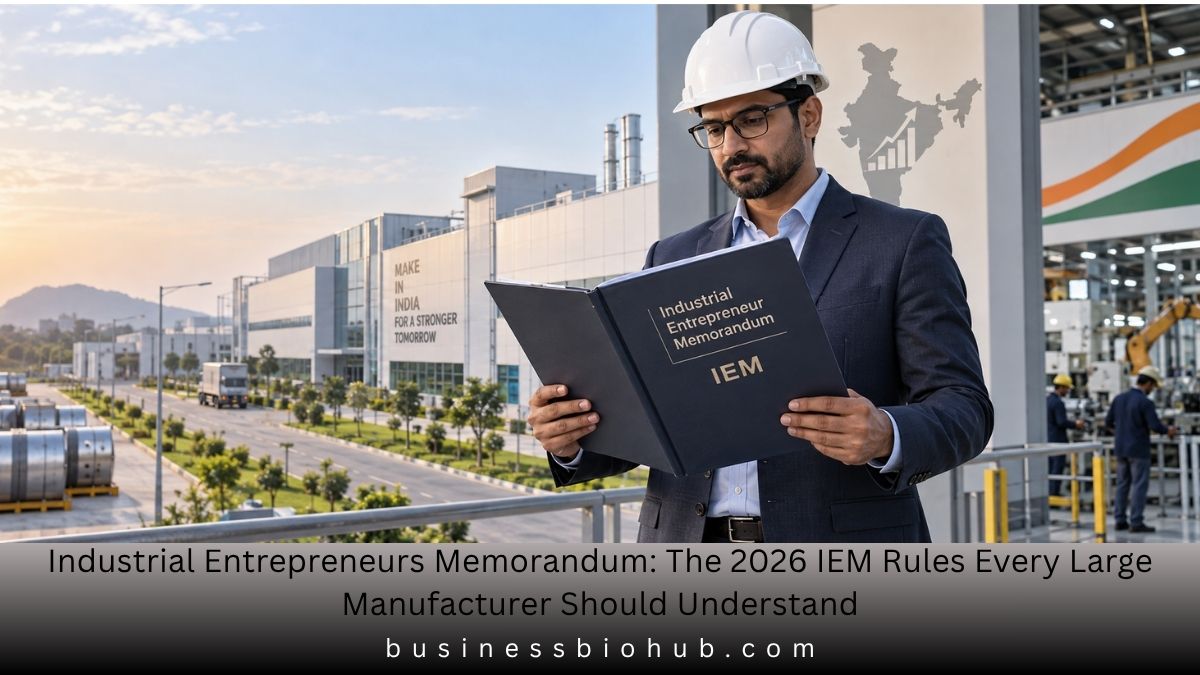
For a large manufacturing project in India, one regulatory misunderstanding can create problems long after machinery has been ordered, capacity has been planned, or commercial production has begun. The Industrial Entrepreneur Memorandum sits directly inside that compliance chain—but it is frequently confused with an industrial licence, project approval, or government clearance.
That distinction matters even more in 2026. The Department for Promotion of Industry and Internal Trade has completed the migration of Industrial Entrepreneur Memorandum services from the older G2B Portal to the National Single Window System, or NSWS. New Part-A, Part-B and relevant amendment filings are now routed through NSWS.
There has also been a major eligibility reset. From 1 April 2025, the applicable large-enterprise thresholds moved to investment in plant and machinery/equipment exceeding ₹125 crore and/or annual turnover exceeding ₹500 crore. That change significantly narrowed the group of businesses for which IEM acknowledgement is relevant.
Bottom line: An Industrial Entrepreneur Memorandum, officially called the Industrial Entrepreneur Memorandum or IEM, is a self-declaratory filing for eligible large-scale industrial undertakings operating in de-licensed manufacturing sectors. It records project information with DPIIT; it is not an industrial licence, environmental approval, factory licence or permission to begin operations.
The Name Causes Confusion, but the Legal Function Is Much Clearer
Searchers frequently use the phrase industrial entrepreneurs memorandum, although the Government of India currently describes the filing as the Industrial Entrepreneur Memorandum (IEM).
The system emerged from India’s post-1991 industrial-policy liberalisation. As industrial licensing requirements were removed from large parts of manufacturing, the government still needed structured information about substantial industrial investments, production capacity, locations and proposed manufacturing activities.
Historically, the government described IEM as an informational mechanism rather than a conventional licensing instrument. A 2012 Ministry of Commerce and Industry clarification stated that the filing had been intended for statistical purposes and for determining whether proposed manufacturing activity attracted industrial-licensing requirements.
That fundamental distinction remains visible in the current NSWS system.
DPIIT’s 2026 guidance describes IEM as self-declaratory, says that the acknowledgement is generated electronically, and explicitly states that an IEM acknowledgement is not an approval, licence or clearance.
What an IEM Actually Records
An IEM creates an official record of a qualifying industrial undertaking and its declared project information.
The ₹125 Crore and ₹500 Crore Test Changed the Eligibility Equation
One of the most important recent changes concerns financial eligibility.
From 1 April 2025, DPIIT revised the threshold used for IEM acknowledgement in line with the revised MSME classification criteria. The earlier limits had been ₹50 crore in plant-and-machinery investment and ₹250 crore in turnover. They increased to more than ₹125 crore and more than ₹500 crore respectively.
2026 IEM Eligibility Grid
| Test | Current position |
|---|---|
| Relevant business scale | Large-scale industrial undertaking outside the MSME category |
| Plant and machinery/equipment investment | Exceeding ₹125 crore |
| Annual turnover | Exceeding ₹500 crore |
| How thresholds operate | Investment and/or turnover may establish eligibility |
| Industry type | Generally a de-licensed industrial/manufacturing activity |
| Filing character | Self-declaratory |
| Government acknowledgement | Electronically generated |
| Industrial licence replacement? | No |
| Other statutory approvals replaced? | No |
| Current filing platform | National Single Window System |
The official 2026 NSWS manual specifically describes IEM acknowledgement as applicable to large-scale industrial units in the de-licensed category meeting the ₹125 crore investment threshold and/or ₹500 crore turnover threshold.
That means an entrepreneur should not decide whether an IEM applies merely by looking at company size.
The nature of the manufacturing activity matters too.
IEM or Industrial Licence? This Is the Decision That Matters First
Before worrying about Part-A or Part-B, a manufacturer should determine whether the proposed activity falls inside a de-licensed sector or a category requiring compulsory industrial licensing.
An IEM is informational and self-declaratory.
An Industrial Licence is a formal regulatory approval.
NSWS currently explains the difference in similarly direct terms: IEM applies to qualifying industrial projects in sectors not requiring an industrial licence, while regulated or restricted manufacturing activities can fall under the industrial-licensing regime.
Four Compulsorily Licensed Areas Identified by NSWS
NSWS currently lists four industries retained under compulsory licensing under the Industries (Development and Regulation) Act, 1951:
- Electronic aerospace and defence equipment
- Industrial explosives
- Specified hazardous chemicals
- Cigars, cigarettes of tobacco and manufactured tobacco substitutes, subject to the stated policy restrictions
The portal also explains that industrial licences may be required under other legislation, including the Arms Act framework for relevant defence-related manufacturing.
This is why filing an IEM should never be treated as a shortcut around sector-specific regulation.
Part-A Captures the Industrial Plan Before Production Starts
IEM Part-A concerns the proposed industrial undertaking.
According to the NSWS March 2026 guidance, Part-A should be filed before commencement of commercial production.
The applicant supplies core details about the entity and planned project, including its location, product classification, expected production capacity, planned investment and employment.
An Acknowledgement Is Not Permission to Ignore Other Laws
This is arguably the most important compliance point in the entire process.
Receiving an IEM acknowledgement does not automatically mean the industrial unit has satisfied:
- Environmental requirements
- Pollution-control permissions
- Factory-related approvals
- Building or land-use requirements
- Fire and safety regulation
- Sector-specific authorisations
- State-level operating requirements
- Court orders or other legally binding restrictions
NSWS explicitly warns that IEM acknowledgement cannot itself be treated as clearance to carry on the contemplated industrial activity unless all applicable statutory and regulatory requirements are separately satisfied.
Part-B Tells the Government That the Factory Has Actually Started Producing
Part-A records intent.
Part-B records implementation.
After commercial production begins, an industrial undertaking that has filed the applicable IEM is expected to report the operational details through Part-B.
The March 2026 NSWS guidance says Part-B is filed after commencement of commercial production.
Information includes:
- Actual date commercial production commenced
- Actual investment incurred
- Installed manufacturing capacity
- Production information
- Employment generated
The applicant logs into NSWS, selects the previously filed Part-A record, chooses the Part-B option, supplies the actual operational figures, submits the declaration and downloads the acknowledgement.
Why Part-B Should Not Be Treated as Optional Housekeeping
A common mistake is assuming the compliance exercise ended when Part-A was acknowledged.
It did not.
The project’s real operating information may differ from its original projections. Part-B enables the official industrial record to reflect what was actually established.
NSWS warns that failure to file Part-B after production starts is one of the common IEM filing errors.
The Portal Migration Quietly Rewrote the Filing Routine
For years, businesses associated IEM applications with DPIIT’s G2B Portal.
That workflow is now obsolete for new filings.
On 1 October 2025, DPIIT announced completion of the migration of Industrial Entrepreneur Memorandum services from the G2B Portal to the National Single Window System. The migration covered Part-A acknowledgement, Part-B filing and Part-A amendments.
DPIIT’s legacy portal now directs applicants to NSWS and states that all new IEM Part-A, Part-B and amendment applications must be submitted exclusively through the new system.
A Short Timeline of the IEM System
| Period | What changed |
|---|---|
| 1991 | India’s liberalised industrial-policy framework expanded de-licensing and established the memorandum-based reporting approach |
| 2012 clarification | Government reiterated the informational and statistical character of IEM |
| 2020 era | DPIIT expanded electronic IEM services through its enhanced G2B environment |
| 1 April 2025 | Eligibility thresholds rose to more than ₹125 crore investment and/or ₹500 crore turnover |
| October 2025 | DPIIT announced completed migration of IEM services to NSWS |
| March 2026 | NSWS issued updated IEM guidance explaining Part-A, Part-B and amendments |
| September 2026 | NSWS continues to identify itself as the current application route for IEM filings |
Amendments Matter When the Project Changes After Part-A
Industrial projects rarely remain frozen exactly as first proposed.
Product portfolios expand. Manufacturing capacity changes. Investment rises. Locations can be revised. Corporate names or registered addresses may change.
The current IEM system therefore provides an amendment route.
For Part-A, NSWS guidance identifies amendments involving matters such as:
- Addition or change of a manufactured product
- Capacity changes
- Location changes
- Company-name changes
- Registered-address changes
- Investment revisions
- Corrections or updates to originally declared information
Applicants use the IEM amendment facility, modify the relevant fields, upload supporting material when applicable and submit the revised information.
Part-B corrections are more restricted. The NSWS manual states that Part-B amendments can address factual matters such as actual investment figures, capacity information, commencement dates or production details, while significant departures may require further clarification.
That reinforces a core feature of the IEM framework: it records industrial facts; it does not automatically authorise an otherwise unapproved project change.
The Real Value of IEM Is Knowing What It Does—and What It Does Not Do
The Industrial Entrepreneur Memorandum is deceptively simple.
For an eligible manufacturer, it creates an official record of a major industrial investment without imposing the full appraisal process associated with industrial licensing. That fits the broader policy objective of making legitimate industrial investment easier to document and administer.
But simplicity creates its own risk.
An electronically generated IEM acknowledgement can look authoritative enough to be mistaken for broader project approval. It is not.
The safer 2026 approach is to treat IEM as one component of a larger compliance map: first determine whether the activity is de-licensed, then confirm the financial eligibility threshold, file Part-A correctly through NSWS, secure every separate statutory permission that applies, and complete Part-B when commercial production actually begins.
That distinction turns IEM from a confusing government acronym into what it was designed to be: a structured record of significant industrial activity, not a substitute for the law governing that activity.
FAQs
What is an Industrial Entrepreneurs Memorandum?
An Industrial Entrepreneur Memorandum is a government filing for eligible large-scale industrial undertakings operating in de-licensed sectors in India. The official government term is Industrial Entrepreneur Memorandum, or IEM. It records details about an industrial project but does not itself constitute permission, clearance or an industrial licence.
Who needs an Industrial Entrepreneur Memorandum in 2026?
An IEM is relevant to qualifying large-scale industrial undertakings outside the MSME category operating in activities not subject to compulsory industrial licensing. Current eligibility uses investment in plant and machinery/equipment exceeding ₹125 crore and/or annual turnover exceeding ₹500 crore.
Is an IEM the same as an industrial licence?
No. An IEM is a self-declaratory informational filing, while an Industrial Licence is a regulatory approval required for specified controlled activities. An IEM acknowledgement does not give a manufacturer permission to bypass sector-specific or statutory approval requirements.
Where is IEM filed in 2026?
IEM filings are now made through India’s National Single Window System. DPIIT completed migration from its G2B Portal in 2025, and the former portal now directs applicants to NSWS for new Part-A, Part-B and amendment filings.
What is the difference between IEM Part-A and Part-B?
Part-A records the proposed industrial project before commercial production, while Part-B reports actual implementation after commercial production begins. Part-A contains projected details such as investment and capacity; Part-B records actual investment, operating capacity, commencement date, production and employment.
Does IEM acknowledgement replace environmental or factory approvals?
No. IEM acknowledgement does not replace environmental clearance, pollution-control permissions, factory-related licences or other statutory approvals. NSWS expressly states that acknowledgement should not be interpreted as permission to conduct an activity contrary to other applicable laws, regulations or official directions.
Editorial Disclaimer
This article is an informational overview of the Industrial Entrepreneur Memorandum framework based on publicly available Government of India, DPIIT, PIB and NSWS material reviewed for September 2026. Regulatory thresholds, portal procedures, licensing classifications and sector-specific requirements can change. Businesses should verify the latest DPIIT and NSWS instructions and obtain appropriate professional or legal advice before relying on an IEM filing for a specific industrial project.

Telehealth Psychiatric & Mental Health Care: Accessible Support for a Healthier Mind

West Palm Beach Detox: A Safe and Supportive Start to Lasting Recovery

Drug & Alcohol Rehab in West Palm Beach, FL: Start Your Journey to a Healthier Life

Drug & Alcohol Detox in South Carolina: A Complete Guide to Safe Recovery

Drug and Alcohol Detox Kentucky: Your Guide to Safe Recovery at Paducah Detox Center

Addiction Treatment in Plymouth: Understanding Addiction & Mental Health Treatment

Ohio Center for Adolescent Wellness: Your Guide to Teen Mental Health Services in Ohio

Massachusetts Center for Adolescent Wellness: Your Guide to Teen Mental Health & Addiction Treatment in MA

Foundation Diploma Singapore: A Practical Route Towards Higher Education

How to Stay Safe and Private While Using Public Wi-Fi

Paul Smalley Studied at University: The Education Behind His Global Football Career

Diamo Jewels Under the Lens: What Buyers Should Know Before Ordering in 2026

Billie Henry: Inside the Private Life Dawn French Fought to Keep Out of the Spotlight

Tina Esposito Advocate Health Bio: The Data Executive Shaping Analytics, AI and Patient Care

Kögel Trailer GmbH Manufacturing or Wholesale? The Business Model Behind the German Trailer Company

iPhone 17 Pro Max Phone Case: Best Protection Choices That Actually Matter in 2026

Pasonet Explained: Why This Digital Name Is More Complicated Than It First Appears

1upHealth Revenue Cycle Automation Partnerships: What’s Real, What’s Emerging, and Why 2027 Changes the Stakes

EliseAI Head of Partnerships 2024–2026: The Leadership Shift Behind Its Expanding AI Partner Network

Industrial Entrepreneurs Memorandum: The 2026 IEM Rules Every Large Manufacturer Should Understand
Telehealth Psychiatric & Mental Health Care: Accessible Support for a Healthier Mind
West Palm Beach Detox: A Safe and Supportive Start to Lasting Recovery
Drug & Alcohol Rehab in West Palm Beach, FL: Start Your Journey to a Healthier Life
Drug & Alcohol Detox in South Carolina: A Complete Guide to Safe Recovery
Drug and Alcohol Detox Kentucky: Your Guide to Safe Recovery at Paducah Detox Center
Addiction Treatment in Plymouth: Understanding Addiction & Mental Health Treatment
Ohio Center for Adolescent Wellness: Your Guide to Teen Mental Health Services in Ohio
Massachusetts Center for Adolescent Wellness: Your Guide to Teen Mental Health & Addiction Treatment in MA
Foundation Diploma Singapore: A Practical Route Towards Higher Education
How to Stay Safe and Private While Using Public Wi-Fi
-
 Celebrity4 months ago
Michael Scott Ryan: The Private Writer Known for His Connection to Jennifer Ehle
-
 Celebrity4 months ago
Benn George, The Private British Businessman Behind a Powerful Chapter in Tiffany Darwish’s Life
-
 Celebrity5 months ago
Daniel Guerard, The Private French Salon Owner Behind Lorraine Bracco’s Early Life Story
-
 Celebrity6 months ago
Caroline Hickman: The Private Life and Public Attention Around Steve Coogan’s Former Wife