
Technology & Tools
Nickolas Means: The Engineering Leader Turning History Into Powerful Lessons for Modern Technology Teams

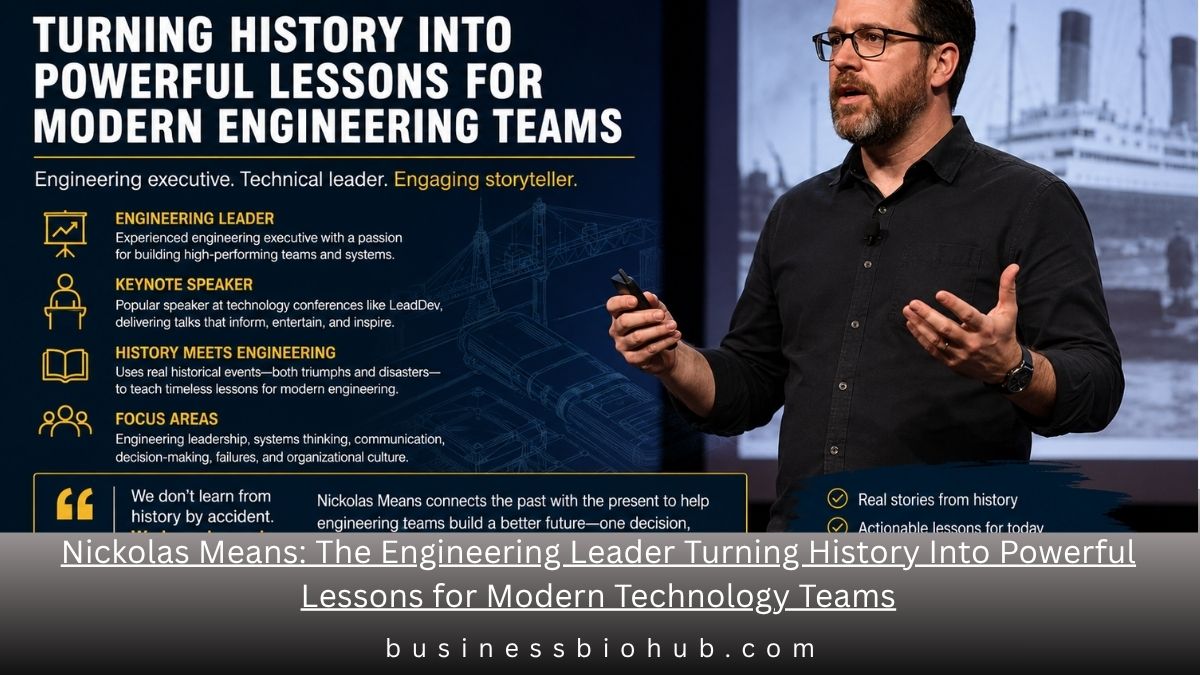
Nickolas Means is a name that has become familiar within software engineering, technology leadership, and conference-speaking circles because of an unusual ability to connect historical events with the everyday challenges faced by modern technical organizations. Rather than limiting his presentations to programming languages, frameworks, or management theories, he often examines major engineering achievements, operational failures, disasters, and complex human decisions to explain how teams behave under pressure. This storytelling-driven approach has helped distinguish him from more conventional technology speakers. For engineering managers, software developers, technical executives, and professionals responsible for complex systems, his work reminds them that technology problems are rarely caused by technology alone. Communication, incentives, organizational culture, decision-making, risk management, and leadership frequently determine whether a technically sophisticated project succeeds or fails. Through this mix of history and engineering insight, Nickolas Means has developed a professional identity centered on helping technical audiences think more carefully about the systems they build and the teams that build them.
Who Is Nickolas Means?
Nickolas Means is widely associated with software engineering leadership, technical management, executive decision-making, and public speaking. He is particularly recognized for presentations that use memorable historical stories as frameworks for discussing modern engineering organizations. Rather than presenting leadership as a collection of abstract management rules, he often approaches the subject through concrete situations involving difficult decisions, incomplete information, technical constraints, competing priorities, and human behavior. This method gives audiences something more memorable than a traditional list of best practices, as listeners can see how decisions unfold in real-world situations with real consequences. His professional interests sit at the intersection of technology, leadership, engineering culture, organizational behavior, and historical analysis. These areas are increasingly important as software systems become larger and more interconnected, requiring engineers to cooperate across departments, manage uncertainty, and understand the broader consequences of technical decisions. Means’ work therefore resonates with professionals who believe that strong engineering leadership requires more than technical expertise. It also requires judgment, empathy, communication, preparation, and an understanding of how people respond when systems begin to fail.
Why Nickolas Means Is Known in Engineering Communities
One reason Nickolas Means has attracted attention within engineering communities is his ability to make leadership lessons engaging. Technical conferences can become highly specialized, with presentations focusing heavily on implementation details useful only to particular audiences. Means has taken a broader approach. By drawing on stories from engineering history, transportation, disasters, organizational failures, and technological accomplishments, he can speak to developers, engineering managers, senior leaders, and people from diverse technical backgrounds at once. The historical narrative provides the story, while the engineering analysis provides the practical lesson. Audiences may hear about a complicated event from the past and then discover that the underlying problems—poor communication, unclear authority, ignored warnings, excessive confidence, inadequate planning, or organizational pressure—still appear inside modern technology companies. This makes his work especially relevant to companies running complex software platforms, where seemingly small decisions can create unexpected consequences. His presentations encourage technical professionals to think beyond individual code changes and consider how organizational systems influence outcomes.
Nickolas Means and the Power of Engineering History
History is one of the strongest features of Nickolas Means’s public speaking style. Engineering history contains countless examples of remarkable creativity alongside costly mistakes, and both categories provide useful lessons. A successful engineering project can demonstrate preparation, collaboration, experimentation, resilience, and disciplined execution. A failure can reveal weaknesses in communication, risk assessment, leadership, or organizational culture. Means uses these kinds of stories to show that failures usually develop through a chain of decisions rather than a single dramatic mistake. This perspective matters in software engineering because production incidents often work the same way. A system outage may appear to stem from one faulty deployment, but deeper investigation can reveal missing safeguards, unclear ownership, poor testing practices, unrealistic deadlines, or communication failures. By examining historical events through technical and organizational lenses, Nickolas Means encourages audiences to look for systemic causes rather than simply blaming individuals. That mindset aligns closely with modern engineering practices, where teams learn from incidents and improve the processes around their technology.
A Different Approach to Technical Leadership
Traditional engineering leadership discussions frequently focus on hiring, performance reviews, roadmaps, productivity, and project delivery. These topics remain important, but Nickolas Means highlights another dimension: how leaders behave when conditions become uncertain. Complex engineering organizations rarely operate with perfect information. Managers must make decisions as deadlines approach, systems behave unpredictably, customer needs change, and teams have competing priorities. Under these conditions, leadership becomes less about following a textbook framework and more about understanding trade-offs. Means’ historical examples help demonstrate why clear communication, psychological safety, responsible escalation, and thoughtful decision-making matter. Employees need to feel comfortable reporting risks, questioning assumptions, and raising concerns before a problem becomes serious. Leaders, meanwhile, must be willing to listen to people with specialized knowledge rather than assuming that authority automatically produces better judgment. These lessons can apply to organizations of almost any size, from growing technology startups to large enterprises operating globally distributed engineering teams.
What Software Teams Can Learn From Nickolas Means
Nickolas Means’ work offers several broader lessons for software teams. One is that technical excellence alone does not guarantee success. A team may employ talented developers and still struggle if communication is poor or organizational incentives encourage unsafe decisions. Another lesson is that teams should not dismiss warning signs simply because they are inconvenient. Engineers closest to a system may notice weaknesses before senior leadership understands the issue’s seriousness. Healthy organizations create channels to raise and evaluate those concerns. A third lesson involves preparation. Strong engineering organizations expect failures to happen and design procedures that make recovery faster and safer. This might include monitoring, testing, incident response plans, backups, documentation, and clearly defined responsibilities. Finally, Means’ storytelling highlights the importance of learning after failure. Organizations that treat mistakes only as opportunities for punishment may discourage people from reporting problems honestly. Organizations that investigate failures carefully can identify greater improvements. These ideas have become increasingly significant as digital services support financial transactions, communications, transportation, healthcare operations, entertainment platforms, and countless other parts of modern life.
Leadership Is About Systems, Not Just Individuals
Another important theme in Nickolas Means’s work is that organizational outcomes should be viewed through a systems perspective. When something goes wrong, people naturally look for the individual who made the final mistake. However, complicated failures rarely depend entirely on one person. Employees operate inside systems shaped by policies, deadlines, incentives, tools, leadership expectations, and available information. If an engineer makes a questionable decision under severe deadline pressure, the organization should examine not only that decision but also the conditions that encouraged it. This does not eliminate individual responsibility, but it produces a more complete understanding of the failure. In technology companies, this way of thinking can improve incident management, engineering culture, risk reduction, and long-term reliability. Leaders who understand systems are more likely to ask productive questions: Why did the process allow this problem to occur? Which safeguards were missing? Why was important information unavailable? Did employees feel comfortable raising concerns? What changes can prevent the same circumstances from appearing again? These questions transform mistakes into opportunities for meaningful improvement.
The Importance of Storytelling in Technical Communication
Technical professionals often need to communicate complex ideas to people who don’t share their level of expertise. Strong storytelling can make that communication easier, and this is another reason Nickolas Means’s speaking approach is notable. A detailed explanation of organizational risk may be accurate but difficult to remember. A compelling story showing how several small decisions combined into a major failure can make the same lesson unforgettable. Stories provide context, characters, decisions, uncertainty, and consequences, allowing audiences to understand not only what happened but why it mattered. Engineering leaders can apply this technique inside their own organizations when explaining architecture decisions, operational risks, strategic priorities, or cultural expectations. Instead of simply announcing a new procedure, leaders can explain the problem that motivated it and the consequences the procedure is designed to prevent. Effective communication helps employees understand the reasoning behind organizational decisions, thereby improving cooperation and accountability. In this sense, technical storytelling becomes a leadership skill rather than merely a presentation technique.
Why His Ideas Matter to Modern Engineering Organizations
Modern technology organizations depend on increasingly complex infrastructure. A single digital service may rely on cloud platforms, databases, third-party integrations, APIs, authentication systems, payment providers, monitoring services, and teams located across different regions. As complexity increases, organizations face more opportunities for unexpected interactions and failures. That makes the leadership principles discussed by speakers such as Nickolas Means especially relevant. Engineering organizations need people who can recognize uncertainty, question assumptions, and design resilient systems. They also need cultures in which technical employees can communicate uncomfortable information without fear. When companies prioritize delivery speed while ignoring operational risk, short-term productivity can create long-term problems. Conversely, organizations that become excessively cautious may struggle to innovate. Effective leadership involves balancing these competing pressures. Historical engineering stories demonstrate that the tension between speed, cost, ambition, safety, and uncertainty is not unique to modern software. Engineers throughout history have confronted similar decisions, which is why examining earlier successes and failures can still provide practical guidance today.
Nickolas Means as a Public Speaker
Public speaking has played an important role in how Nickolas Means has shared his ideas with technology audiences. He is known for keynote-style presentations that entertain while challenging audiences to reconsider familiar assumptions about engineering and leadership. Conferences such as LeadDev and similar industry events provide environments where engineering managers and technical leaders can exchange knowledge about building effective teams. Means’ presentation style fits naturally within this setting because his talks often address organizational challenges rather than focusing exclusively on specific technologies. A programming framework may become outdated within several years, but problems involving communication, authority, risk, and decision-making are far more persistent. By emphasizing these durable themes, his talks can remain relevant even as the technology industry changes. This also explains why historical examples work: the technology in an old engineering project may differ completely from modern software, but the human challenges around it can feel surprisingly familiar.
The Meaning Behind the Name Nickolas
Beyond Nickolas Means’s professional profile, the first name Nickolas has an interesting linguistic history. Nickolas is an alternative spelling of Nicholas, which originates from the Ancient Greek name Nikolaos. The name combines nikē, meaning victory, with laos, meaning people. It is therefore commonly interpreted as “victory of the people.” Variations of the name have appeared across many languages and cultures, including Nicholas, Nikolaos, Nikolai, Nicolas, and related forms. While this origin is separate from Nickolas Means’s professional identity, it provides useful context for people searching for the name itself. In most technology-related searches, however, the phrase “Nickolas Means” refers to the engineering leader and speaker rather than simply to the meaning of the first name.
What Makes Nickolas Means Relevant Beyond Software
Although his primary audience is closely connected to software engineering and technology leadership, his lessons extend beyond software companies. Organizations in aviation, manufacturing, healthcare, logistics, finance, infrastructure, and other industries operate complex systems where communication failures can have serious consequences. Managers in these fields face similar questions about accountability, risk, decision-making, and organizational culture. Historical engineering stories offer examples that cross industry boundaries because they focus as much on human behavior as on technical design. A manager does not need to understand every engineering detail of a historical event to recognize the importance of listening to experts, responding to warnings, preparing for unexpected failures, or creating clear communication channels. This universality helps explain why the combination of history, leadership, engineering, and storytelling can be valuable to a wide professional audience.
Conclusion
Nickolas Means stands out in the technology leadership space because he approaches engineering lessons from a perspective that combines technical thinking with history, organizational psychology, and storytelling. Rather than treating failures as isolated mistakes or leadership as a set of management formulas, his work encourages audiences to examine the systems that surround important decisions. Historical engineering events demonstrate that ambition and innovation can produce remarkable achievements. Still, they also show what happens when communication breaks down, warnings are ignored, or organizational pressure overwhelms good judgment. For modern software teams, these lessons remain highly relevant. Building reliable technology requires talented engineers, but it also requires strong leadership, open communication, thoughtful risk management, resilient systems, and cultures that learn from mistakes. Through memorable conference talks and leadership-focused discussions, Nickolas Means has helped bring these ideas to technical audiences in a form that is both engaging and practical. His approach shows that understanding the past can offer valuable guidance to people building the technologies of the future.

Telehealth Psychiatric & Mental Health Care: Accessible Support for a Healthier Mind

West Palm Beach Detox: A Safe and Supportive Start to Lasting Recovery

Drug & Alcohol Rehab in West Palm Beach, FL: Start Your Journey to a Healthier Life

Drug & Alcohol Detox in South Carolina: A Complete Guide to Safe Recovery

Drug and Alcohol Detox Kentucky: Your Guide to Safe Recovery at Paducah Detox Center

Addiction Treatment in Plymouth: Understanding Addiction & Mental Health Treatment

Ohio Center for Adolescent Wellness: Your Guide to Teen Mental Health Services in Ohio

Massachusetts Center for Adolescent Wellness: Your Guide to Teen Mental Health & Addiction Treatment in MA

Foundation Diploma Singapore: A Practical Route Towards Higher Education

How to Stay Safe and Private While Using Public Wi-Fi

Paul Smalley Studied at University: The Education Behind His Global Football Career

Diamo Jewels Under the Lens: What Buyers Should Know Before Ordering in 2026

Billie Henry: Inside the Private Life Dawn French Fought to Keep Out of the Spotlight

Tina Esposito Advocate Health Bio: The Data Executive Shaping Analytics, AI and Patient Care

Kögel Trailer GmbH Manufacturing or Wholesale? The Business Model Behind the German Trailer Company

iPhone 17 Pro Max Phone Case: Best Protection Choices That Actually Matter in 2026

Pasonet Explained: Why This Digital Name Is More Complicated Than It First Appears

1upHealth Revenue Cycle Automation Partnerships: What’s Real, What’s Emerging, and Why 2027 Changes the Stakes

Industrial Entrepreneurs Memorandum: The 2026 IEM Rules Every Large Manufacturer Should Understand

EliseAI Head of Partnerships 2024–2026: The Leadership Shift Behind Its Expanding AI Partner Network
Telehealth Psychiatric & Mental Health Care: Accessible Support for a Healthier Mind
West Palm Beach Detox: A Safe and Supportive Start to Lasting Recovery
Drug & Alcohol Rehab in West Palm Beach, FL: Start Your Journey to a Healthier Life
Drug & Alcohol Detox in South Carolina: A Complete Guide to Safe Recovery
Drug and Alcohol Detox Kentucky: Your Guide to Safe Recovery at Paducah Detox Center
Addiction Treatment in Plymouth: Understanding Addiction & Mental Health Treatment
Ohio Center for Adolescent Wellness: Your Guide to Teen Mental Health Services in Ohio
Massachusetts Center for Adolescent Wellness: Your Guide to Teen Mental Health & Addiction Treatment in MA
Foundation Diploma Singapore: A Practical Route Towards Higher Education
How to Stay Safe and Private While Using Public Wi-Fi
-
 Celebrity4 months ago
Michael Scott Ryan: The Private Writer Known for His Connection to Jennifer Ehle
-
 Celebrity4 months ago
Benn George, The Private British Businessman Behind a Powerful Chapter in Tiffany Darwish’s Life
-
 Celebrity5 months ago
Daniel Guerard, The Private French Salon Owner Behind Lorraine Bracco’s Early Life Story
-
 Celebrity6 months ago
Caroline Hickman: The Private Life and Public Attention Around Steve Coogan’s Former Wife